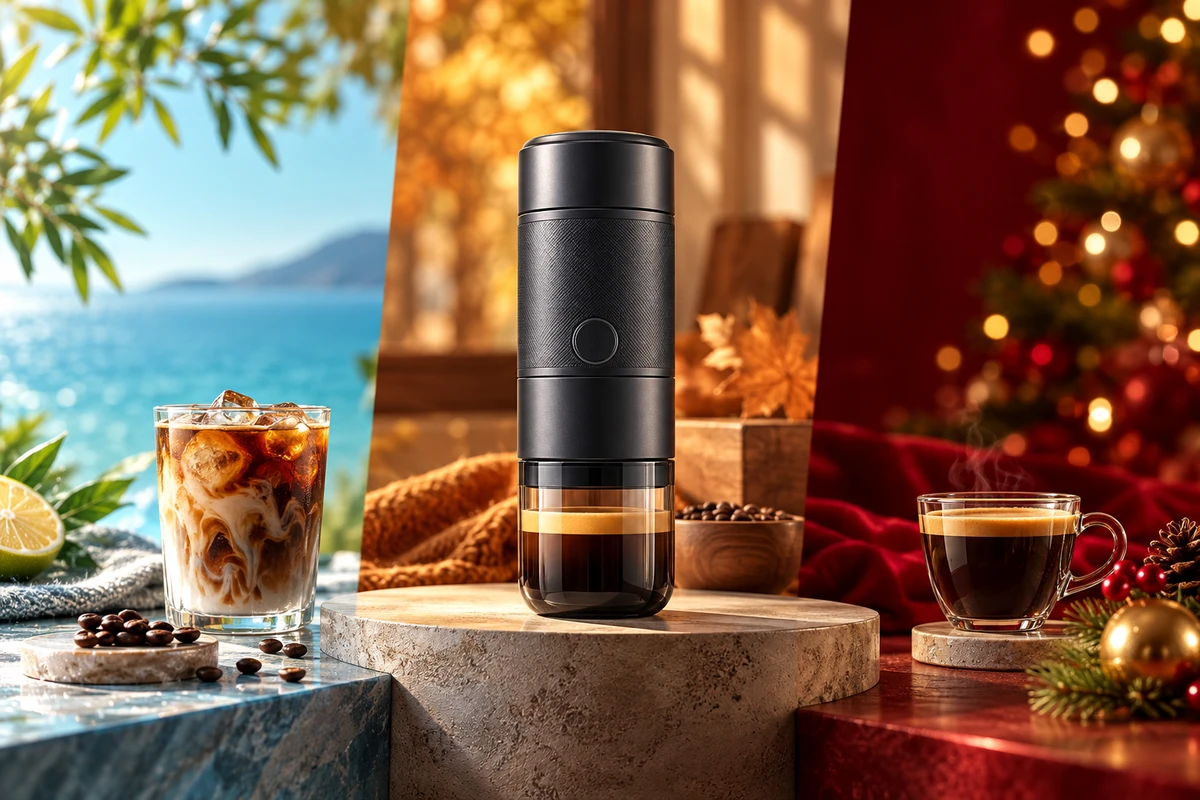
When one product needs a summer, autumn and year-end campaign, the apparently efficient answer is to film once and let AI replace the background. That is also where the plan often breaks. If the first shoot leaves only a locked edit with a finished grade, later changes are mostly cosmetic. If the product body, hand interaction, liquid behaviour and packaging text are also regenerated, the three films may look different while no longer showing the same product.
A more dependable approach is to treat the first studio day as product-fact capture. The team records material that can be composited, recombined and re-approved across seasons. This article uses a hypothetical portable espresso maker to demonstrate the method. It is not an ONCE client project, and no product function or campaign result should be inferred from the example.
U-STUDIO Commercial Studio Production 10/10
Decide what must remain true in every season
Weather, colour, pace and human relationships can change. The information a buyer uses to understand the product should not drift. For the hypothetical espresso maker, the reusable foundation should preserve at least five groups of facts:
- the silhouette, proportions, colour, materials and position of visible marks;
- the real structure of the water chamber, controls, outlet and accessories;
- the correct sequence for filling, assembling, starting, extracting and cleaning;
- the liquid flow, distance to the cup, contact shadow and surface reflections;
- the packaging, accessory combination and approved claims for the version currently on sale.
The goal is not to record every possible angle. It is to cover what a future production should not be asked to guess. A useful first shoot can include front, side and rear views; one approved hero angle; a slow turntable pass; interface and material details; a complete operating sequence; product-to-cup and accessory scale; clean background plates; takes with and without the performer; and enough negative space for landscape and portrait versions. Each shot should retain the sample ID, product state, lens, camera height, light direction and operating version.
The value of this package is not that the brand will never have to film again. It makes the next decision visible: is the new season changing atmosphere, or changing a product fact?
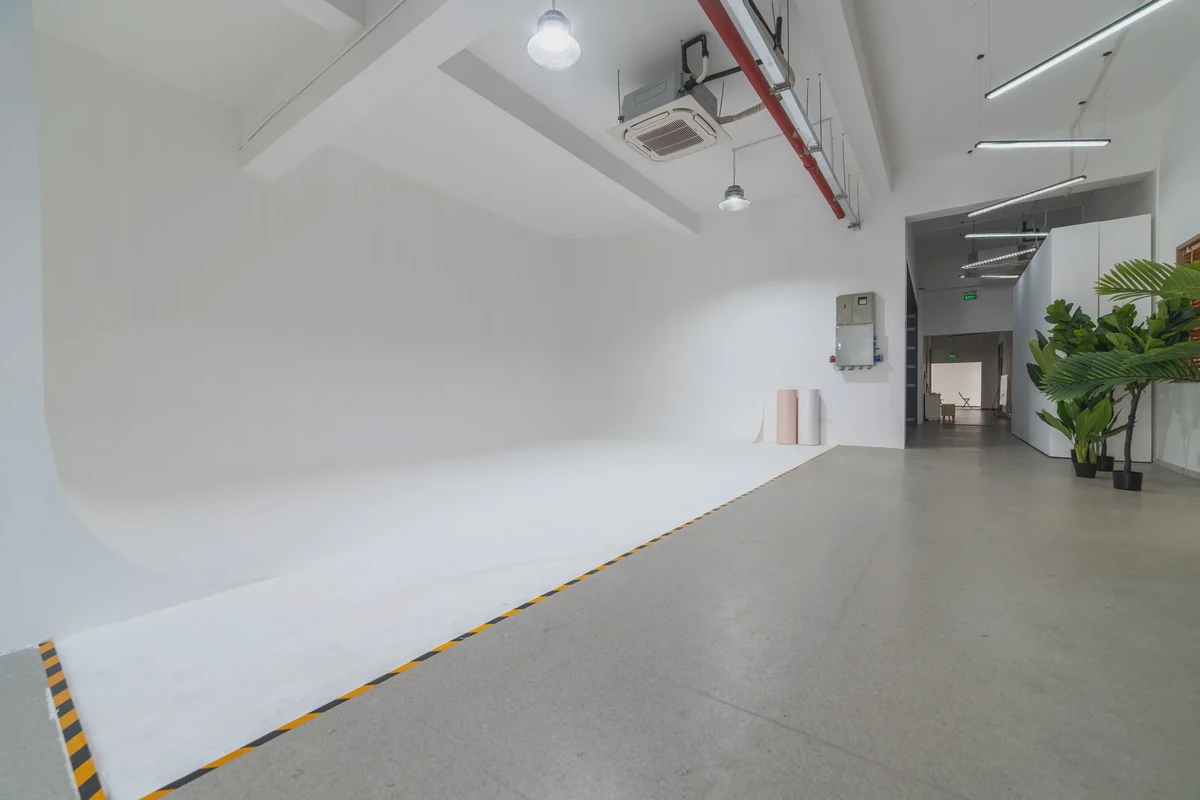
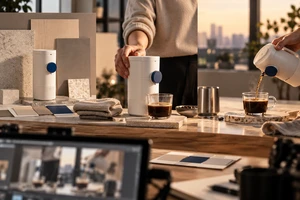
The 64 m² white cyclorama shown on the current U-STUDIO page. A controlled base can support product silhouettes, materials, actions and clean plates. Equipment, set changes, sound conditions and dates still require project confirmation.
Give each season a different communication job
Summer: establish immediacy
The summer version should make the product feel light, refreshing and easy to bring into a spontaneous moment. The reusable product layer can supply the hero shot, filling action, control detail, extraction and product-to-cup scale. The human action should be filmed for the season: carrying the product, adding ice, using it and drinking form a continuous physical sequence. Hands, wardrobe, liquid and the direction of attention all carry the idea.
AI is better used to extend the bright view beyond a window, distant plants, the space outside the tabletop or a wider sense of summer travel. If ice, coffee flow or condensation is being used as product proof, it should not exist only because a model generated it.
Autumn: move from speed to routine
Autumn is not summer footage with an orange grade. Its communication job shifts from “get a drink now” to “this product belongs in a settled morning.” The control, extraction and material details may remain useful, but the performer needs new pauses, eyelines and distances: open the curtain, arrange the cup, start the product and let both person and machine remain in the frame.
AI can extend the light outside the window, background furnishings, a distant bookshelf or decoration that does not participate in the operation. The real tabletop contact area, cast shadow, hand occlusion and any genuine steam should come from live action or an approved compositing asset. The season changes; the product’s operating logic does not.
Year-end gifting: make packaging and relationships visible
The year-end film asks why the product is worth giving. It should not simply repeat the extraction demonstration. If the box, gift set, accessories or co-branding changes, the production needs the current retail version. The interaction also needs new coverage: offering, receiving and opening the gift introduce new hands, occlusion, wardrobe and rights.
AI can extend background lights, a festive view, non-functional decoration and transitions. It should not invent gift-box copy, partner marks or items inside the package. A gifting film can look convincingly seasonal while showing a configuration the customer cannot actually buy. Packaging therefore enters approval before atmosphere.
Use a change-and-reshoot decision table
| Change | Default response | Reason | Confirm before production |
|---|---|---|---|
| Seasonal colour, distant scenery or non-contact decoration only | Reuse the filmed product master and test an AI environment extension | Product facts remain unchanged | Silhouette, reflection, contact shadow and depth still look natural |
| Wardrobe, gesture, grip or distance between person and product | Reshoot the interaction; reuse isolated product shots where useful | Occlusion, weight and eyeline cannot be reliably inferred from old footage | Talent rights, correct operation and wardrobe reflections |
| Controls, ports, material, size or function | Reshoot the affected product-fact shots | The old image now describes another version | Latest sample, manual, approved wording and sales region |
| Packaging, gift set, accessories or readable copy | Reshoot packaging and unboxing | The image defines what the buyer expects to receive | Retail version, language, marks and accessory list |
| Aspect ratio, subtitles or end card only | Reframe and version existing material | This is channel adaptation, not a new product idea | Safe areas, language and channel specifications |
| Talent licence has expired or does not cover generated derivatives | Stop reusing the person and confirm rights again | Technical extensibility does not create permission | Territory, term, media and generated or derivative use |
The order is simple: does the change alter a product fact, a physical relationship between person and product, or a right? If the answer is no to all three, extension can be tested first. If any answer is yes, confirm the new condition and reshoot where necessary.
Preserve working masters, not only finished films
A reusable studio day should deliver more than a 45-second hero film and several cutdowns. Material that can support another season includes:
- product hero and complete operation shots without seasonal packaging;
- versions that allow the product, performer, foreground and background to be separated, including clean plates;
- composition space for both landscape and portrait reframing;
- sample, package, lens, light, colour and operating-state records;
- source and permission records for sound, music, type, talent and generated elements;
- the inputs, selected outputs, failed tests and change notes for each AI extension.
As of 10 October 2026, the C2PA 2.4 specification describes provenance information that can record how an asset was created, edited and composed from other ingredients. Adobe’s current Content Credentials overview explains that certain generated assets can carry information about the tool and creation actions. These mechanisms do not perform legal clearance or prove that a product image is accurate. They reinforce a practical production principle: when an asset is extended repeatedly, its source and change record should travel with the version rather than remain in one person’s chat history.
The ONCE AI commercial production page frames each shot as a decision between live action, generation and compositing. For three seasonal campaigns, that decision needs to exist at source-asset level, not be reconstructed after the first finished film.
Test one difficult five-second shot before extending a season
Do not prove the process with the easiest static packshot. Choose a difficult five-second relationship: the espresso maker sits at a three-quarter angle, a hand enters and presses the control, coffee begins to flow, and the controlled studio background extends into an autumn window scene.
The test may change only the background and non-contact decoration. The product, hand, liquid and tabletop contact area remain from the live-action plate. Review it frame by frame:
- Does the product silhouette, mark, control or port drift?
- Do finger occlusion and product reflections remain continuous?
- Do the liquid, steam and cup scale still come from the real action?
- Does the new background match perspective, depth of field and light direction?
- Does the product remain recognisable after landscape and portrait crops?
- Are the generation tool, source assets and permitted uses recorded?
Passing this sample proves only that this shot relationship is workable with the current method. It does not approve every shot in the film. If it fails, do not immediately switch models. Identify whether the problem is weak product separation, a missing clean plate, mismatched light, complex motion blur or a concept that asks AI to alter the protected product area. The right fix may be a cleaner product layer or a simpler camera move filmed in the studio.
Know when reuse is the wrong objective
If a new model changes structure, material, function, packaging or accessories, the old master no longer proves the current product. If a seasonal concept depends on complex use in a genuine outdoor environment, a studio simulation may be less credible than a new location shoot. If the market changes the language, marks, claims or talent rights, those conditions need renewed approval as well.
AI should not turn three seasons into three colour treatments of the same film. Summer is about immediate use, autumn is about a settled routine, and year-end gifting is about a relationship between people. They need different openings, actions and reasons to finish watching. What can remain stable is the accurate product foundation, not the audience’s reason to care.
U-STUDIO offers home sets, a future-tech set and a white cyclorama that can support lifestyle interaction, visual tests and product-master capture. To assess a complete production, send a project brief with the product, the communication job for each season, target markets and channels, available material, sample and packaging status, talent rights, launch timing and budget range. ONCE can then separate what must be filmed, what can be reused and what is suitable for AI extension before deciding what the first shoot should preserve for Seasons Two and Three.
Series navigation
- 01 How to Give a Studio Commercial Its Own Brand World
- 02 Designing Product Commercials in a White Cyclorama
- 03 Localising Ecommerce Lifestyle Videos Shot in Shenzhen
- 04 Making Studio-Shot Social Videos Feel Natural
- 05 Planning a Commercial and Social Videos in One Studio Shoot
- 06 Keeping Batch Product Shoots Consistent Without Losing Hero SKUs
- 07 When Motion Control Adds Meaning to a Product Commercial
- 08 Approving the Visual Direction Before a Remote Shenzhen Shoot
- 09 How to Keep Three Months of Studio Social Content Fresh
The most valuable result of the first shoot is not one film that appears usable forever. It is a reliable source package that supports new creative work while the product remains true—and tells the team when a change makes filming again the responsible decision.