Natural does not mean dimming the lights, asking an actor to stumble over a line and making controlled footage look accidentally captured on a phone. For international social video production, a stronger method is to give the person a real, continuous task that can be interrupted by product feedback, then place the script, eye line and camera around that action. The brand can still control the product angle, lighting, approved information and delivery formats. The performer simply does not have to sell to the lens every second.
This article uses an explicit hypothetical project: a portable electric coffee grinder for the United States, filmed in a Shenzhen studio as one 20-second vertical paid ad with two alternative openings. The performer is a paid actor. The product, character and sequence are illustrative, not an ONCE client project or a test that has already been run.
U-STUDIO Commercial Studio Production 04/10
One product action can support two valid performances
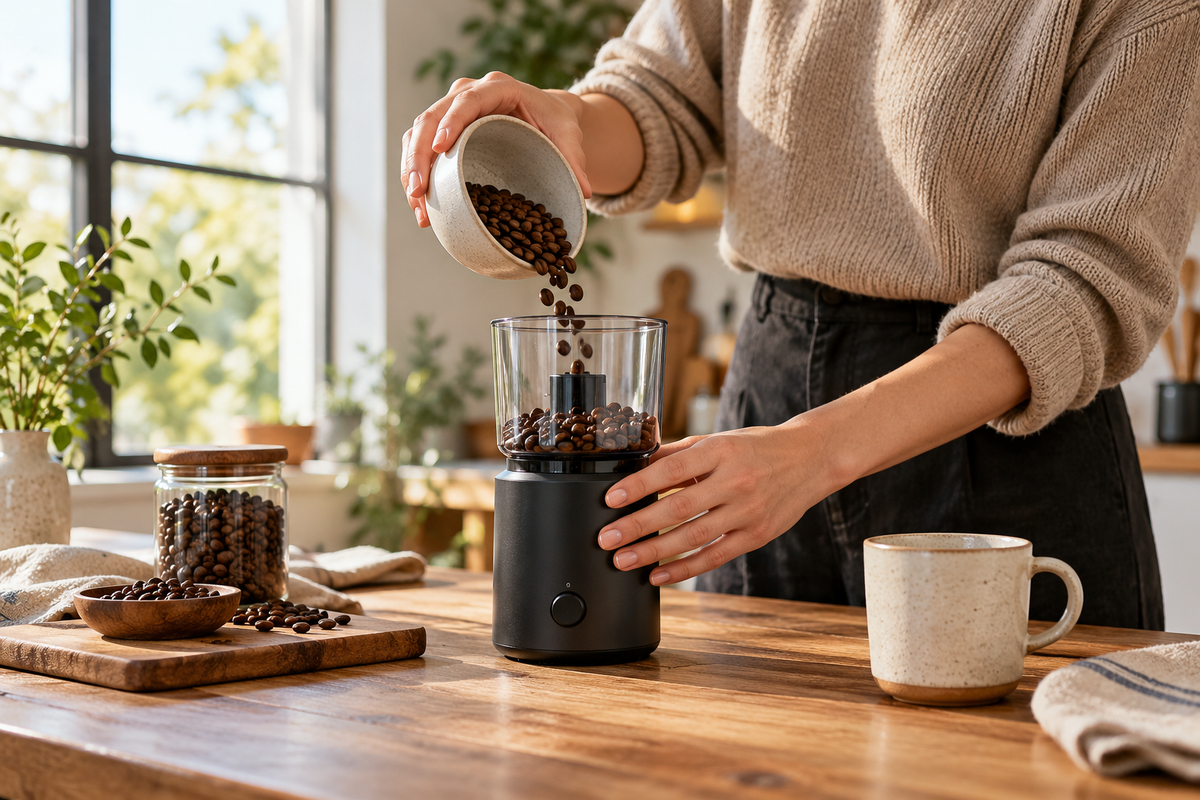
Fix the action first. The actor pours one cup's worth of beans into the grinder, locks the lid, presses the button, waits for the motor to stop and removes the grounds cup. The product team has approved only those visible facts. The script makes no unconfirmed comparison about speed or noise and does not claim that the coffee will taste better.
Both a polished commercial performance and a natural demonstration can work. The difference is not image quality. It is why the person performs the action.
| Element | Polished commercial performance | Natural-use demonstration |
|---|---|---|
| Person | Knows every next beat; each action lands precisely on the visual rhythm | Completes a morning task; attention moves between beans, lock, button and cup |
| Eye line | Looks more often to the lens or a fixed performance mark | Briefly addresses the lens, watches the product during use and returns after the motor stops |
| Dialogue | Complete and compressed, suited to a brand line or functional close | Short phrases sit around the current action and can be divided by real feedback |
| Product distance | Often held near the chest or centre of frame to establish a hero image | Sits at a credible working distance; close-ups supply identification when needed |
| Lighting and art | More designed separation, colour and background rhythm | Still controlled, but motivated by a window or practical source; props explain the task |
| Sound | Music and designed effects organise the beat | Beans, lid, button and motor stop provide real feedback |
If the piece is a visual declaration in a product launch, the polished approach may be right. If the job is to let feed viewers understand how a person uses the product, the natural demonstration may work better. Do not loosen a highly designed commercial merely to imitate UGC. Equally, do not direct a lifestyle demo so that every action waits for an invisible cue.
Let the product move the person's attention
The hardest part of natural performance is not producing a relaxed smile. It is making attention credible. After pouring the beans, the person should check the amount and the opening. While locking the lid, they look at the alignment. After pressing the button, they listen for feedback. If the performer stares at the lens throughout, their hands appear to be carrying out a separate mechanical task. If they look down for the whole film, the audience receives no human address.
Write eye lines into the storyboard instead of leaving the set with a direction to “be more natural”:
- Look to camera: ask one specific opening question or give the final next step.
- Look to product: pour, align, lock, start and observe the stop.
- Look to result: open the grounds cup and check what is actually visible.
- Pause: allow one response after the lock, button feedback and motor stop.
A pause is not manufactured hesitation. It comes from information the product gives the person. If the sample has no clear signal, do not ask the actor to pretend they heard one. When the brand needs a fully stable information take, record a separate formal version. The natural take does not need to carry every explanation.
Write the intention, not a sentence that must be delivered in one breath
“This lightweight, portable, fast and easy-to-clean grinder makes every morning better” contains several messages but no place for action. The actor can only hold the product, finish the line and then demonstrate it. Person and product run on parallel tracks.
A more shootable script has three layers:
- Fixed facts: product name, visible operation, approved functions and necessary qualifications.
- Immediate intention: make one coffee without spreading equipment across the counter before leaving.
- Flexible speech: short phrases, connective words and pauses the actor can organise within the approved facts.
The opening might be, “I'm only grinding one cup before I head out, so I don't want a whole setup across the counter.” This is an advertising scenario. It should not be presented as the actor's long-term customer review. If the actor has no such experience, do not write, “I've used it for six months,” “This is the best one I've bought,” or a simulated reply to a customer comment.
The US Federal Trade Commission's current Consumer Reviews and Testimonials Rule Q&A says that actors portraying testimonialists may still create a deceptive impression, while an obviously fictional dramatization is not the same as a claimed real experience. This article does not offer legal advice. The brand or its adviser still needs to confirm the market, account, final message and required disclosure for the released version.
A light set is not an empty set
The current U-STUDIO page lists a contemporary living room, sunlit home interior, future-tech set and white cyclorama at ONCE's Shenzhen base. For this hypothetical film, a window-side table in the sunlit home or contemporary living room could work. The choice is not which room looks more premium. It is whether the morning task makes sense and whether the vertical frame can hold face, hands and grinder at once.
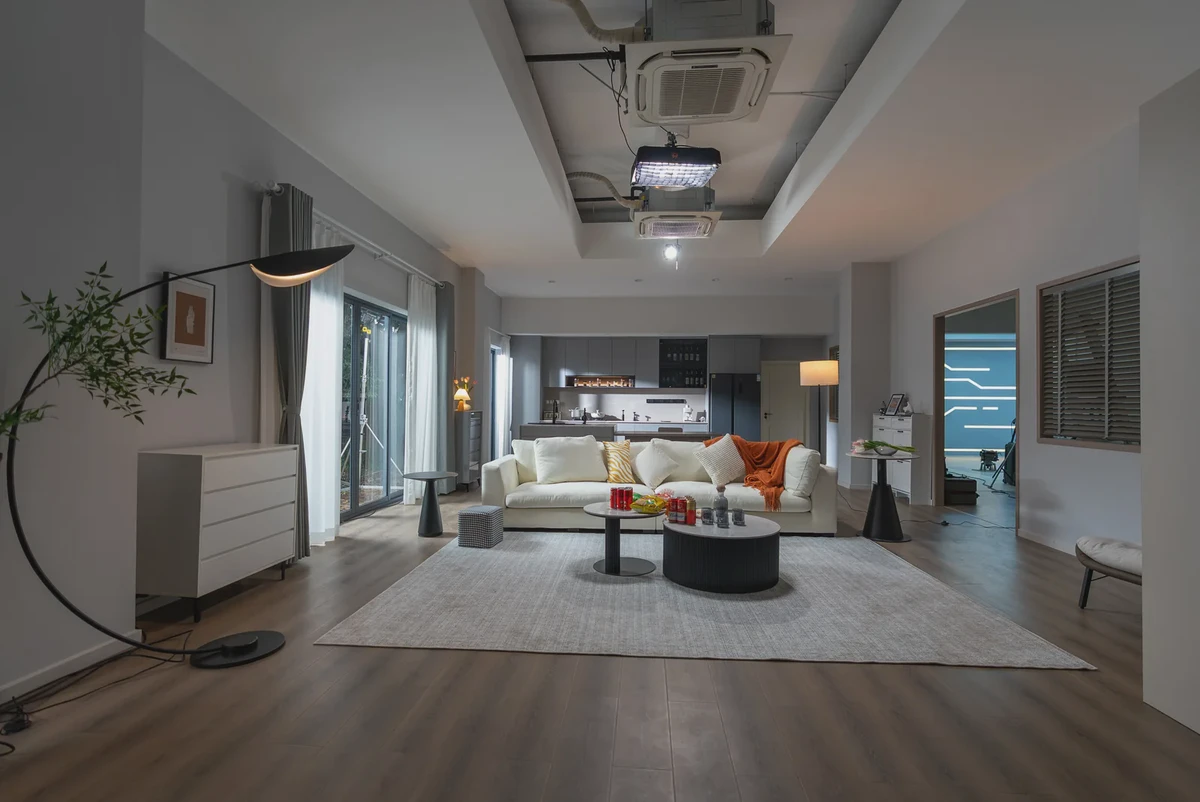
Keep four categories of props on the table: a small bean container, a cup, a bag placed down during the action and a note relevant to the morning task. Every object is either handled or helps explain the moment. Filling the frame with bread, flowers, newspaper, headphones and several cups in the name of lifestyle makes it harder for the performer to find the centre of the action.
Lighting requires the same restraint. A directional key can appear motivated by the window, while limited fill keeps the eyes, black locking detail and product mark legible. Natural does not mean accepting an ugly ceiling source or uncontrolled packaging reflections. A studio is useful precisely because it can combine a window-side impression with repeatable product readability.
Sound turns a posed gesture into a completed action
Mute the music and the empty parts of the performance become obvious. Beans landing in the chamber, the lid locking, a button press, the motor starting and stopping and the cup returning to the table all tell the viewer that the action happened. If every sound is replaced by an exaggerated effect, the film returns to demonstration theatre. If the set is noisy, dialogue, product effects and room tone need a separate plan; do not assume that every practical studio environment will automatically provide final production sound.
ScreenSkills' current first assistant sound skills guide includes pre-production preparation, microphone placement, production recording and portable recording for B-roll. It is a role reference, not a promise about U-STUDIO acoustics. The useful point is that product sound belongs in the shooting plan rather than being treated as an incidental post-production layer.
A 20-second passage you can test
The following is a proposed test, not a completed experiment. Keep the actor, sample and set unchanged and compare only the polished and natural performance grammar.
0–3 seconds: The actor puts a bag beside the chair and briefly addresses the lens: “I'm only grinding one cup before I head out.” The product is already recognisable in the first frame.
3–7 seconds: Their eyes return to the hands while pouring beans and locking the lid. Dialogue stops or moves off-camera, leaving the beans and lock audible.
7–11 seconds: A medium-close frame shows the button press. The actor does not continue listing benefits; after the motor starts, the hand withdraws.
11–15 seconds: A side close-up holds for the motor stop. The person looks to the product, then removes the grounds cup.
15–18 seconds: The cup moves towards the coffee filter, showing a credible quantity without an exaggerated aroma reaction.
18–20 seconds: The actor looks back to camera: “The counter stays clear. Next step, make the coffee.” The brand CTA appears separately.
The polished version can preserve the same operations but open on a stable hero composition, place the gestures on a consistent musical beat and end on a designed product frame. In the natural version, product feedback changes the person's rhythm. Record a clean action-only take for each so language and information order can change later. That clean take is useful production material; cropping one shot into several ratios does not make several independent creative ideas.
TikTok for Business' Creative best practices for performance ads, updated in June 2025 and checked for this article, recommends vertical 9:16, sound, safe-zone awareness, people on screen and a DIY or not-overly-polished aesthetic as starting points. It also describes the advice as general guidance and recommends testing. It does not prove that rougher images perform better. During the test shoot, apply the real vertical safe frame and confirm that the face, product, hands, captions and any commercial disclosure do not compete for the same space.
Turn vague directing notes into observable actions
| Vague note | More useful direction | What to review |
|---|---|---|
| “Make it more natural” | Watch where the beans land before the next line; pause after the lid locks | Whether eye line and pause are triggered by the product |
| “Talk like a friend” | Give the opening problem to camera; stop explaining to camera during the operation | Whether the person communicates instead of reciting the benefit list |
| “Bring the product closer” | Keep a credible working distance, then add a hand-and-lock close-up | Whether the close-up explains the action without placing the product unnaturally beside the face |
| “Make it less like an ad” | Keep one continuous action take without music and listen to the real button and motor | Whether the action remains clear once the packaging is stripped away |
| “Show more positive emotion” | Return to camera after the result appears, not before the grinder starts | Whether the reaction follows a real result |
A natural-use review method
First watch silently. Then listen without looking. Finally restore captions and disclosure. Three passes produce more useful feedback than “It still does not feel UGC enough.”
Watch the action silently
- Are the person, product and task established within the opening three seconds?
- Does the eye line follow the operation instead of searching for the lens or an off-camera director?
- Is the product at a credible working distance, with close-ups covering the critical details?
- Does a pause receive product feedback, or does it look like forgotten copy or a wait for the edit?
- Do props compete with the task? Has the pursuit of an improvised look reduced product legibility?
Listen without the picture
- Does the dialogue sound like something the person could say at that moment, or does it compress every benefit into one breath?
- Do the operation sounds correspond to visible events, without exaggerating the product impression?
- Does music cover the lock, button or stop that the viewer needs to hear?
- Is there an abrupt change in voice or space between production dialogue, practical sound and replacement audio?
Restore text and release information
- Is a paid actor presented as an actual buyer, long-term user or independent recommender?
- Are every function, comparison and experience statement within the brand's approved material?
- Has the publishing owner checked the target platform's current commercial-content label, captions, CTA and safe area?
- Do alternative openings and language versions preserve the same product facts?
TikTok's commercial content disclosure guidance, updated in April 2026, says creators posting content that promotes a brand, product or service should use its disclosure setting. That page concerns creator posting and does not decide every brand-account, paid-media or national legal requirement. Treat account action, media buying and the delivered video file as separate approval items.
When not to imitate a casual user video
A highly stylised brand film, a technical demonstration that must prove each safety-critical step, and a testimonial that must come from a real customer should not all inherit actor-led UGC grammar. The first two may need stronger design or continuous proof. The third has to return to real experience, permission and disclosure; an actor cannot substitute for evidence.
The studio is not there to flatten every performance. It provides controlled light, adjustable space, repeatable actions and conditions for multiple versions. Naturalness comes from allowing product feedback to take time and removing lines no person could deliver while doing the task. The actor does not become more credible by looking less professional, and an image does not become more truthful by looking rough. Useful naturalness is when human behaviour, product facts and brand identity stop fighting on the same timeline.
ONCE's short-form video production service connects script, direction, studio filming and platform versions. For a new project, send ONCE a production brief with the product, target market, platforms, character profile, approved copy and functions, sample status, delivery versions, timing and budget range. Those inputs are enough to decide whether to begin with a short performance test or move into a full U-STUDIO production.
Sources accessed 9 October 2026. This article checked the current ONCE U-STUDIO and short-form production pages, TikTok for Business creative and disclosure guidance, the US Federal Trade Commission's reviews and testimonials Q&A, and ScreenSkills production-sound material. It does not provide legal advice, platform approval or an acoustic guarantee. The cover is an original generated commercial concept, not a photograph of U-STUDIO or a client production.