An overseas lifestyle does not become believable because someone places a British-looking mug on a kitchen counter. In an ecommerce appliance video, credibility usually comes from smaller and more practical details: whether the product is the version actually intended for Great Britain, whether it fits the worktop, where the power lead goes, how the performer opens the drawer, and whether the packaging, interface and subtitles sound as though they belong to the same market.
This article uses one clearly labelled hypothetical project: a compact 4.5 L air fryer for Great Britain, approximately 28 × 36 × 31 cm, requiring one product-page film and three social cutdowns. The dimensions, capacity, channels and story are illustrative; they are neither market statistics nor an ONCE client case. The central judgement is simple: lock the GB product version and the real sequence of use before dressing the Shenzhen set. If the product facts are still moving, film a neutral demonstration first rather than over-performing “British life”.
U-STUDIO Commercial Studio Production 03/10
Why the same appliance action changes with the target market
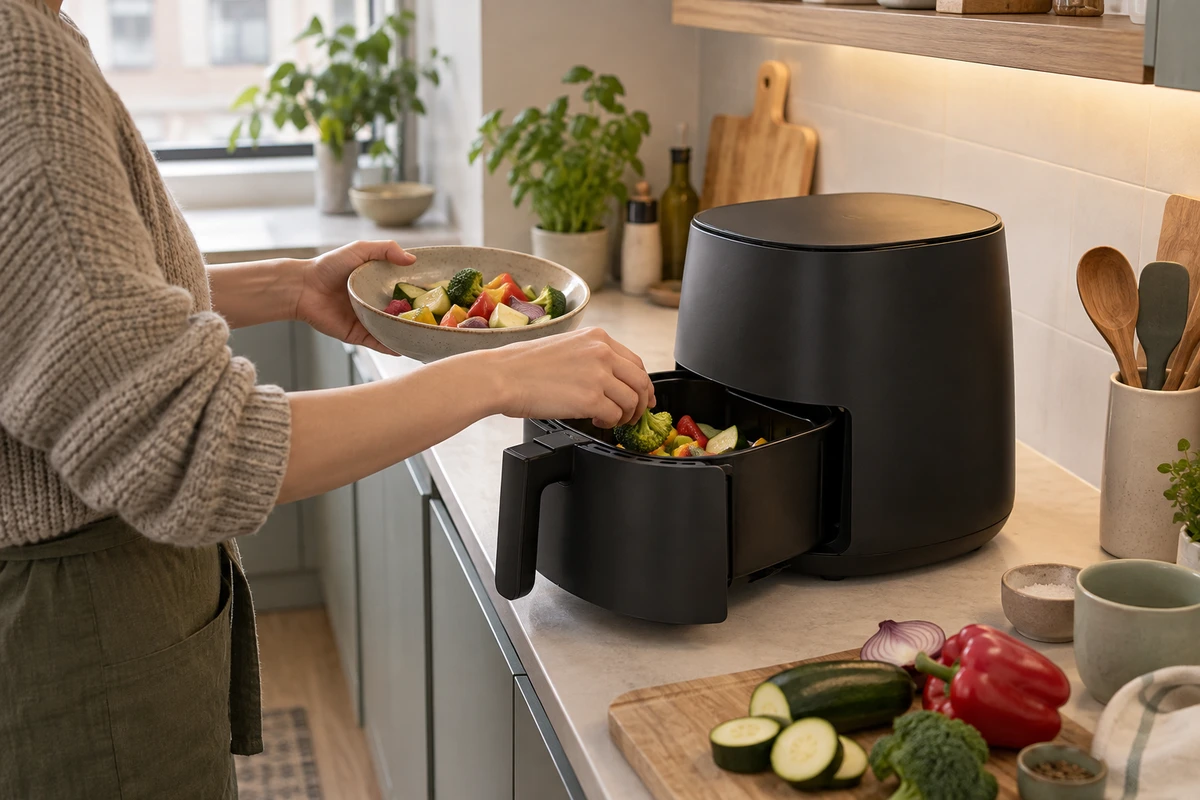
Imagine the film following a young professional in a small British city flat. They return from work and use the air fryer to make dinner for one. The product team wants viewers to understand three things: the appliance fits on a compact worktop, its drawer opens without awkward manoeuvring, and the food is easy to remove. The creative team wants the moment to feel relaxed and efficient.
If production receives only the instruction “make it look like a Western kitchen”, the image can become complete but incoherent: an oversized island, an appliance floating far from the wall, an unconfirmed plug, American grocery packs and a performer delivering “I use this every day” as though it were an independent review. Every element looks vaguely international; together, they describe no real market and no credible operation.
A more useful approach separates localisation into four layers:
- Product version: the sample, power lead, plug, interface, packaging and instructions that are approved for Great Britain.
- Spatial scale: worktop depth, cabinet height, socket and cable relationship, and the clearance needed to pull the drawer out fully.
- Use behaviour: the actual sequence for loading, setting, removing, plating and cleaning.
- Language and market judgement: British English for packaging, supers, voiceover and subtitles, plus a local reviewer’s view of whether the situation feels plausible.
The UK Office for Product Safety and Standards’ current guidance on the Electrical Equipment (Safety) Regulations 2016 explains the responsibilities of manufacturers, importers and other parties placing electrical equipment on the GB market. This article does not offer a compliance opinion. The production implication is narrower: the product version, markings and operation shown on screen cannot be improvised by the art department. They need confirmation from the people responsible for the product and its market readiness. Northern Ireland also has different arrangements, so “the UK market” should not be used as an unexamined catch-all.
Lock the right sample before debating whether the set feels British
Lifestyle production is easily undermined by the wrong product version. Before set dressing begins, the brand should provide a shootable product pack:
| Input | Brand or product team confirms | Production uses it to decide |
|---|---|---|
| Sample identity | Model, finish, capacity, GB retail unit or engineering sample, and parts still subject to change | Which appearances and functions can be shown without concealing a material difference |
| Electrical details and markings | Whether the lead, plug, rating label, warnings and display belong to the target-market version | Worktop layout, cable path and close-ups that do not introduce another market’s unit |
| Operating instructions | Approved steps, required clearances, hot surfaces and cleaning precautions | Performer movement, food state, hand positions and continuity |
| Packaging and language | Final pack, manual, interface terms and approved supers | Which text can appear clearly and which props should remain unbranded |
| Claims list | Approved functions, prohibited implications and comparisons that need substantiation | Separate approval criteria for factual and atmospheric shots |
If the only available sample is a non-GB engineering unit, production may still test materials, silhouettes and generic actions without showing the lead or retail packaging. It should not replace labels in post, attach a cosmetic plug or obscure the mismatch to suggest that a market-ready retail unit has been filmed. The less stable the product, the more restrained the lifestyle claim should be.
Adapt the set to product dimensions, not a pile of national symbols
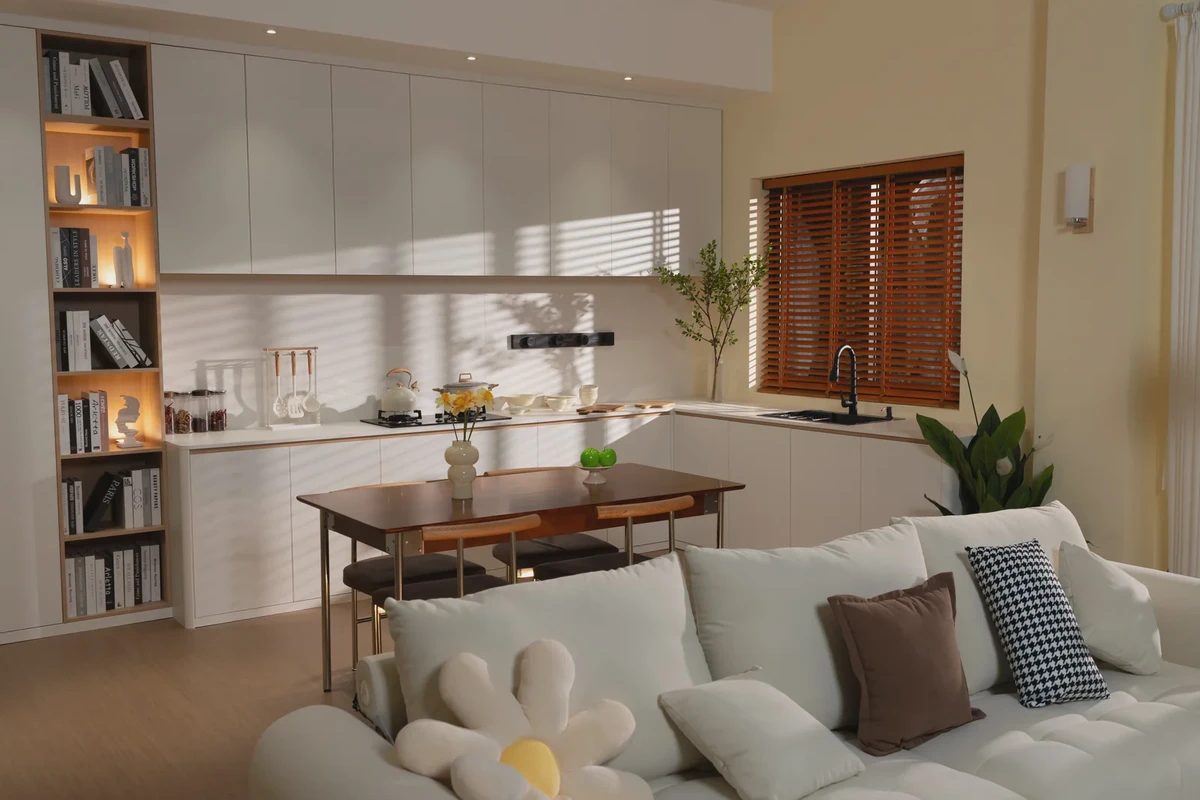
The official U-STUDIO page lists a sunlit home set with a connected dining and kitchen area at ONCE’s Shenzhen production base. It also states that props, colour and local set dressing can be adjusted around a product. That provides a controlled starting point for a British-flat kitchen image, but it remains a set in Shenzhen. It is not a home in Britain and should never be presented as local UK location footage in the film, behind-the-scenes material or production notes.

For the hypothetical air fryer, place a full-scale card model on the worktop before the final sample arrives, then ask four practical questions:
- Do the rear and overhead clearances match the approved instructions, rather than a composition that squeezes the appliance into an implausible position?
- When the drawer is fully open, can the performer stand naturally and load food while the camera still sees the relationship between hand and product?
- Can the confirmed target-market cable reach the approved power position without disappearing magically out of frame?
- Do the chopping board, plate, oil and ingredients leave enough room for the action, or has the counter been dressed like a still-life photograph?
British does not have to mean tartan, a red bus and a stack of cultural shorthand. In a contemporary flat, more useful props might be a correctly scaled tray, an everyday mug, cabinets that are not overloaded, food portions that fit this meal and neutral packaging that does not steal attention from the product. Wardrobe should follow the character’s task as well. A light knit or casual shirt for the after-work situation may work; conspicuous “British styling” can turn the appliance into background decoration.
Direct one continuous and credible use sequence
The performer is there to help the viewer understand how the product enters a routine. They do not need to deliver a simulated customer review. The current CAP Code rules on misleading advertising require marketing communications not to materially mislead and contain specific provisions on fake or misleading consumer reviews. When a paid performer demonstrates the product, the result should read as advertising, not as an undisclosed independent customer experience. Objective product claims still require the brand’s own substantiation and approval.
A shootable passage might read:
0–3 seconds: A wide view establishes the narrow worktop. The performer places a coat over the back of a chair; the air fryer already sits in a position confirmed for the real product.
3–7 seconds: A close view shows one portion of ingredients entering the drawer without the hand hiding the capacity relationship.
7–12 seconds: A side medium shot continuously shows the drawer closing, an approved programme being selected and the button feedback.
12–18 seconds: After a time transition, the performer opens the drawer from the same position. Steam, food state and heat-handling behaviour have been prepared for the actual unit.
18–25 seconds: The meal is plated. A large spread of food does not suddenly appear and contradict the original one-person task.
25–32 seconds: The product returns to the hero composition. Packaging and interface text appear only if the GB-market language has been approved.
The director’s work here is less about making the performer “look happier” and more about gaze and pauses. After a button press, the performer needs a short beat to read the feedback. When the drawer opens, their eyes should go to the food rather than remaining fixed on the camera. Real drawer movement, button feedback and plating can remain audible instead of being buried beneath music.
Google Ads’ current ABCD guidance for video ads recommends showing the product early, using people to humanise a product story and keeping the message focused. It applies specifically to YouTube advertising, not every placement. The practical connection here is that human action should make the appliance easier to understand, rather than merely making the frame busier.
Native review is more than changing American spelling
A British English reviewer is most useful at script, test-shoot and final-cut stages. Their task is not limited to changing color to colour. They should ask:
- Do the pack, interface, supers and voiceover come from one approved language set? Are the units, temperatures and product terms consistent?
- Does the character sound like the intended audience rather than an actor repeating internet slang? Even a film without dialogue needs a review of the tone used in supers.
- Do the ingredients, portion, plating, time description and occasion feel plausible, or has another market’s routine been treated as universal?
- Does a line create an objective claim about speed, energy use, health or performance? If so, it goes back to the brand’s claims or legal owner rather than being decided by the translator.
- Have “sold in Britain”, “made for the GB market” and “shot in Britain” been confused? This hypothetical film can claim the first two only when approved; the production itself remains in Shenzhen.
The native reviewer should not approve electrical safety or advertising compliance alone. They own language and market context. The product owner confirms the unit and its operation. The brand or legal owner approves claims. Direction and art translate those conditions into images. This division turns “it does not feel local enough” into feedback a production can act on.
A market-fit review checklist for the cut
Do not ask only, “Does it look British?” Give each owner a set of concrete questions.
Product and operation
- Are the model, colour, plug, lead, interface, packaging and accessories the approved version for Great Britain?
- Do placement, drawer travel, hot-surface handling, cleaning and food states follow the final instructions?
- Can the viewer see each functional action and result continuously, or is an edit concealing an operation that could not be performed?
Space and performer
- Are the worktop and product proportions credible, or has the pursuit of a premium image created an unrealistic space?
- Do props serve this meal and character? Are there uncleared brands or packaging cues from several different countries?
- Do wardrobe, eye lines, pauses and hand movements feel natural? Is a paid performer being presented in a way that could be mistaken for an independent customer?
Language, claims and location
- Have packaging, interface terms, voiceover, subtitles and CTA been reviewed in British English and checked against the final brand glossary?
- Does every objective function or comparison have brand-approved support? Do the supers claim more than the images establish?
- Do production materials accurately describe this as a Shenzhen studio set without implying that it was filmed in a British home or neighbourhood?
Delivery and stop conditions
- Do the product-page master and social cutdowns preserve the same product facts, or has faster editing removed a necessary qualification?
- Has the named approver for product version, language and market context signed off their respective area?
- If the GB retail sample, final packaging, instructions or a central claim remain unapproved, will production switch to neutral product footage or pause the affected lifestyle passage?
A studio controls variables; it does not replace market judgement
The benefit of producing a GB-market appliance video in Shenzhen is not the ability to disguise a set as Britain. It is the ability to place product, space, action and versions inside an environment that can be adjusted and reviewed. An existing home set can shorten the path to a usable frame; art direction can adapt worktops, props and colour. Credibility still depends on product facts and market review supplied by people who know the intended release.
If an idea works only through exaggerated props or an ambiguous location, it may not suit the project. When the approved sample, operating instructions, character task and language are stable, a Shenzhen studio can deliver a clear and natural lifestyle demonstration for British buyers—provided the production is described honestly and the set is not passed off as local location footage.
For a similar project, review ONCE’s ecommerce product video production, the remote product shoot workflow and U-STUDIO environments. Then contact ONCE with the product, target market, channels, approved dimensions and instructions, sample and packaging status, creative references, timing and budget range. Those inputs are enough to decide whether to begin with a set-and-action test or move into a full production.
Sources accessed 9 October 2026. This article reviewed current ONCE U-STUDIO and ecommerce production pages, the UK Office for Product Safety and Standards guidance for Great Britain, the ASA/CAP misleading-advertising rules and Google Ads creative guidance. It does not provide legal, product-compliance or safety advice, and source inclusion does not imply endorsement of ONCE.