When a brand chooses a studio for a commercial, the conversation can drift from “What should people remember about us?” to “Which room looks best?” An existing set gives the production somewhere to begin, but it does not supply the brand idea. A more useful starting point is to turn the proposition into a human action, then find a space that can make that action meaningful on camera.
U-STUDIO Commercial Studio Production 01/10
This article uses one hypothetical desk lamp to explore two distinct brand worlds. The concepts, shots and proposed tests are illustrative; they are not client work, completed experiments or reported campaign results. The practical recommendation is conditional: use an existing set with purposeful dressing and lighting when it supports the defining action. Consider a partial adaptation or custom build when the spatial relationship itself is central to the idea.
Decide which kind of life the viewer should remember
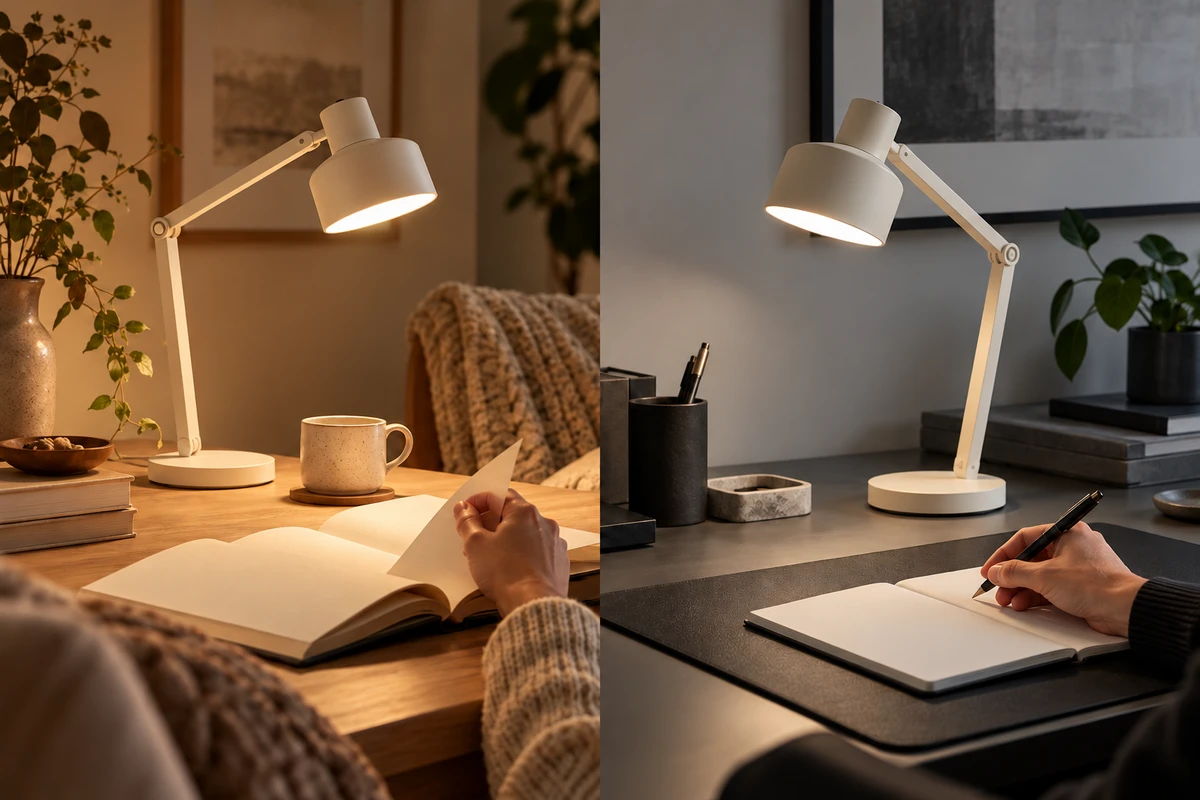
Imagine a consumer brand with a finished product and an established visual identity launching a desk lamp to young urban adults in China. Its hero film will run on the brand website and in online advertising for three months. The immediate job is to establish one clear brand association, rather than document every function. The same cream-white lamp appears in both concepts. For this hypothetical brief, the sample has been confirmed to switch on and off and to allow adjustment of the lamp head. Those are the only operations shown. There are no claims about eye protection, productivity, sleep or unverified performance.
The brand is choosing between A, “Keep a little time for yourself after work,” and B, “Give your attention to the thing in front of you.” A should feel personal and unhurried. B should express orderly focus. Both ideas can involve a lamp, but they require different behaviour. A warm grade and a cool grade alone would not distinguish them.
Google Ads’ About the ABCDs of effective video ads recommends bringing the brand or product into the film early and keeping the message focused. This guidance concerns YouTube ads, rather than a universal formula for every channel. Its useful implication here is that the lamp should participate in the emotional change, instead of arriving at the end of an otherwise attractive lifestyle film.
The brand supplies the proposition, verified product facts, identity assets and channels. The creative team develops the situation, while the director, cinematographer and art department work out how it becomes a shot. The brand lead approves colour references; the product lead confirms the operation; one named lead reviewer consolidates the visual feedback. The departments need not make every decision together, but each should understand what “unhurried” means in this particular film.
One lamp, two shootable worlds
The choices below are creative proposals for this example. They are neither universal rules of colour psychology nor descriptions of an ONCE project.
| Picture and sound | A: Time for yourself | B: Attention to the task |
|---|---|---|
| Spatial relationship | A small table beside the living room; the person moves from shared space into a personal corner | A simple work desk; clearing a few objects establishes a defined working area |
| Colour | Beige and light wood dominate, with the brand accent appearing on a book spine | A grey-white desktop and darker desk mat create separation, with the brand accent on one familiar object |
| Dressing | A book already being read and a cup; no collection of decorative lifestyle props | A notebook, pen and working document; each object has a reason to be handled |
| Light | The lamp becomes the visual destination after the person sits down, while the room retains depth | The lamp head, hand and document remain distinct within a more graphic composition |
| Performance | Sit, move the phone aside, switch on, open the book; pauses give the action room | Clear a space, adjust the head, place the document in the lit area, make the first mark |
| Camera rhythm | Establish the person within the space, move closer to the hands, then hold on reading | Start with the desktop action; consistent screen direction connects clearing, adjustment and writing |
| Sound | Cup, switch and page sounds, with room in the music for the gestures | Objects moving, the head being adjusted and pen strokes establish an ordered rhythm |
| Product memory | Switching on marks the move from a busy day into personal time | Adjusting the head marks the start of the task |
A could begin as the person puts down a bag, without first touring the room. They sit, push the phone towards the outer edge of the table, touch the switch and open the book in the light. The ending holds the relationship between lamp, hand and book. This expresses a choice about personal time; a relaxed performance must not stand in for a health claim.
B could start with loose working papers on the desk. The person clears a position, adjusts the lamp head, places the document and makes the first mark. Fast cutting is not required to manufacture a feeling of efficiency. If clearing the desk occupies too much of the sequence, the viewer may remember tidying rather than the lamp. The real adjustment should be the turning point that starts the task, without suggesting that the product makes someone work better.
Sound should follow the same proposition. A needs a transition from the day's activity into a quieter rhythm. B needs a sense of several actions being completed in sequence. Persistent urgent percussion would work against A, while exaggerated mechanical effects could overwhelm B. Record a test of the actual operation before the shoot. If the location cannot support usable recording, the sound team should plan the work separately; do not assume every studio set is suitable for production sound.
Existing set, partial adaptation or custom build?
All three can produce a complete commercial. Choose according to what the brand expression still needs.
| Approach | Application in this example | When it makes sense | What to establish first |
|---|---|---|---|
| Existing set with dressing | A uses a living-room corner with selected props, textiles and revised blocking | The room already supports the move into a personal corner, without structural changes in the key shots | Permission to move furniture or change visible decoration, feasible camera positions and lighting control |
| Partial art adaptation | B adds a desktop, scenic panel or controlled colour area within an existing space | The composition needs a local change, rather than an entire dedicated room | Adaptation permissions, material samples, build and strike time, reinstatement and the actual framing |
| Custom build | Geometric panels echo the lamp head, with movement through a purpose-designed space | The set itself carries the brand idea and existing rooms cannot support the defining action or composition | Shootable drawings, actual product scale, performer and camera routes, build and test arrangements |
A table in a white cyclorama can be a complete creative choice when the product's appeal lies in its shape and movement. Less room information may make the lamp head, hands and light easier to read. Conversely, an elegant isolated product move may lose the emotional starting point of an idea about someone entering a different kind of space. A custom build is not inherently more distinctive, and an existing interior is not inherently generic.
ScreenSkills’ Art director skills describes translating design ideas into a practical space that works with other production departments. Its material concerns film and television roles, not local studio rules. The relevant lesson is collaboration: discuss the art direction alongside the shot and action, rather than asking the cinematographer to make a completed set look premium afterwards.
Bringing U-STUDIO into the idea
The U-STUDIO introduction, checked for this article, lists an 800 m² Shenzhen base with a contemporary living room, sunlit home interior, future-tech set and 64 m² white cyclorama, alongside studio and equipment rental and complete production services. For this example, the living room is a starting point for A, while the white cyclorama could support B's desktop or geometric-panel direction. These are suggestions for creative fit, not confirmation that an adaptation has been approved or a set is available.
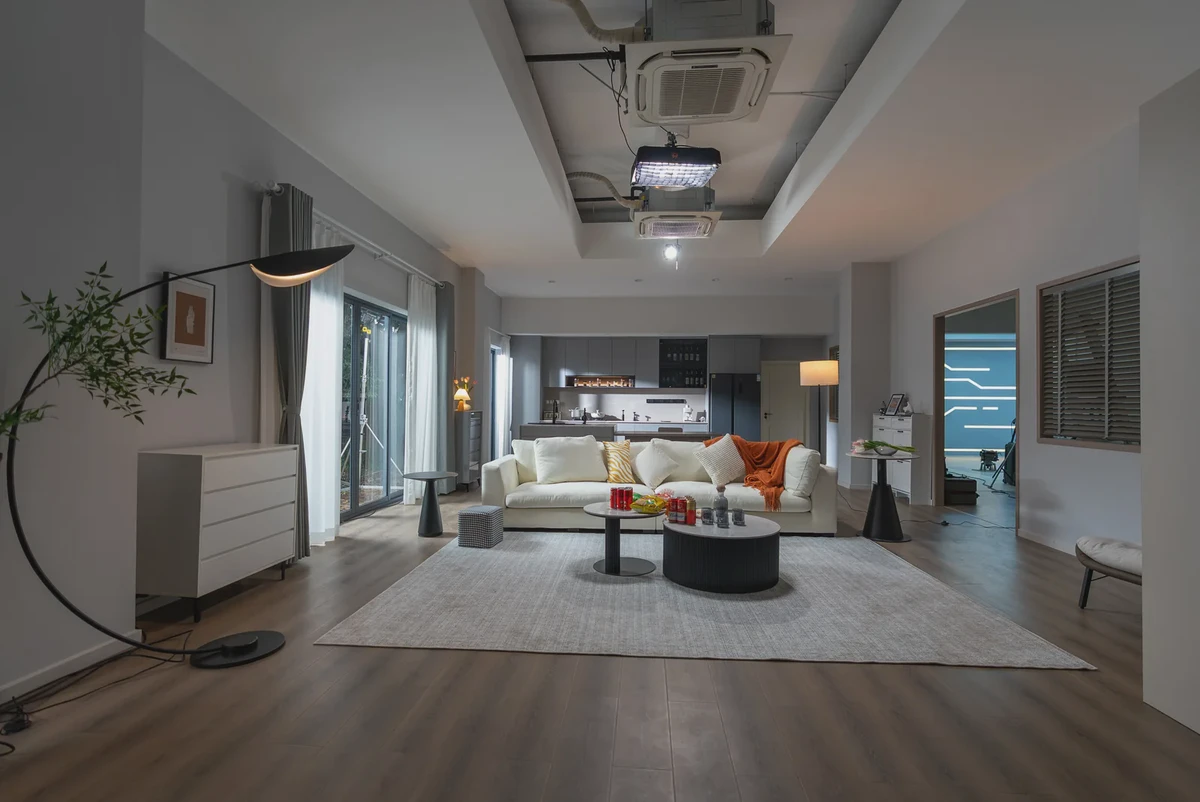
Bring the sample and key storyboard frames when assessing a set. Check the relationship between desktop and product, where the person sits, the distance to the background and which angle tells the intended story. Set photographs cannot establish lighting control, sound, power or permission to alter dressing. Confirm those conditions for the actual production.
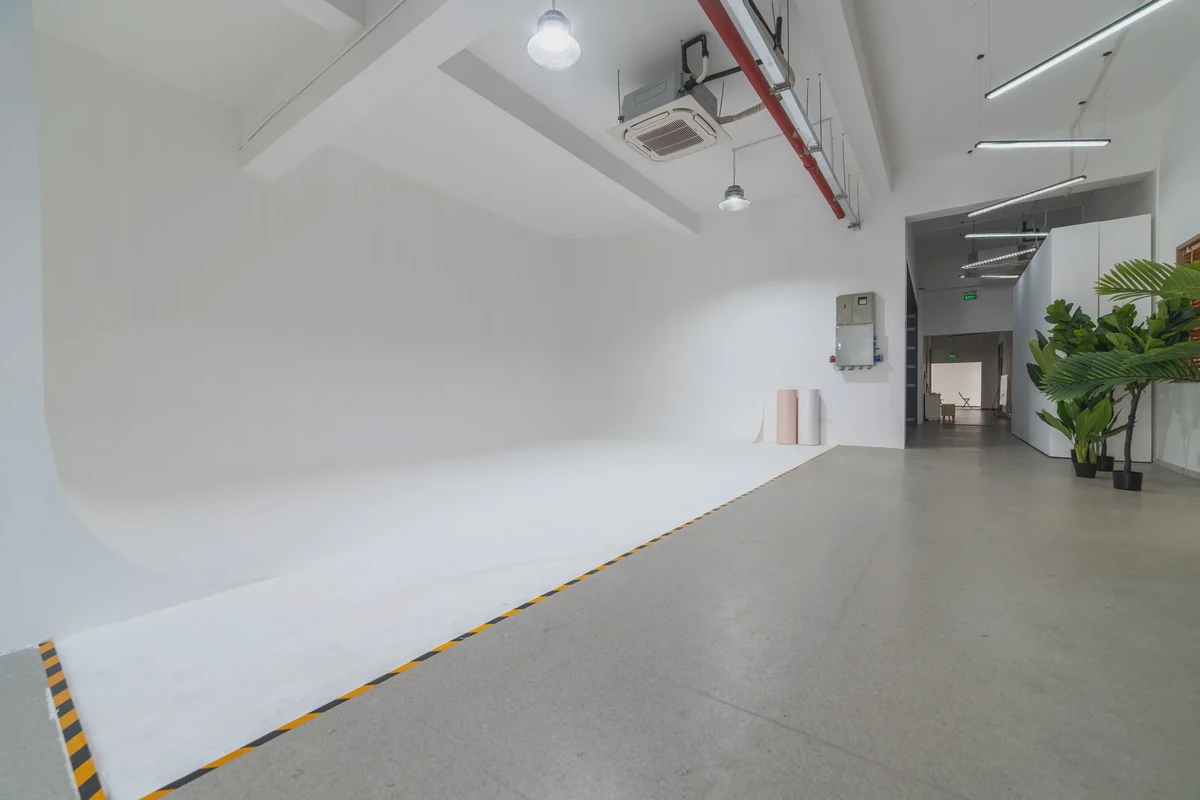
For work extending from proposition to finished film, the ONCE commercial production service describes coordinating script, direction, photography, art and post-production around a campaign idea. If your own crew arrives with a developed treatment, still share the intended modifications, actions and sound requirements with the studio so the booking reflects the shoot you plan to make.
Test a short sequence before committing to the full set
Consider two roughly ten-second tests, rather than another large collection of references. This is a proposed test, not an experiment already conducted. Use the same actual sample, comparable shot sizes and the same delivery aspect ratio. A tests “switch on and begin reading”; B tests “adjust the head and begin writing.” Establish the proposition in a minimal setup before expanding the scenery.
For each direction, retain a frame showing the spatial relationship, a medium-close view of product and hand, and an ending frame. Review the stills, continuous action and sound together. Are the directions distinguishable without the copy? Does the product cause a change? Could another brand replace it with almost no alteration? If so, adjust the action and identifying visual cues before adding more props.
Ask a small number of intended viewers to describe the product and what the sequence brings to mind. Listen before explaining the proposition, rather than leading them towards the desired answer. Qualitative feedback can reveal an overlooked product, an unintended mood or excessive dressing. It cannot establish advertising effectiveness and is not a sales or brand-lift experiment. Quantitative campaign research would need a separate method, sample and budget.
If a test misses the point, change one major relationship at a time. If A resembles a furniture commercial, bring the switch-on earlier. If B resembles a tidying tutorial, shorten the clearing and emphasise adjustment followed by the first mark. If both reduce to “cosy” or “clean,” revisit why the proposition belongs to this product. Colour grading cannot settle an unclear idea.
A one-page scene brief to fill in
Use this brief to put the brand, director, cinematographer and art department in the same conversation. It does not replace the full production documentation.
| Field | What to enter | Example for direction A |
|---|---|---|
| Audience and channels | Intended audience, market, main placements and usage period | Young urban adults in China; website and online ads; three months |
| One association to retain | What the viewer should remember about the brand | Keep a little time for yourself after work |
| Product action | A real operation and the change it creates in the scene | Switch on, open the book and begin personal reading time |
| Identifying assets | Approved colours, product appearance and other assets | Cream-white lamp; a small brand accent on a book spine |
| Spatial approach | Existing set, partial adaptation or custom build, with a reason | A living-room corner showing a move from shared space into a personal area |
| Person and sound | Action, pauses, wardrobe relationships and audible details | Sit, move the phone, switch on, turn a page; leave space between sounds |
| First sequence to test | The action and ending composition that best test the idea | Switching on through turning the page; end on lamp, hand and book |
| Unwanted impression | Props, gestures or tone that would misdirect the idea | Luxury furniture showcase; conspicuous posing; unverified eye-care implications |
| Decisions and preparation | Lead reviewer, product approver, sample status, timing and budget range | Enter actual contacts and an acceptable range; do not assume more scenery is required |
Once approved, use the test and brief as a shared reference for the main shoot. There is room to discover a better performance, but an improvised request for a more premium look should not alter product facts, the defining action or the agreed visual direction. The scene earns its place by turning the brand's words into an experience someone can see, hear and understand.
Developing a commercial at U-STUDIO?Send ONCE your production brief with the product, target market, channels, proposition or creative references, sample status, intended timing and budget range. Start with this one-page brief and a short test to determine whether an existing set, partial adaptation or custom build best serves the idea.
Sources and image note
Sources checked on 9 October 2026. Studio facts and the two in-article photographs come from the official Chinese and English U-STUDIO pages; the production-service description comes from ONCE's commercial page. Creative guidance draws on the Google Ads and ScreenSkills pages linked above, which do not state a clear update date. Both lamp directions and the test are hypothetical. The cover is an original generated commercial concept, not a photograph of U-STUDIO or a client production.