Imagine an ecommerce hero video for an action camera. The storyboard includes a product close-up crossing the waterline, a swimmer pressing the shutter, and an outdoor sequence by the sea. It is tempting to group all of these as “waterproof shots” and expect one location day to cover product beauty, operation, scale and performance claims.
A safer production decision is to separate three jobs. A tank gives precise control over product detail. A pool provides human scale and repeatable movement. Open water supplies environmental credibility. Claims about depth, duration, housing requirements and allowed liquids must still come from the current specification and approved documentation for the exact SKU. A beautiful underwater slow-motion shot cannot replace that basis.
Decide what the viewer is being asked to believe
Two shots of a camera entering water can communicate very different things. One may only suggest a water-ready design. Another may imply that the camera can operate while swimming. A third may be read as proof of a stated depth rating. The more realistic the demonstration looks, the stronger the implied claim can become.
Current manufacturer documentation shows why “action cameras are waterproof” is not a usable production instruction. DJI lists different depth conditions for the Osmo Action 5 Pro with and without its waterproof case, requires its battery and USB-C covers to be closed and its lens cover tightened, recommends the case for long underwater use or high water-impact pressure, and excludes hot springs, corrosive liquids and unknown liquids. DJI’s current support page describes these conditions for that model. GoPro’s support material likewise separates models, properly closed doors and housing use; several recent HERO models are listed at 10 metres without housing and up to 60 metres with the relevant housing. GoPro’s support page is a manufacturer statement, not independent testing of the client’s particular sample.
Add a “viewer inference” field to the shot list. If a shot is purely visual, write the visual task: droplets, the moment of immersion or a water-shedding lens surface. If it is a functional demonstration, record the sample ID, housing, liquid, depth, duration, device state and expected result. If the image will carry a performance claim, first connect it to formal testing, certification or product-owner evidence. Do not ask the shoot to certify the product by accident.
Use a tank for controlled product detail
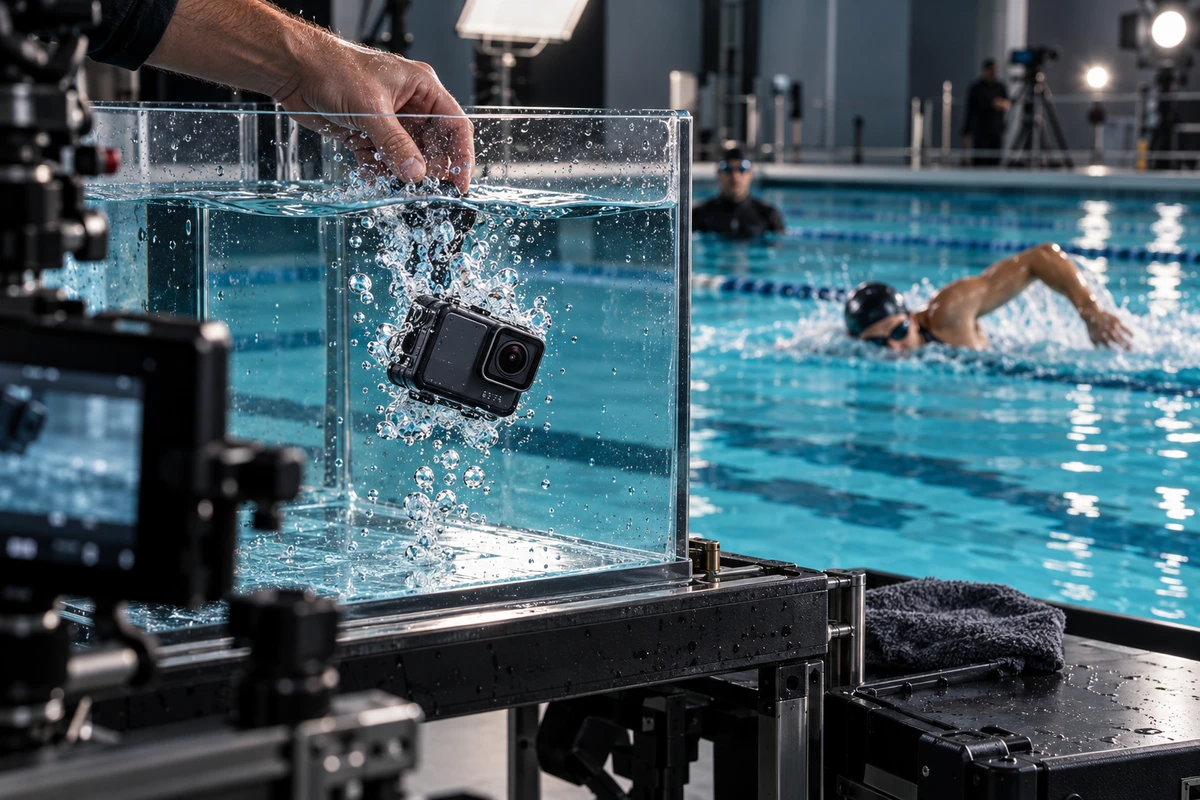
A clear tank is well suited to controllable beauty work. The main camera can stay outside the water while filming the product crossing the waterline, bubbles moving across the lens, a button press, a screen response or droplets leaving the surface. Water clarity, background, light and product position can be repeated, and macro photography can reveal the port cover, lens cover and housing construction.
A tank can efficiently cover:
- the visual transition from dry product to immersion;
- structural details of the bare camera or waterproof housing;
- repeatable button and screen actions in shallow water;
- bubbles, refraction and droplets for hero imagery;
- motion-control or hand-operated shots that do not require a swimmer.
It does not establish a deep-water rating, long immersion, surf impact or open-water handling. A shallow tank remains a shallow condition even when slow motion and sound design make the moment feel powerful. If a film needs to state a depth, the product owner must supply the approved claim and its basis, and production must design a controllable method around that requirement. Camera angle should never be used to create a false impression of depth.
The tank itself also requires production planning. Confirm its dimensions, floor loading, fill and drainage route, overflow protection, glass or acrylic reflections, electrical separation, breakage responsibility and reset time. “Studio controlled” does not mean risk free.
Use a pool for scale, wearing and repeatable action
An action camera is small. Isolated macro shots cannot show how it sits in a hand, on a helmet or chest mount, beside goggles, or on a floating grip. A pool is valuable because talent can repeat mounting, water entry, turns, swimming movements and transitions above and below the surface within a managed route. It is not automatically a stronger waterproof proof than a tank.
Pool footage should answer practical questions:
- How large does the camera look on the head, chest or grip?
- Can the performer plausibly see and operate the button or screen at the surface?
- How do the tether, mount and flotation accessory relate to the body?
- Does the sequence from preparation to immersion and recovery make sense?
- Can the product’s point-of-view file be matched to an external camera angle from the same action?
Capture one continuous reference action first: inspect the mount, start recording, enter the water, complete the movement and return to the edge. Then break it into preparation, wide entry, underwater close-up, product POV and recovery. This gives the edit a real continuity spine instead of asking it to join different housings, mount states or recording screens.
A pool is not automatically suitable for every sample or crew. Confirm water temperature and treatment, cleaning rules, access hours, lifeguard or safety coverage, filming permissions, electrical separation and the performer’s swimming ability. Ontario’s public film and television water-hazard guidance discusses rescue planning, competent water personnel, water temperature and wet-location electrical protection. It is not legal advice for a Shenzhen production; the applicable venue rules, local requirements and project safety lead remain authoritative.
Use open water for environmental truth, not laboratory proof
Coastlines, rivers, lakes and water-sport locations provide elements a tank or pool cannot: natural wind and waves, glare, shoreline access, equipment transport and movement that will not repeat exactly. They can establish the intended world of surfing, paddleboarding, wet-weather riding or a snorkelling trip.
The most useful open-water shots show relationships: how the user carries the camera to the water, installs and retrieves it, checks the screen in sunlight, handles a flotation accessory and connects the camera POV with an external view of the same action. Larger waves and a dramatic horizon do not, by themselves, establish a waterproof depth, impact rating or saltwater durability.
Before booking the location, verify permission, tide or water level, forecast, visibility, current, boats and public traffic, shore access, equipment security, safety cover, communications and exit conditions. Salt, sand and unknown liquids may also change cleaning and seal requirements. If the conditions cannot be controlled, move appearance and operation shots back to the tank or pool instead of forcing a claim-bearing shot into an unsafe exterior.
Build an immersion card for every sample
An underwater sample card needs more than “one black camera.” Record:
- model, SKU, sample ID, firmware and cosmetic condition;
- bare body or housing, plus the condition of the lens cover, battery door, port covers and seals;
- the manufacturer-approved liquid, depth, duration and exclusions;
- battery, media, aspect ratio, frame rate, stabilization and recording state;
- approved mounts, tethers and flotation accessories;
- planned immersion count, approximate underwater time and stop conditions;
- the required fresh-water rinse, external drying, inspection and reopening procedure;
- who can authorize immersion and who can stop the take.
DJI currently instructs users to rinse the camera with clean water after underwater use and let it air dry completely. GoPro setup guidance stresses that the camera should be dry and clean before opening the door and that debris must be removed from the seal. Those instructions are model specific; the formal manual for the sample on set should control the procedure.
Before the first production sample enters the water, rehearse framing, buoyancy, entry speed and retrieval with an empty housing, substitute object or product-owner-approved test unit. This rehearsal validates the production movement, not the camera’s waterproof performance. The quote and call sheet should also state who authorizes immersion, how loss or water ingress is handled, and whether a same-version replacement is available.
Treat every immersion as a traceable take
Putting every underwater shot into one block and checking the files at the end creates unnecessary risk. A better rhythm is to inspect seals and recording state before each immersion, dry the exterior and read back the file after recovery, check for fogging or abnormal behaviour, and confirm the sample before the next take.
The log can remain compact: shot number, sample, housing, liquid, estimated depth, entry and exit time, file name, inspection result and approver. For talent shots, bind the external camera take to the product POV take. Post-production can then match the same action, and the product owner can quickly quarantine affected files if a sample later shows a fault.
If the film uses CG, generative splashes or a composited environment, mark that scope clearly. Synthetic water can strengthen a non-performance hero image, but fabricated depth, surf or immersion duration must not be edited as a real test. For U.S.-facing advertising, the FTC states that objective express and implied claims require a reasonable basis before dissemination. Its advertising substantiation policy applies to what the ad communicates, not only the words printed on screen. Other markets require review by the brand’s platform and legal owners.
Review the claim, action and scale separately
Amazon’s May 12, 2025 seller guidance says product videos can help shoppers understand size, features and functionality. That is a useful acceptance structure for an action camera: review appearance, operating cause and effect, human scale and environmental meaning as separate jobs. Amazon’s current guide does not turn a product film into a certification test.
For every water shot, ask: Does the model, housing and accessory match the copy? Does the button press occur before the response? Is the recording state continuous above and below the surface? Did the product POV come from the same action? Does every depth or capability statement have an approved SKU and condition? If the caption disappears, would the picture alone imply something stronger and unsubstantiated?
ONCE’s ecommerce product video service connects product-page films, demonstrations and platform versions in one production scope. U-STUDIO in Shenzhen publicly shows its white cyclorama, lifestyle sets and production resources. A tank, pool or open-water location still needs project-specific confirmation; those pages do not imply an existing underwater facility or live availability.
If you are preparing a film for an action camera, dive light or another water-use device, share the exact SKU, target market, public specification, sample and housing status, intended locations, performer actions, delivery channels and launch date. ONCE can first label each shot as appearance, operation, scale, environment or performance claim, then decide what belongs in a tank, what requires a pool and what is worth taking into open water.