When a brand wants a commercial, a product-page video and several social ads from one studio day, the things worth sharing are the sample, set, base lighting and verified product facts—not a single narrative. The commercial builds a brand world. The product-page video completes an explanation. Each social ad needs a specific reason to stop watching everything else. Cropping one landscape film into three aspect ratios may create three files, but it does not create three ideas.
U-STUDIO Commercial Studio Production 05/10
A stronger plan gives every channel its own opening, action and ending first. Only then does the team identify the shots that can genuinely be shared. This approach reduces repeated setups without turning the short-form deliverables into leftovers from the hero film.
Give each deliverable a separate job
Teams often start by discussing camera count before agreeing on what each film must help the viewer decide. A simple task map prevents that confusion.
| Deliverable | The viewer's immediate question | The job it must complete | The job it should not carry |
|---|---|---|---|
| Brand commercial | What kind of life and attitude does this product represent? | Build emotion, relationships, a visual memory and a branded resolution | Explain every operating step |
| Product-page video | How does it work, and can I see the size, sequence and result? | Show states, steps and relevant limitations clearly | Hide critical facts behind suspense |
| Social ad | Why should I stop now? | Enter through one problem, contrast or sensory moment and answer it | Compress every message from the hero film |
All three can feature the same product, but they require different viewing reasons. If pre-production supplies only a 45-second hero storyboard, the editor later has to assemble short ads from whatever actions happen to exist. The missing material is rarely another beauty shot. It is usually an action designed specifically for the opening.
A hypothetical brief: one countertop ice maker, five films
The following is explicitly a hypothetical project, not an ONCE client case or a completed performance test. The product is a compact countertop ice maker intended for an English-speaking market. Its appearance, operating sequence, publishable specifications, packaging language and safety information would all require brand approval before filming. The deliverables are a 45-second brand commercial, a 30-second product-page demonstration and three 12–15-second vertical social ads.
The set is a controllable dining and kitchen interior. The public U-STUDIO page shows a sunlit home interior with connected living, dining and kitchen areas, which makes it a useful starting point for this kind of lifestyle-production conversation. Availability, set changes, sound conditions and equipment still need to be confirmed for the actual project.
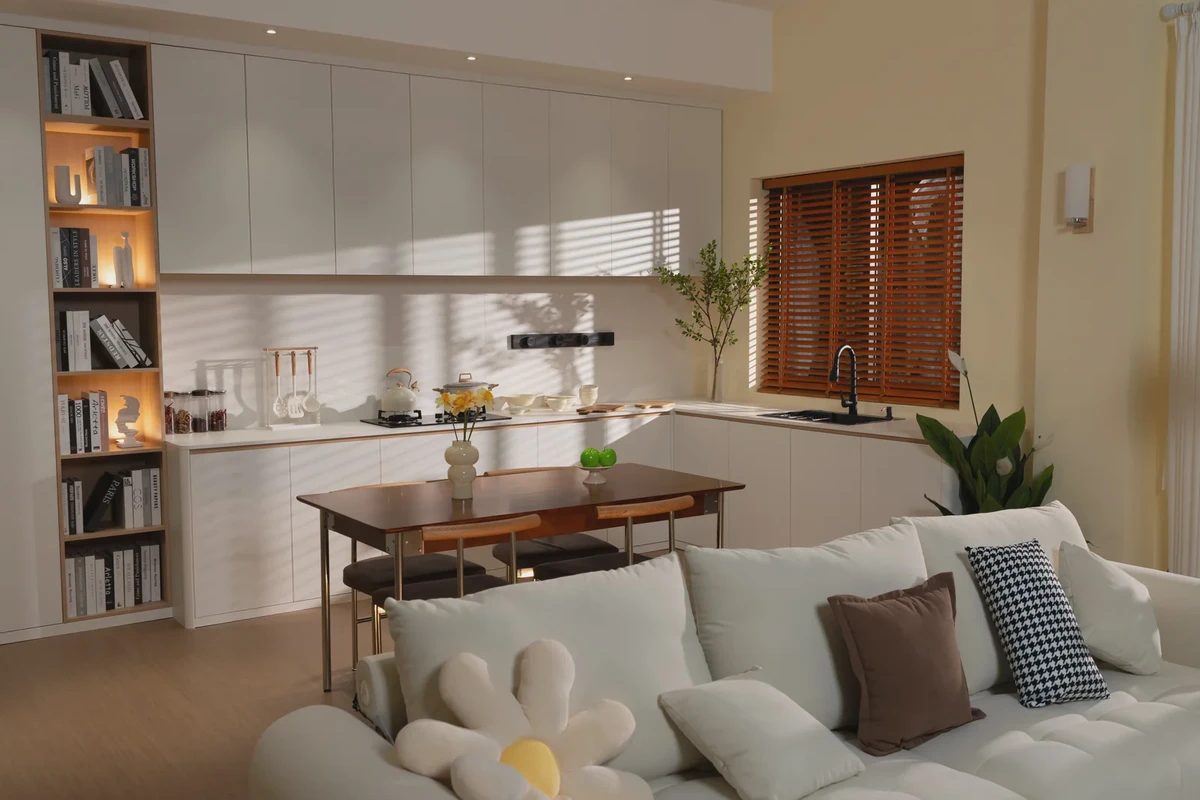
A kitchen wide view published on the U-STUDIO page. It helps a team judge counter scale, talent movement and the relationship between camera positions.
The 45-second commercial: make ice the beginning of a gathering
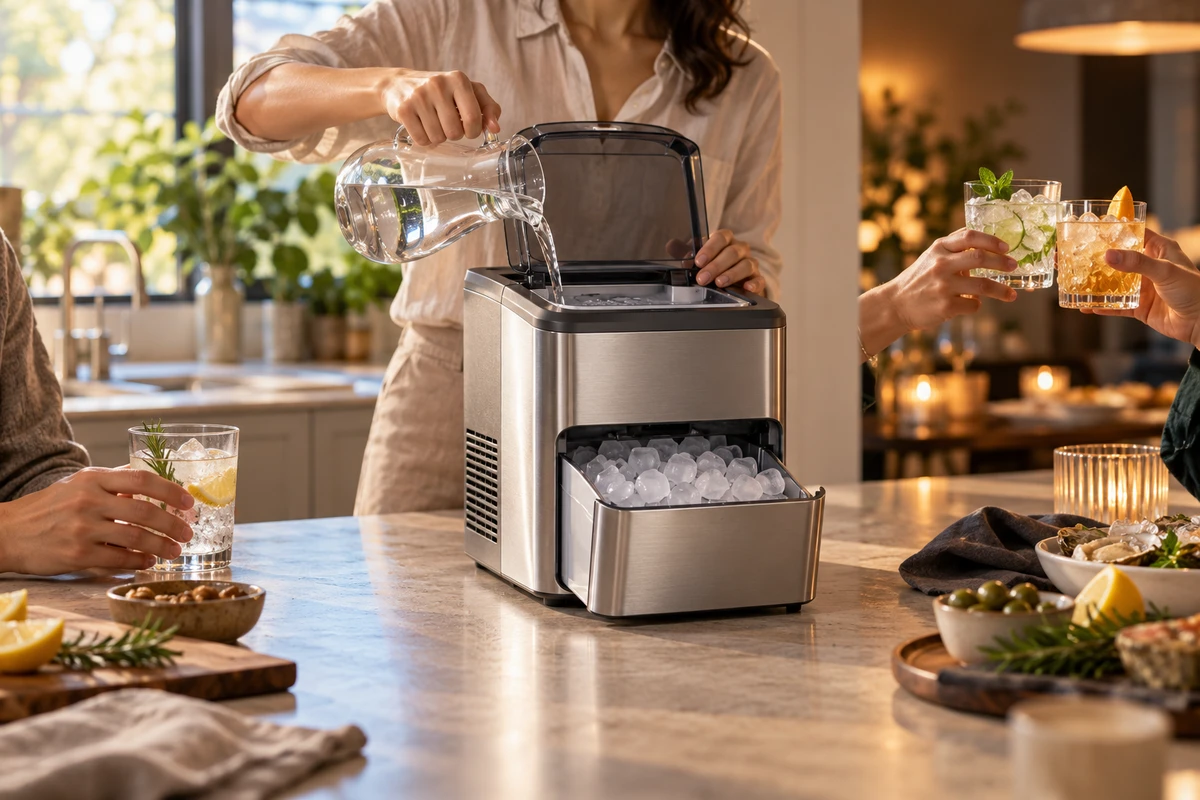
The hero film does not rush to explain every button. It opens in a quiet afternoon kitchen. A person places a glass on the counter, pours water into the machine and the sound of ice landing breaks the silence for the first time. The film moves from a single drink to friends arriving, more glasses appearing and the table becoming animated. Instead of ending on a feature list, it holds the machine at the centre of the final image while clinking ice resolves into the brand music.
The relationships, passage of time and emotional resolution belong to this version. They need horizontal space, continuous blocking and an ending with room to breathe. Close-ups of the ice dropping, a hand collecting it and ice entering the glass can be shared. The arrival of the friends, however, does not automatically become a product-page explanation.
The 30-second product-page film: complete the chain of cause and effect
The product-page version begins with a clean, complete view. It then shows the brand-approved sequence for filling, selecting a mode, reading the operating state, collecting ice and cleaning. Every action holds long enough to reveal its starting point and result. If the sample cannot reproduce a state reliably, fast cutting from the hero film should not be used to conceal that limitation.
The camera can be more neutral: stable framing, readable controls, hands that do not cover key details and matched before-and-after product states. This film shares the sample and selected details with the commercial, but it needs its own complete action chain, caption space and clear ending. ONCE's current ecommerce product video page similarly frames versions around the product page and buyer questions rather than finished duration alone.
Three social ads: one problem per film
The first is called “You have the glass. Where is the ice?” It starts with the sharp sound of an empty glass hitting the counter. In a vertical close-up, the person looks at the glass rather than the camera, then moves immediately into filling the machine and dropping ice into the drink. This film resolves an immediate problem; it does not retell the gathering story.
The second asks, “Will it take over the counter?” The opening places a hand, a glass and the machine in the same frame to establish scale, followed by a top-down view of the appliance among everyday objects. This is an objection-handling film. It needs a dedicated overhead setup and vertical edge space, not a hard crop from the commercial's wide shot.
The third is “Turn the afternoon into the evening.” A quiet solo drink transitions to friends clinking glasses, with the cup held in the same position across the cut. The ice sound becomes a rhythmic marker. This version borrows the talent and set from the commercial, but the product enters earlier, the emotional path is shorter and the opening and ending are designed to loop.
The production implication is not that every shot becomes 9:16. Vertical framing, safe areas and sound should all be settled before the shoot, but none of them can replace the reason for a social idea to exist. Each short begins with a different action.
What is genuinely shareable
A shared shot should remain an accurate, recognisable product fact after it is removed from the original story. For this hypothetical project, the production can build a “product truth master” containing:
- clean full-product views, ports, the ice compartment and controls;
- the verified filling, selection, operating, collection and cleaning sequence;
- hand-to-product and glass-to-product scale references;
- controllable practical sounds such as ice falling, a lid closing, button feedback and water pouring;
- dialogue-free hand actions, glass details and neutral shots with caption space;
- a small set of transitions checked for both landscape and portrait subject size.
These shots can appear in the commercial, product-page film and social ads, but they should not be labelled universal. The same ice-collection close-up may last half a second in the commercial, need a complete action in the product film and become an opening beat on social. The crew therefore records appropriate duration, handles and clean sound for each intended use instead of assuming one take will work everywhere.
What needs a dedicated design
Openings, decisive actions and endings are poor candidates for generic sharing because they determine why a film exists.
The commercial opening establishes space and a person's state. The product film opening presents the appliance clearly. A social opening poses a problem through its first action. The commercial may use a slow move to build anticipation; the product film needs a front or three-quarter view of the structure; the footprint ad needs overhead scale evidence. The product is the same, but the shots are not merely different exports of one camera position.
Endings require the same discipline. The commercial resolves an emotion and a brand image. The product video resolves the operating explanation and next information. A social ad returns to its single question, contrast or action. One generic packshot cannot give every version the right conclusion.
A shot-ownership table the crew can use
| Shoot unit | Commercial | Product page | Social 1: immediate problem | Social 2: footprint | Social 3: state change | On-set requirement |
|---|---|---|---|---|---|---|
| Clean product and details | Shared | Shared | Optional | Shared | Optional | Capture landscape and portrait-safe options without baked-in text |
| Fill—select—operate—collect | Rhythmic extracts | Dedicated full chain | Opening and payoff | Not needed | Collection beat | Record start, process, result and clean practical sound for each step |
| Quiet kitchen and solo state | Dedicated | Not needed | One usable shot | Not needed | Dedicated first half | Log props, glass contents and lighting state |
| Friends enter and glasses meet | Dedicated | Not needed | Not needed | Not needed | Dedicated second half | Film separate portrait spacing and a looping ending |
| Empty glass hits counter | Not needed | Not needed | Dedicated | Not needed | Not needed | First frame must read clearly and leave UI-safe space |
| Overhead footprint comparison | Not needed | Optional size proof | Not needed | Dedicated | Not needed | Use a true overhead setup, not a crop from a landscape wide |
| Final product shot | Commercial ending | Product ending | Optional CTA | Optional CTA | Looping resolution | Capture at least three endings, not just three captions |
The table matters because it tells the director, cinematographer, producer and editor why a shot exists, which film owns it and what breaks if it is missing. The crew structure may be smaller on a commercial studio day, but shot ownership still has to be logged.
Schedule around scene states, not finished-film order
One studio day can be efficient without filming the commercial from beginning to end and then starting every other version from scratch.
Capture the clean product and fingerprint-sensitive details first, followed by complete product actions. Establish the kitchen lighting and prop baseline, then film the continuous product-page demonstration. Once talent enters, complete the commercial's landscape blocking. While the set can still be reset accurately, film the three dedicated vertical openings and actions. The gathering state—with more glasses, food and people—comes last. Every change logs water level, ice quantity, glass contents, counter objects, wardrobe and the machine display.
Sound belongs to shoot units as well. Ice, lids, buttons and pouring can explain the product or become the rhythmic centre of a short ad. What can be shared is a clean, truthful recording. The commercial's music structure and each social edit's rhythm cannot be shared automatically. If the set is not suitable for clean recording, the team should decide how to capture wild tracks or replacements before the edit rather than assuming the required sounds will be available later.
Landscape and portrait are not two exports from one camera
The landscape commercial can use spatial relationships to move from solitude to a gathering. A vertical social ad relies more heavily on subject size, hand movement and first-screen information. Both can be filmed under the same lighting state, but they need separate decisions about camera height, distance, eye line and prop positions.
A practical method is to make a “first-frame card” for every vertical concept: what is visible immediately, how large the product is, where the action enters and what the platform interface may cover. The commercial gets a “space card”: where the person enters, how product and environment coexist and when the camera moves closer. The shared asset is the scene state, not a compromised composition.
Run a no-borrow edit before the shoot
Before the call sheet is locked, make an 8–10-second still-board or phone test for every deliverable. Each edit may use only shots marked as shared or owned by that version. It cannot borrow another film's opening or ending to make sense. Then ask:
- Without the title, what problem does this film pose in its first three seconds?
- Does the action actually answer that problem, or does it merely display an attractive product?
- Does the ending complete this film's job, or does it jump to a generic packshot?
If the footprint ad needs the commercial's gathering scene to become interesting, the footprint idea is incomplete. If the product film needs voiceover to repair an unreadable step, the demonstration shot is incomplete. If the commercial loses all emotion when the feature captions are removed, the brand story has not become independent.
When one combined shoot is the wrong answer
Combining everything is risky when the sample is unstable, the commercial and product page use different market versions, talent rights differ between channels, or the permitted product claims have not been aligned. In those cases, a sample test or one critical proof-of-concept should come before the combined shoot.
A heavily custom-built commercial set may also conflict with the lighter, direct demonstration a social concept needs. Two clearly defined shoot units can be more reliable than repeatedly dismantling and rebuilding one compromised setup. “One studio shoot” does not mean one light, one camera position or one performance. It means the genuinely shared work is shared and the dedicated work receives explicit resources.
Brief the content jobs, not just the quantities
When planning a commercial and a set of short-form videos in one production, provide the product and sample status, target market, hero-film job, product-page actions that must be understood, the independent question behind each social concept, channels and aspect ratios, creative references, launch timing and budget range. ONCE can then map shared shots, dedicated shots and post-production versions onto U-STUDIO's sets, lighting control and product-action requirements.
When you send the project brief, include one answer to “Why is the commercial worth watching?” and separate answers to “Why is each short worth stopping for?” Deliverable counts are easy to total. Usable films come from giving every version a reason of its own.