Put a whole product range in front of a camera and two bad outcomes are common. If every SKU gets to “do its own thing,” the finished library can look as though it belongs to several brands. If the team forces every large appliance, small accessory, metal surface and glass panel into one camera setup, the background may be consistent while the products become harder to understand.
U-STUDIO Commercial Studio Production 06/10
Consistency in a batch shoot does not mean making every SKU look the same. It means making the family recognisable. The colour relationships, tonal range, background logic, default orientation, typography and sound attitude can remain stable. Framing scale, light shaping, product actions and information priority should change when the product requires it. A hero SKU may receive exceptions, but every exception should carry a more important communication job, not simply produce more beauty shots.
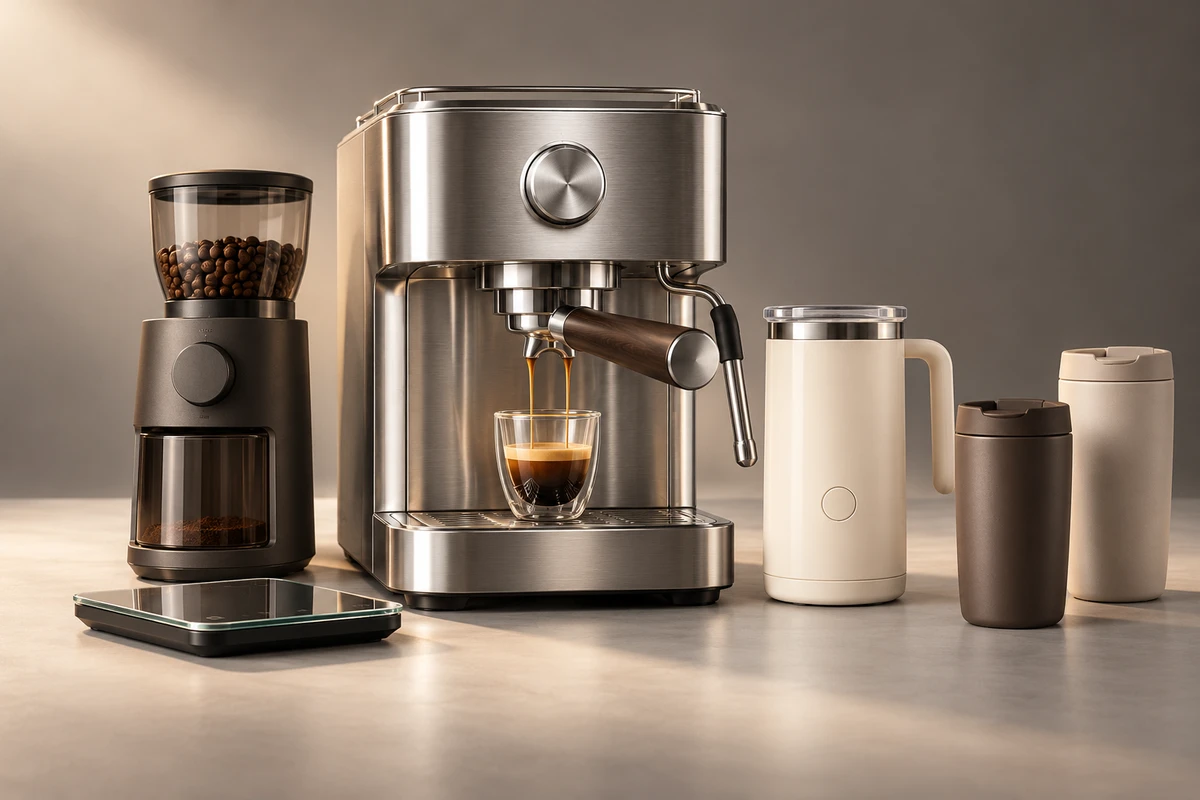
The example below is explicitly hypothetical. Imagine a home-coffee brand preparing photography and video for international ecommerce channels. The batch includes a hero semi-automatic espresso machine, a grinder, a milk frother, a coffee scale and two colourways of a travel mug. These are not ONCE client products, completed shoots or reported performance tests.
Turn “consistent” into rules the camera can repeat
“Clean, premium and warm” is not yet a production standard. A crew needs relationships that can be repeated and, where necessary, adjusted deliberately.
For this hypothetical range, the brand could lock six rules: a low-saturation warm-grey background; brand brown appearing only in small props or liquid; a consistent default product orientation; shadows falling to the rear right; a related centre of visual weight; and a sound language built from real buttons, grinding, steam and cup contact rather than oversized mechanical effects.
Those rules make the products feel related. They do not require every SKU to occupy the same percentage of the frame or every surface to use the same diffusion. The espresso machine needs enough space to show its mass, handle and operating area together. The small scale needs a closer overhead view to make its glass surface readable. A travel mug photographed from the espresso machine position would simply look stranded. The system fixes the visual grammar, not the camera coordinates.
Amazon's current product image guide asks main images to represent the real scale, quantity and colour accurately, and separates main, detail, angle and other image roles. Shopify's current product photography workflow recommends planning a shot list, preparing products and grouping similar items, while a locked camera can help keep variants aligned. These sources support standardisation; they do not decide which products deserve an independent composition. A better production rule is to approve one reference per group, then permit controlled departures when accuracy or clarity requires them.
Group by four production conditions, not catalogue order
One product may belong to several groups at once. Grouping is not merely a schedule. It identifies which visual conditions can be shared and which must be rebuilt.
| Grouping dimension | Products in this example | What can be shared | What should not be forced |
|---|---|---|---|
| Size | Large espresso machine; medium grinder and frother; small scale and mugs | Baseline, negative-space ratio and scale cue within each size group | One camera distance or identical frame occupancy for every size |
| Material | Brushed metal, matte polymer, glossy glass, coated mug bodies | Tonal target, brand colour and shadow direction | One diffusion size, flag position or highlight length |
| Action | Place cup, pour beans, grind, froth, weigh and open the lid | Performance attitude, hand styling and sound restraint | Functional steps, start and end states, or proof of result |
| Sample status | Production sample, working sample, appearance sample, unfinished packaging | SKU identification and status labelling | Editing an appearance model as successful operation or treating old packaging as final |
Size decides how large the product needs to read. Material decides how light describes it. Action decides how much of a process must remain visible. Sample status decides which facts can truthfully be filmed. A catalogue-order shoot repeatedly crosses these conditions. A material-only batch can still miss the fact that two metal products require entirely different actions. The useful production groups emerge when all four dimensions are considered together.
Three product roles need three ways of being understood
The hero espresso machine: connect structure, scale and use
The baseline product frame still follows the shared background and shadow language, but the composition opens slightly so the handle, cup and control area form one relationship. The video does not begin with a generic turntable. It enters through a complete action: lock the handle, place the cup, start the machine and see the coffee land. The highlight must travel coherently along the metal during the shot, not look good only in one still frame.
This product earns one hero exception. A camera move travels from a structural detail to the liquid in the cup, then reveals the grinder on the same surface. The exception communicates that the products form one coffee system. Additional slow motion, smoke or rotation would not be a hero strategy if it failed to establish that relationship.
Grinder and frother: keep the family, separate the actions
The two medium products can share surface height, background, prop colour and hand styling. They should not share a functional sequence. The grinder needs the cause-and-effect chain of beans entering, a control being set and ground coffee emerging. The frother needs its initial liquid state, the actual operation and the final state. Both may open at a related three-quarter angle; subsequent views follow their different operating paths.
Sound should express “one brand, different products.” Grinding can establish rhythm, while the frother does not need to imitate the same intensity. Consistency does not mean pasting one effect over every shot. It means keeping the recordings clean and restrained while the real operation determines the beat.
Scale and travel mugs: provide scale evidence without pretending everything is the hero
The small scale uses a closer overhead view and a standard cup for proportion, with separate reflection control for its glass surface. The travel mug is understood through a hand, a cup holder or the lid action. Both retain the shared background, colour and shadow direction, but neither borrows the espresso machine's low hero angle.
These supporting SKUs need to make differences, proportions and key actions clear. Without a separate campaign job, each colourway does not need its own lifestyle narrative. Yet every real colour, lid structure and packaging version still requires its own identity and file approval. Colour grading and captions must not substitute for the actual product.
Build a master in the cyclorama, then allow each group to depart
The current U-STUDIO page lists a 64 m² white cyclorama alongside home interiors, a contemporary living room and a future-tech set. For this hypothetical range, the cyclorama offers a controlled place to establish a brand master without lifestyle scenery competing for attention: one large-product reference, one medium-product reference and one small-product reference, plus material references for metal, glass and matte surfaces.
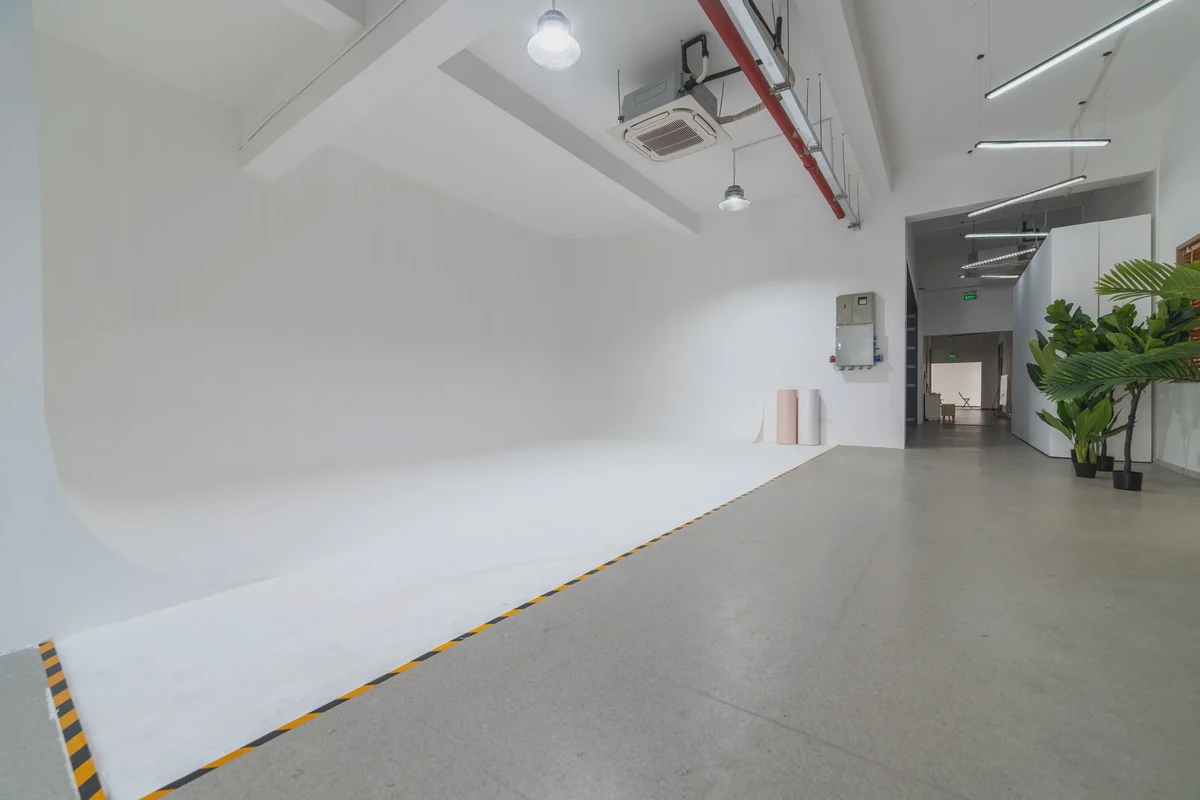
A master is not one picture that every SKU must copy. It is a collection of relationships: baseline, shadow direction, background separation, amount of brand colour, caption space and the stopping point of a product turn. Shoot one representative sample from each group and approve it before expanding the batch. If the glass reflection, scale or label direction is wrong, the team corrects one group instead of copying the error across the range.
If lifestyle content is also required, ONCE's ecommerce product video service describes product-page films, detail videos, advertising cutdowns and channel versions as connected but distinct jobs. For a real project, the shot list should still state which SKU needs talent, which only needs a scale cue and what question each scene must answer.
Give every hero exception a reason
A hero SKU is not simply the product receiving the most shooting time. It carries the most important communication task. Its exceptions should be few and explicit.
| Area | Range-wide standard | Hero espresso-machine exception | Communication job |
|---|---|---|---|
| Colour | Warm-grey background and limited brand brown | Coffee liquid becomes a stronger moving colour field | Put the brand palette inside a real use action |
| Composition | A baseline for each of three size groups | One move from structural detail to the wider system | Establish the hero's relationship to the range |
| Styling | Props provide scale or enable an action | Add cups and a bean container without hiding controls | Build a complete use context |
| Light | Shared tonal family and shadow direction | Finer moving highlight along the metal structure | Reveal form and material rather than merely increase brightness |
| Product state | Clean exterior plus a truthful, completable action for every SKU | Preserve before, during and after extraction | Make the hero visual informative as well as attractive |
| Sound | Real, restrained and consistently balanced | Build a sequence from locking, starting, pouring and cup contact | Create a memorable action rhythm |
The table also provides a brake. If an exception cannot answer what the viewer understands or remembers because of it, the exception is probably decoration. A hero product may go deeper, but supporting SKUs still require accurate colour, proportion, structure and function approval.
When a sample is not ready, change the task instead of faking completion
Suppose the coffee scale is only an appearance model and its screen interface is not final. The second mug colour has arrived, but its retail packaging has not. They should not be treated in the same way.
The appearance model can enter exterior, scale and non-functional shots, provided the files are labelled “appearance only.” It must not be edited into a successful weighing demonstration. The mug body and lid action can be filmed while its packaging shot remains incomplete. Packaging from another colourway should not be borrowed and recoloured to imply a final version.
A simple three-state system helps. Green means the production appearance, function, accessories and approved facts are ready. Amber permits only the specifically listed exterior or non-functional shots. Red means the product identity, critical structure or safe operation is unresolved and the SKU leaves the current batch. A brand product owner approves the status; the crew should not decide that two versions are “close enough” by appearance.
When an unready SKU exits, the main batch can still be completed. The tracker should retain three fields: what was captured, what remains missing and which conditions a reshoot must restore. “The batch is finished” should never conceal an unfinished product.
Internal pickup shoots can match the system—if the difficulty is honest
An in-house brand team can capture some long-tail updates without breaking consistency, but it needs more than a few reference images. The handover should include camera height and distance, focal length, product baseline, background and surface materials, light positions and sizes, white-balance and exposure references, a colour chart, shadow direction, prop list, naming rule and one ungraded reference.
Suitable in-house pickups usually include a colourway, packaging update, port difference or simple lid action under a fixed camera. Complex glass reflections, moving metal highlights, continuous functional success or a hero scene involving talent are harder to reproduce. In those cases, preserving the original studio state or treating the pickup as a controlled production unit is more reliable than trying to make an office shot “look close.”
Review the pickup as an overlay: Is the product baseline aligned? Is subject size within the agreed tolerance? Have whites and brand colours shifted? Does the shadow fall in the opposite direction? Has a change in light made the material feel like a different finish? For video, add the action start and stop, hold duration and sound attitude. These observable checks determine whether the new asset belongs to the same system.
A fillable visual-standard and hero-exception table
| Field | Range-wide standard | Allowed group variation | Hero exception | Owner / approval status |
|---|---|---|---|---|
| Background, surface and brand-colour ratio | ||||
| Baseline and frame occupancy for large, medium and small products | ||||
| Highlights and shadows for metal, glass and matte surfaces | ||||
| Default orientation and visible label area | ||||
| Required exterior, detail and scale shots by group | ||||
| Unique functional action and successful state by SKU | ||||
| Practical sound, music and caption tone | ||||
| Sample status: green / amber / red | ||||
| Reproducible pickup parameters and approval method |
Fill and test this table with one representative sample from every size and material group before scaling up. Photography and video can share product IDs, colour targets, props and parts of the lighting foundation, but they still need separate approval. A still is judged for single-frame structure, colour and retouching; a video is judged across the full action, including reflections, focus and sound. If a standard lives only in a slide deck and cannot become a reference frame or review question, it is not production-ready.
A dependable batch system lets all six products stand together as a family, while giving the hero espresso machine a reason to step forward. Consistency comes from recorded, approved relationships. Emphasis comes from the product's role in the communication plan.
If you are preparing a multi-SKU photography and video batch, send ONCE the project brief with the product list, target markets, channels, hero SKU, dimensions and materials, sample status, must-show functions, existing brand standards, launch timing and budget range. ONCE can turn those inputs into range-wide rules, controlled group variations, hero exceptions and pickup conditions, then match the plan to a suitable U-STUDIO setup.
Source and image note: ONCE checked the current U-STUDIO, product-video and enquiry pages on 10 October 2026, alongside current Amazon Seller Central and Shopify guidance, Adobe Firefly reference-image documentation and peer batch-production material. Every product, shot and test in the example is hypothetical. The cover is an original generated commercial concept, not a photograph of U-STUDIO or a client production.