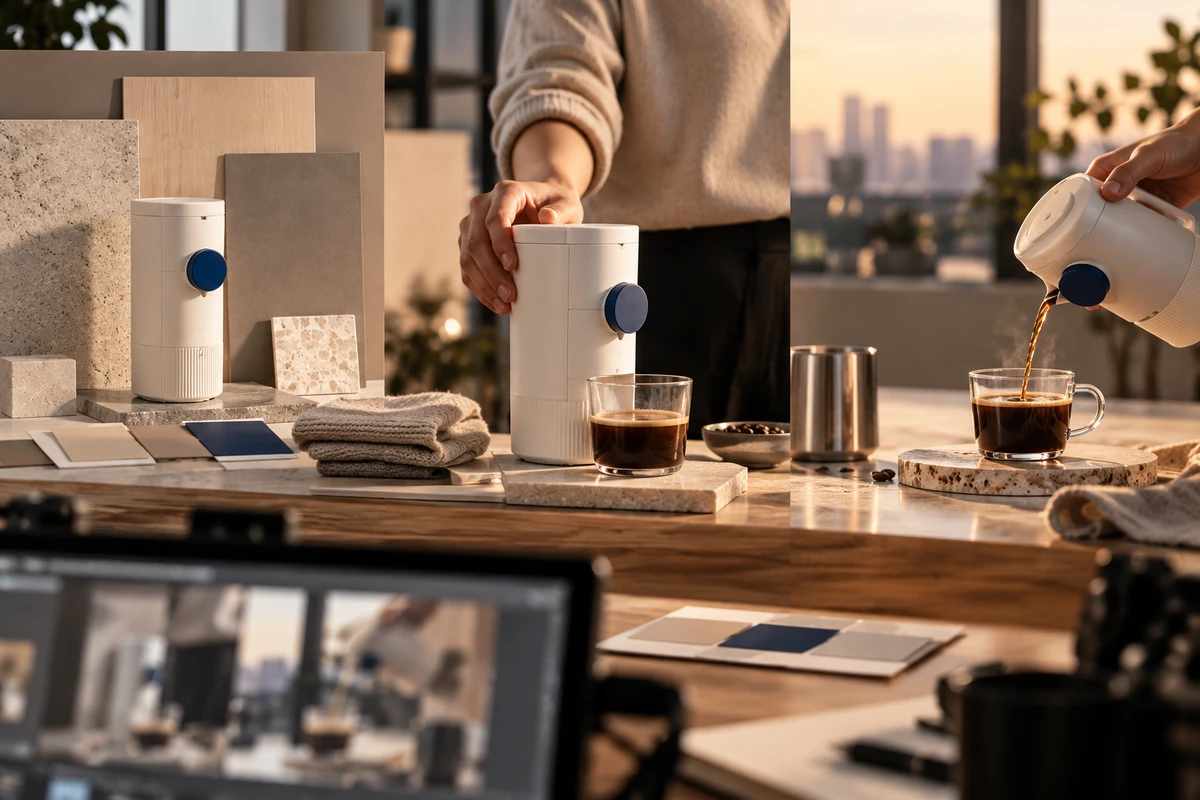
When an overseas team cannot attend a Shenzhen shoot, the biggest risk is not simply losing sight of the set. It is approving an attractive mood board without approving what the real product will look like on camera. A useful pre-shoot decision therefore needs three layers of evidence: static references to align the intent, still tests of the real sample to prove colour and scale, and a short moving test to prove action, rhythm and sound. None of the three can substitute for the others.
U-STUDIO Commercial Studio Production 08/10
This article uses a clearly hypothetical project. An international consumer brand plans to film a compact coffee maker in Shenzhen for its DTC homepage and paid social. The product has a warm-white matte body and a dark-blue control; the proposition is “a quiet, precise ritual in a busy morning.” This is not an ONCE client case. The product, proposition and test outcomes are teaching examples.
Approve relationships, not a single attractive frame
A visual direction is not the name of a filter. It is a set of relationships: product colour against set colour; product scale against a hand, cup and worktop; props against the task; wardrobe against the product silhouette; and performance against camera rhythm.
“We like this reference” leaves the production team guessing. Does the brand like the morning light, the restrained palette, the close framing or the fact that the performer never addresses the camera? A decision that can be filmed is more precise: “Keep the environment warm, but separate the warm-white product from the beige worktop. The blue control is the only saturated accent. Show only a hand and shoulder, and establish the product silhouette in the first second.”
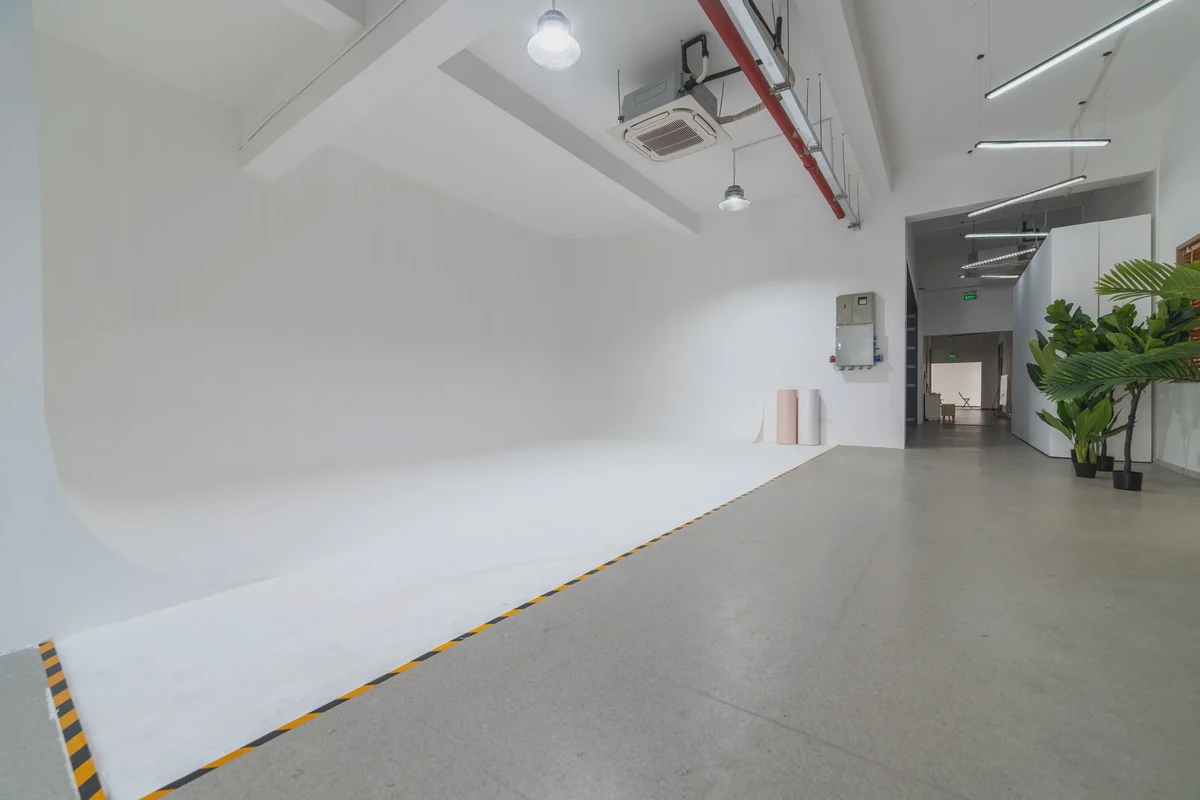
That language turns taste into testable conditions. It also lets the team decide whether to use a furnished area, a partial art-direction change or a controlled white-cyclorama test at U-STUDIO in Shenzhen. An existing set is a production base, not a finished brand world. Current availability, accessories, modifications and on-set support still need project-specific confirmation.
A visual approval pack should answer five questions
1. Colour: does the environment support or swallow the product?
Break “warm” into separate decisions. The environment may use low-saturation mineral neutrals and the light may feel like early morning, but the warm-white body must retain its own edge and tonal shape. The blue control should carry the accent; the cup, towel and packaging should not compete with an equally strong colour.
The brand is approving three relationships: whether the product colour is credible, whether the set supports the intended tone, and whether the accent lands in the right place. Record the file version and viewing setup with colour comments. Adobe’s current guidance explains why: displays differ, while colour management improves predictability across a known workflow rather than making every unmanaged screen identical (Adobe, updated 2026).
2. Scale: can a first-time viewer understand the product's real footprint?
An isolated close-up may make a compact coffee maker look like a full-size appliance. An oversized cup and a deep counter may make it look smaller than it is. A scale test should place the actual sample, a familiar cup, a hand and the worktop depth in one frame. Test both a slightly elevated three-quarter angle and a view closer to the user’s eye line.
Do not ask only which angle feels more premium. Ask whether a new viewer can tell where the product belongs and how a person approaches it. If scale is unclear, change camera distance, height, reference objects or blocking before resorting to an unrealistic enlargement in post.
3. Props: does each object help explain the task?
The task in this example is making one coffee during a busy morning. A clear glass can reveal the liquid state; a small tray can organise the operating area; an open planner can suggest time pressure. A vase, a full breakfast service and decorative food may look polished yet turn the scene into a generic lifestyle advert.
Approve props in three columns: required, replaceable and prohibited. This identifies which objects carry product meaning and which merely shape the frame. It also prevents a vague request for an “international look” from replacing a defined market and use task.
4. Wardrobe: does the person help the product read clearly?
This is not a casting, accent or rights discussion. It is a picture decision. A low-contrast knit may suit the tone, but a loose cuff cannot cover the grip or control. Skin, fabric and the warm-white body need enough separation for the action to remain legible.
Approve colour blocks, texture, silhouette and movement range, not a retail image of the garment in unrelated light. ScreenSkills’ descriptions of art direction and costume design both connect mood boards, fittings and visual proposals with discussion and approval by production decision-makers. For a remote brand team, wardrobe approval should therefore include the actual garment and product in the same test condition.
5. Action: can a truthful operation carry the brand rhythm?
For the hypothetical coffee maker, film an eight-second test. A hand places the unit on the worktop, pauses for half a beat, moves the blue control, and lets the machine begin its confirmed operation. The camera holds rather than cutting immediately. Real mechanical and liquid sounds remain audible. The person lifts the cup and leaves the product in frame.
This is not a miniature final film. It tests four questions: Is the order of operation truthful? Does the hand cover a key structure? Does the pause express “quiet precision”? Does real sound make the action more credible? If the final product operation has not been confirmed, the team must not present an invented movement as a product fact.
What each evidence layer can and cannot approve
| Evidence | What it can approve | What it cannot prove | Useful output |
|---|---|---|---|
| Static reference board | Colour relationships, composition, prop categories, wardrobe silhouette and intended tone | Real-sample reflections, dimensions, skin and material interaction, action rhythm | One page with “borrow” and “do not borrow” notes on every image |
| Real-sample still test | Product colour, reflections, scale, camera height, props and wardrobe competition | Continuity of action, focus changes, operating sound or edit rhythm | Three to five frames made under the same conditions, with camera position and open decisions |
| Moving style test | Action order, pauses, eye line, focus, real sound and basic landscape/portrait risks | The finish of the whole film, every set and performance, final grade or mix | A six-to-ten-second clip that changes one primary variable |
An AI mood image belongs in the first layer only. Adobe Firefly’s current documentation treats composition references and style references as different controls. That is a useful reminder: a generated image can propose spatial structure or an aesthetic, but it does not prove the real product’s colour, scale, reflections or operation. Mark every element that still requires a sample test, and confirm the relevant source and generation rights before the reference enters production.
A one-page approval form the team can actually complete
This does not need to become a long meeting record. Each approval item should point to visible evidence and a clear next action.
| Field | What to record |
|---|---|
| Product and version | Model, finish, sample status and anything likely to differ from the retail unit |
| Channel and format | DTC homepage, paid social and other uses; primary landscape/portrait safe area |
| Core proposition | What this visual direction must make the audience feel or understand |
| Evidence reviewed | Static board, sample stills or moving test; file name and version |
| Colour | Product colour, environmental key colour, single accent and unacceptable deviations |
| Scale | Reference objects, camera position, on-screen footprint and legible interaction |
| Props | Required, replaceable and prohibited |
| Wardrobe | Colour block, texture, silhouette, cuff and hand movement range |
| Test action | Starting state, complete action, pause, end state and real sounds to retain |
| Decision | Approved, approved with conditions or retest; conditions must be executable |
| Locked choices | Decisions the shoot team must not change independently |
| Open decisions | Owner, deadline and downstream effect of no decision |
“Make it more premium” is not an approval condition. A workable note is: “Keep the camera position and props. Reduce the environmental colour by one level, add separation on the product’s left edge, replace the heavy knit with a fine knit, then return one still under the same light.” The team can now see what is locked and what must be tested again.
When a test fails, identify the failed layer first
A failed test does not always invalidate the direction. Diagnose one primary variable at a time:
- If the product colour looks dirty, align the file and viewing condition first. Then separate white balance, environmental reflection, worktop colour and the sample itself. Return a neutral reference under the same light before rebuilding the set.
- If the product looks too small, change camera distance, height, reference-object scale or blocking. Reframe only after those relationships are understood.
- If props dominate, remove one visual layer and protect the product silhouette and operating area. Do not add more decoration to “balance” the frame.
- If wardrobe merges with the product, change one colour or material while preserving the other conditions.
- If the action feels performed for an advert, remove one line, shorten the preparatory hand movement, adjust eye line and pause, and repeat the same six-to-ten-second test.
If the failure comes from a changed product version, proposition or functional fact, stop refining the old look and reopen the approval pack. If it is one visual variable, do not allow a local problem to trigger an unnecessary reset of the whole film.
The point at which testing can stop
The direction is ready to lock when all five relationships have executable decisions and the moving test has exposed no unresolved product fact or action problem. “Locked” does not mean every final frame must duplicate the test. It means the formal shoot can move within approved rules for colour, scale, props, wardrobe and action.
This approval pack is not the whole remote-production process. Sample receipt, monitoring, access, file handover and revision rounds still belong in their own plans. ONCE’s ecommerce product video production and remote product shoots in China pages cover that wider context. The narrower job here is to convert “what we like” into “what the team can actually film” before the shoot begins.
To build this pre-shoot visual approval pack for a Shenzhen product production, contact ONCE with the product, target market, channels, creative references, sample status, timing and budget range. We can then identify which decisions need only a static reference, which require the real sample and which deserve a short moving test.