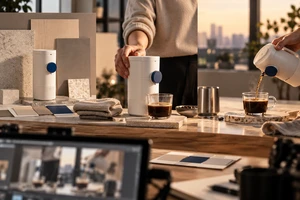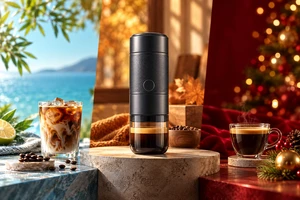
When the same studio is used for three months, the sofa, wall or lighting is rarely what becomes repetitive first. The real problem is that every post keeps answering the same question. A different shirt, another cup or a portrait crop of a landscape shot creates surface variation. Freshness comes from moving the audience's understanding of the product forward.
This article uses a hypothetical smart sleep lamp to build a twelve-week programme of product demonstrations and people-led social videos. The target market, channels and approved product functions are assumed to be clear, with one person responsible for publishing and feedback. This is not an ONCE client project or a report of campaign results. It is a practical production model.
U-STUDIO Commercial Studio Production 09/10
Fix the brand rules, then change the question
Ongoing content does not need to look completely different every week. If the product colour, camera distance, casting tone and sound world change constantly, viewers struggle to recognise the brand. If every opening, action and conclusion stays the same, there is no reason to keep watching.
A more useful division is to fix the recognition rules and vary the content question. For the hypothetical lamp, the following could remain stable for three months:
- approved product colour and brightness, without arbitrary recolouring in post;
- one principal bedside or living-room corner, with the same wood, fabric and one brand accent colour;
- a consistent product-to-person scale, primary camera height and soft side-light direction;
- a short touch or room-tone motif at the opening, without forcing every film to use the same music;
- one approved vocabulary for functions, product facts and captions.
The audience question, use moment, first action, performer intention, prop state, time-of-day feeling, shot size and ending can all change. The fixed elements make the brand recognisable; the changing elements give each film a reason to exist.
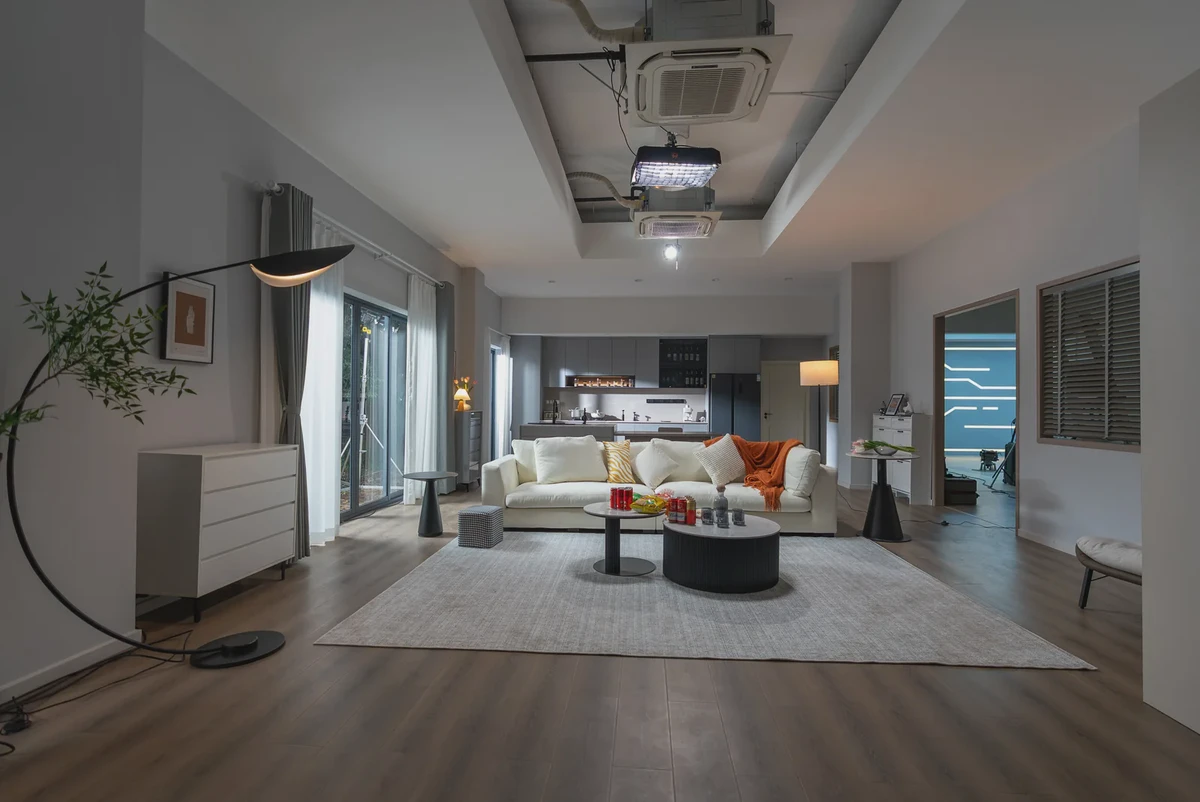
A modern living-room set shown on the current U-STUDIO page. A stable space can support brand recognition, while props, light, performance and the communication problem still need to be designed for each round.
Treat three months as a learning journey, not twelve isolated ideas
The table below assumes one principal post each week. It is not a recommended posting frequency or a performance promise. A brand can split the ideas into more or fewer versions. What matters is that each month has a different job.
| Stage | Week and audience question | Additional footage | What this film should not repeat |
|---|---|---|---|
| Month 1: make the problem visible | 1. How does the lamp enter a late-night scrolling routine? | Phone put down, hand reaches product, mixed light becomes calmer | Do not explain every function first |
| 2. What does first use require? | Approved placement, connection or setup actions | Do not hide essential steps with fast cuts | |
| 3. Will it fit a small space? | Hand, book, bedside table and product establish scale | Do not use wide-angle distortion to make it look smaller | |
| 4. What changes after one action? | A continuous before-and-after in the same frame | Do not repeat Week 1's emotional opening | |
| Month 2: make the choice easier | 5. Who is it for—and not for? | Contrast two clear routines without claiming universal relevance | Avoid vague lifestyle montages |
| 6. How do two approved modes differ? | Keep the environment stable and change one setting | Do not change location, performer and captions at once | |
| 7. “Will it be too bright?” | Show real exposure, distance and occlusion rather than relying on dialogue | Do not make unapproved health claims | |
| 8. Does a 15-second bedtime routine feel simple? | One complete sequence from approach to use and exit | Do not repeat Week 2's instructional order | |
| Month 3: make ownership believable | 9. Where does it live after a week? | Stable placement with light traces of everyday use | Do not disguise paid performance as a customer testimonial |
| 10. How might two people share the space? | Distance and coordinated actions around different schedules | Do not expand this into an unverified suitability claim | |
| 11. How is it cleaned, reset or stored? | Only maintenance actions approved by the manual and brand | Do not turn maintenance into another launch film | |
| 12. What question appeared most often in feedback? | Choose one real question from the first eleven weeks | Do not pre-write “the question everyone asks” |
The progression is simple: Month 1 explains why the product deserves attention, Month 2 helps someone decide whether it fits, and Month 3 makes ownership more credible. The same set can return, but it performs a different cognitive task each time.
Give every film its own first action, even within one production base
A regular studio base makes approved spatial proportions, lighting references, prop positions and product states easier to repeat. The current U-STUDIO page presents a modern living room, a sunlit home set, a future-tech set and a 64 m² white cyclorama. Dates, sound conditions, art changes and equipment still need project confirmation. A known base reduces relearning; it does not replace new scripts.
Week 3 might begin with a book placed on the bedside table before the product enters the same plane, immediately framing the scale question. Week 7 might begin with the performer adjusting their distance in a dark room before the lamp action appears. Both can be filmed in the same bedside setup, but the opening question, camera distance and visual proof are different.
If the team records one polished turntable shot, one touch action and one generic ending, then rearranges them into twelve edits, it has created twelve files—not twelve ideas.
Use a fixed-versus-variable sheet before filming
| Layer | Keep stable for three months | Change by topic | Record whenever it changes |
|---|---|---|---|
| Product | Approved colour, scale, logo direction and claims | Operating state and relationship to hands or objects | Sample ID, settings and surface condition |
| Setting | Main materials, base dressing and brand accent colour | Time of day, local props and use area | Prop positions, lighting reference and continuity stills |
| Person | Overall tone, styling principles and credible operation | Immediate task, eyeline, pause and distance to product | Script version, action marks and wardrobe change |
| Camera | Primary height, basic colour and exposure logic | Shot size, movement and opening composition | Lens, camera diagram and format safe areas |
| Sound | Approved sound character and genuine operation sound | Opening cue, pace and environmental layers | Music and effects rights, clean recordings |
| Ending | Brand recognition and product facts | A close that resolves this film's question | CTA purpose and publication channel |
This sheet does not force everything to remain static. By defining recognition rules, it gives the director and art team permission to vary the right elements without returning to “try another colour” every week.
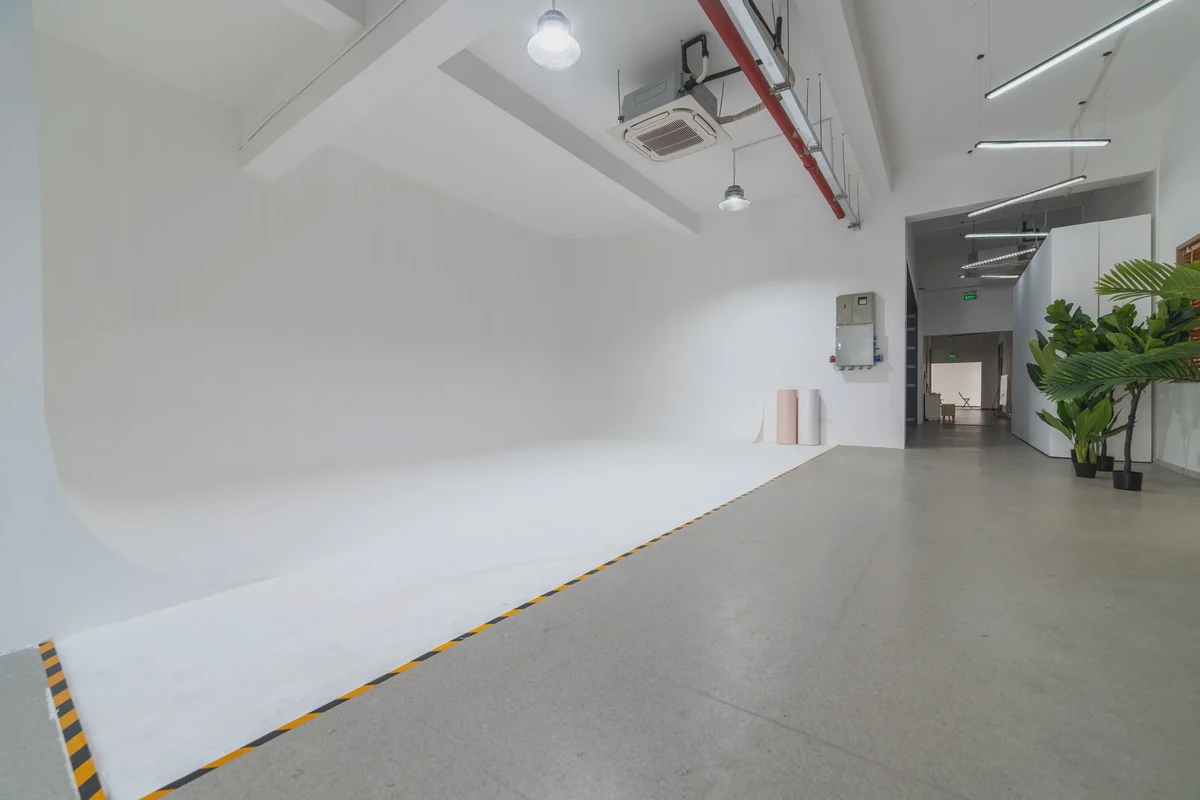
The 64 m² white cyclorama shown on the U-STUDIO website. It can be a controlled base for product, performance or local art changes, but the space alone does not create a new content question.
Separate three kinds of feedback
1. Aesthetic freshness
First, editors and brand owners can ask whether the new film is distinguishable from the previous one when muted and shown without its title. Has the first action, shot size or use context genuinely changed? At the same time, if the account name disappears, do the colour, people and spatial rules still feel like the same brand?
This judgement is useful for finding repetition, but it does not prove media or sales results. Place the opening and key frames from all twelve ideas on one page. If only the prop colours differ, return to the audience questions.
2. Observable viewing behaviour
The publishing owner can record facts such as early retention, completion, saves, specific questions in comments and visits to a product page. Platform definitions and reporting can change, so the current dashboard remains the source of truth. The useful comparison is not a universal benchmark; it is how different questions, openings or forms of proof behave for the same brand under reasonably comparable conditions.
TikTok's split-testing documentation, updated in January 2026, describes separate audience groups for different versions. Its current ad testing guide recommends defining the objective, holding other conditions stable and changing one variable at a time. Google Ads similarly asks advertisers to begin a video experiment with a hypothesis and can hold audience and campaign settings constant while the creative changes. The production lesson is straightforward: if topic, audience, budget, copy and timing all change together, it is difficult to learn which creative decision mattered.
3. Business results
Only the brand's sales and business systems can answer questions about qualified enquiries, add-to-cart actions, orders or store visits. Those outcomes are also affected by media spend, audience, offer, landing page, inventory and timing. Viewing behaviour should not be presented as proof that one film caused sales, and one result cannot guarantee three months of performance.
Aesthetic freshness asks whether the work is still worth noticing. Observable behaviour shows how people responded. Business results indicate whether the content supported a commercial goal. The three can inform one another, but they are not substitutes.
Know when to stop a theme
The waste in an always-on programme is not one average film. It is producing a third and fourth version simply because two already exist. After each review, place a theme in one of four groups:
- Continue: the question still matters and comments or behaviour reveal a specific next direction.
- Change one variable: the question matters but the opening or proof is unclear; keep the theme and replace one element.
- Move to the evergreen library: the function has been explained; retain it for product pages or customer support rather than the weekly lead story.
- Stop: successive versions create no new understanding or actionable feedback and merely restate the same conclusion.
There is no universal “stop after two films” rule. Before publishing, write the hypothesis, observable measure and review date. Judge the result against the brand's own sample and media conditions. If the data is too thin, do not declare a winner. Look for a new question in qualitative feedback or create a smaller, single-variable test.
AI can help previsualise backgrounds, prop combinations or opening frames, and can extend non-functional environmental elements. A generated reference does not verify product scale, operation or rights. Adobe's current guidance on Content Credentials, updated 2 September 2025, explains how credentials can carry information about the creative process and AI use. For an ongoing programme, keeping source, permission, product-fact and version records matters more than generating variation quickly.
Write the feedback into the next shot list
Five fields are enough to prevent the next studio session from beginning with a blank page:
- Keep: the clearest product fact, brand image and genuine operation sound from this round.
- Stop: the topic that has been fully answered or no longer has value.
- Next question: one precise issue from comments, customer support, sales or product teams.
- One variable to change: the opening action, proof shot, performer distance or ending—not all four.
- Acceptance test: can someone understand the question and answer without the title, are the product facts accurate, and does the image still belong to the brand?
If Week 12 is selected from real feedback to Weeks 1–11, the three months have formed a learning path. If it is simply Week 1 with new props, a regular studio has only made repetition more efficient.
A regular studio is useful, but should not be forced
The model suits a stable product, a brand that needs visual consistency, and a team willing to record feedback and return to related settings. A living-room set, a home interior and a white cyclorama can form a dependable mix of lifestyle, explanation and controlled comparison without rebuilding every condition each time.
But a change in product construction, market, talent rights or core claims requires renewed sample, script and permission checks. Content that depends on a genuine outdoor environment, store or local cultural context should not be forced into a studio simulation. A stable base is a production condition, not an answer to every creative problem.
For a three-month short-form production programme, review the current U-STUDIO spaces and production options. When you send a project enquiry, include the product, target market, channels, audience questions to progress over three months, available feedback, sample status, references, timing and budget range. ONCE can then identify which brand elements should remain stable, which themes merit a staged test, and how each round should feed the next production.
Using the same studio does not mean using the same idea. The brand judgement should stay consistent; what changes is the next thing the audience needs to understand.