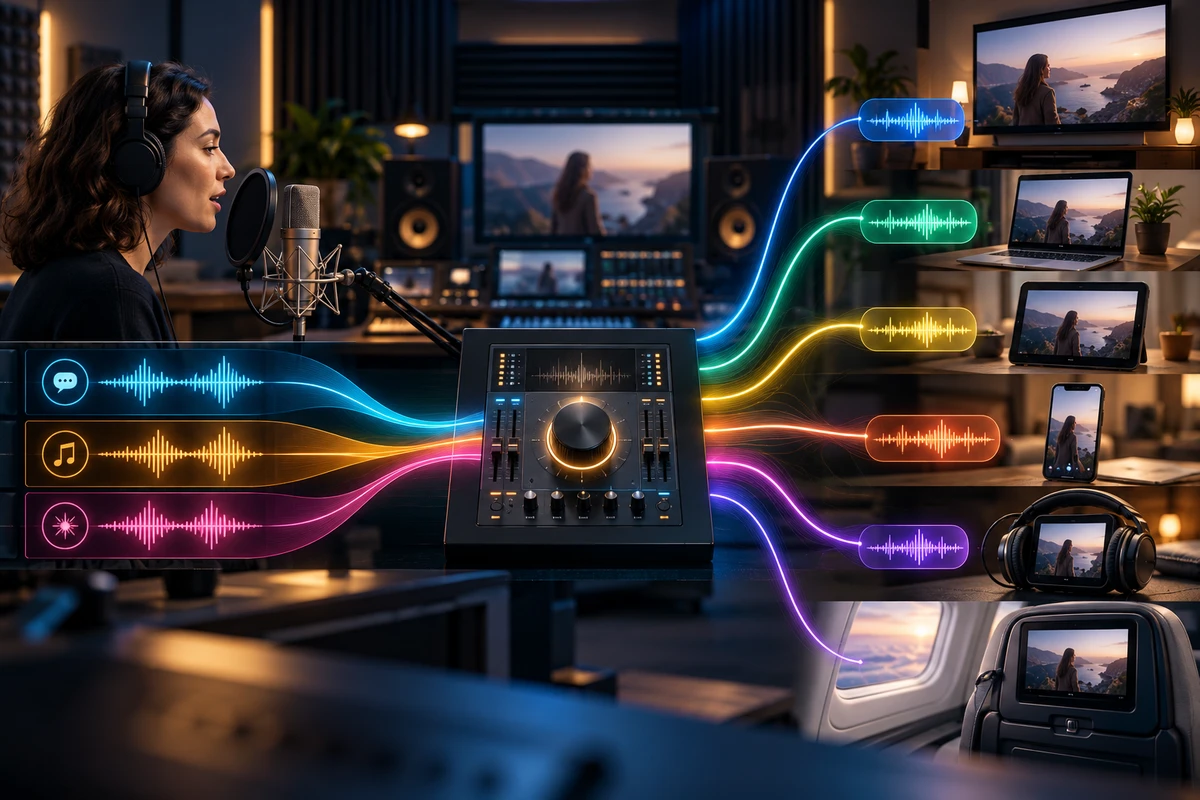
Automatic dubbing does not eliminate localization. It changes where localization happens.
For clean, explanatory and relatively low-risk video, language is becoming a configurable delivery layer rather than something permanently baked into the edit. That makes a new production unit possible: one localization-ready picture-and-audio master, governed language assets, and a documented escalation path. It does not mean every market should receive the same machine-generated voice. Regulated claims, prices, cultural humor, visible lip sync and trust-heavy performances still justify human review or a local reshoot.
The practical question is no longer “How many translated exports should we buy?” It is “What must the source production contain so each language can be generated, reviewed, replaced and traced safely?”
The platform shift is real, but narrower than the hype
TikTok’s Multilingual tool documentation, updated in September 2026, says Ads Manager can translate ad audio, add captions and serve the result according to a user’s device language. The scope matters. It is currently a Smart+ capability, unavailable to non-Smart+ campaigns, and its supported placements and objectives are defined rather than universal.
YouTube takes two routes. Its current automatic dubbing guidance says eligible uploads can receive generated translated audio tracks, with a manual-review publishing option. The same page identifies material failure conditions: speech can be too fast; accents, dialects and background noise can reduce accuracy; proper nouns, idioms and jargon can be mistranslated; and generated dubs cannot be edited directly.
YouTube also lets eligible creators upload their own language tracks to one video or Short. The player can default to the viewer’s preferred language, while the creator retains a human-produced replacement path. That distinction is important: one video object does not require one unchangeable audio track.
Meta supplied a third signal in its May 2026 article From Scroll to Chat to Cart, stating that generative-AI voiceover translation was becoming available to more advertisers and that translations for text in image overlays were being introduced.
These are verified product capabilities, not evidence that every language pair, advertiser or campaign has reached the same quality level. Their shared implication is more useful: if a brand hands the platform a flattened file with noisy dialogue, burned-in prices and undefined product terminology, the platform can only automate the ambiguity it receives.
The hidden cost lives inside the “final” file
A traditional master often locks dialogue, music, sound effects, captions, offer language and graphic text into one render. That is efficient for one language and one release. It becomes expensive as soon as another market needs to change only one layer.
The speech recognizer may hear a product name incorrectly because music masks a consonant. The translation model may treat a model number as a normal word. A long German or Spanish line may no longer fit the time budget of a compressed English sentence. A price or unit burned into the picture may disagree with the new audio. A claim that is acceptable in one country may require a qualifier in another.
Each error can look small in isolation. In a generated pipeline, the errors compound: recognition feeds translation; translation feeds timing; timing feeds voice synthesis; synthesis is mixed back under a picture that may still contain the source-market message.
Automatic dubbing therefore lowers the marginal rendering cost of some language versions. It does not remove the costs of factual approval, market responsibility or creative judgment.
The ONCE Localization-Ready Master Pack
For recurring international content, a production contract should describe a master that another system or language team can safely take over. The pack has six connected parts.
1. A dialogue-clean master and separated stems
Deliver the approved picture, the full mix, and separate dialogue, music and effects tracks. Clear dialogue improves the starting signal for platform processing. Separate stems also let a human dub replace speech without rebuilding the entire soundscape.
2. A timecoded semantic beat sheet
Record the speaker, source line, timing, non-negotiable meaning and any words that can be compressed. A transcript tells a localization team what was said. A semantic beat sheet tells them which promise, proof or transition must survive when the target language needs a different number of syllables.
3. A pronunciation, no-translate and controlled-term glossary
Specify brand names, product names, model numbers, people, materials and technical terms. Mark terms that must remain unchanged, require legal approval or have an approved local equivalent. This turns a known platform weakness—proper nouns and jargon—into an input that can be managed before publication.
4. A text-light picture master
Keep essential copy in replaceable layers and preserve caption-safe space. If a product label, unit, offer or CTA must appear inside the image, supply a clean plate and replacement graphics. A second language should not have to sit on top of the first.
5. A market-claim matrix
Map approved prices, units, product claims, disclaimers, calls to action and destinations by market. Voice can be generated at delivery time; accountability cannot be transferred to the generator.
6. A language-QA grid with stop conditions
For every language, review the opening, product names, core claim, numbers, units, disclosures and CTA. Define in advance when platform-native dubbing must stop: repeated name errors, distorted pacing, meaning lost in a legal line, distracting lip mismatch, or a native reviewer unable to approve the result. The next route is a revised human-reviewed track or a local performance, not repeated publication of the same defect.
Established entertainment-localization practice supports the upstream logic. The Entertainment Globalization Association workflow lists a picture reference, M&E, dialogue stems, full mix and dialogue scripts among core inputs, followed by adaptation, approvals, recording, mixing and QC. Netflix’s dubbing principles treat context, natural phrasing, authentic performance, lip sync and an immersive mix as creative quality—not as a file-conversion problem. A 30-second ad is not a feature film, but both workflows become more controllable when the source can be separated and reassembled deliberately.
Choose one of three routes by consequence, not novelty
Route 1: Platform-native dubbing
Use it for a demand test when speech is clean, the video is explanatory, on-screen text is limited and the commercial claim is low risk. A 30- to 60-second product walkthrough is a better candidate than a dense legal offer or a performance built on wordplay. The objective is to learn whether a language market merits deeper investment, not to declare localization finished because the toggle worked.
Route 2: Human-reviewed AI or studio dubbing
Use this when product detail, paid reuse, brand voice or moderate claims make mistakes consequential. A native reviewer should approve meaning, terminology, timing and performance before the language track is uploaded. YouTube’s multi-language audio workflow shows the operating model: keep one video object, but replace an unacceptable automatic result with a controlled track.
Route 3: Native-market performance
Reshoot or commission local talent when humor, emotion, spokesperson credibility, regulation, gesture or visible lip movement carries the message. At this point, the task is not to make the original sentence audible in another language. It is to make the performance true in another market. Preserving the source picture at all costs can shift savings from production into review cycles, awkward adaptations and reputation risk.
Price an approved market-language minute
Per-export pricing puts ten mechanical renders and ten approved local versions in the same denominator. A more useful procurement measure is:
Cost per approved market-language minute = (master separation + transcript and glossary + translation or dubbing + on-screen text treatment + market review + QA and rework + publishing configuration) ÷ market-language minutes actually published and accepted.
This is not an industry benchmark. It is a scope test. A platform-generated dub may have almost no generation fee, but two days spent correcting names, replacing old prices and rerouting approvals still belong in the localization cost.
Keep this model separate from activation-ready creative delivery. The localization-ready master answers whether a video can safely become another language. Activation-ready delivery answers whether the approved version can reach the correct account, market and ad object and return usable IDs and performance data. They should connect, but production, localization and media teams can own different parts.
A 30-day pilot is enough to expose the real bottleneck
Choose one 30- to 60-second product explainer and two target markets. Produce the six-part master pack. For each market, create one platform-native version and one human-reviewed track. Inspect the first ten seconds, every product name, the central claim, all numbers and the CTA. Log the layer where each defect began: recognition, translation, timing, pronunciation, mix, on-screen text or market compliance.
Do not judge the pilot only by views or conversion. Track approval rate, rework minutes per finished minute, the share of versions forced into a higher-cost route, and elapsed time from source master to publication. Most importantly, check whether an error can update the glossary, claim matrix or next master instead of living in a chat thread.
If platform-native versions remain stable in a low-risk market, keep that route as a demand-testing channel. If critical lines repeatedly fail, promote the language to a human-reviewed track. If the performance loses credibility even when the words are accurate, stop dubbing and commission a local creator or actor.
Platforms that generate language do not make production less important. They make the architecture of the master visible. The scalable asset is not a folder of permanently baked files; it is a source package in which language can change while meaning, ownership and approval remain under control.