Low-altitude aircraft are easy to make look futuristic and surprisingly hard to make credible. Rotors spinning up, a city skyline, digital flight paths and an expansive voice-over can create scale in seconds. The harder questions are more practical: What stage has the aircraft actually reached? Whose task does it solve? What does each shot genuinely demonstrate?
A stronger film does not treat every image as proof, nor does it turn the hero film into an engineering report. It gives brand promise, technical evidence and application context separate jobs. The future can remain visible, but it should rest on a product state that the team can substantiate.
Decide what kind of trust the film must earn
The same aircraft needs to earn different kinds of trust from investors, industry buyers, partners and the public. Before writing “advanced technology,” decide what the viewer should believe when the film ends.
Consider a hypothetical cargo eVTOL that is still in testing:
- A logistics partner needs to understand payload tasks, loading, ground coordination and route constraints.
- A technology audience needs to see structure, key systems, test methods and disciplined iteration.
- A public audience needs a clear use case, a human relationship to the aircraft and an honest distinction between current capability and future intent.
Those films may share product footage, but they should not share an identical story. A precise proposition tells the crew what to capture and gives reviewers a way to separate evidence from atmosphere.
Build the story on three tracks
An executable treatment can be organised as three parallel tracks.
The brand track: explain why this team
The brand track is not a wall of slogans. It is the selection rule for the entire film. If the proposition is “making urgent supplies more reachable,” product reveals, characters, environments and sound should reinforce timely arrival. If the proposition is “engineering discipline for low-altitude logistics,” the camera should spend more time on inspection, testing, operator feedback and system coordination.
The brand track determines emotion. It cannot replace evidence.
The evidence track: define what each image proves
Separate the existence of a product from the achievement of a capability. A complete-looking prototype can demonstrate physical form and design relationships. It does not automatically prove range, payload, certification status or permission to operate commercially. A simulation can explain a principle without proving that the corresponding test has been completed.
Create an evidence-state table before the shoot:
| Visual material | What it can support | What it does not prove by itself | Suggested treatment |
|---|---|---|---|
| Exterior prototype and static details | Product form, structural relationships, design language | Completed flight validation or commercial delivery | Identify it as a prototype or current version |
| Ground or bench testing | A named system tested under defined conditions | Whole-aircraft performance across all conditions | Preserve the test item, conditions and date |
| Controlled flight test | Observable behaviour in that test and phase | Approval to operate in every market | State the test context and filming conditions |
| 3D or AI extension | Structure, intended use and conceptual environments | Real flight, real orders or completed infrastructure | Make the demonstration or concept status clear |
Add two lines to every storyboard card: “What does this shot prove?” and “What must it not imply?” That is far more efficient than trying to rescue an overreaching voice-over in post-production.
The application track: show a complete task
An aircraft is not a silhouette floating over scenery. Begin with the constraints of the task: where the cargo is, how narrow the time window is, who hands it over, how ground staff verify status and what happens after arrival. Even when a full flight cannot be filmed, the real actions before and after it can still be shown.
For the hypothetical medical-supply mission, capture the packing checklist, cargo weighing, door locking, operator inspection, take-off-zone coordination and receiving confirmation. The viewer then understands the aircraft's place in a system rather than merely watching it pass over a valley.
A credible film does not require a complete flight sequence
The practical situation is often uneven: the prototype is available, the flight window is not; test data exists, but some parameters cannot be disclosed; infrastructure is being built; approval in a target market is still in progress. The risky shortcut is to use generated imagery to turn missing evidence into something that appears to have happened.
Four alternatives are more useful:
- Film physical relationships. Use people, cargo, doors, landing gear and interfaces to establish scale and move the design beyond a render.
- Film verification work. Capture inspection, assembly, ground testing and review. The aim is not laboratory mystique but a visible path to a conclusion.
- Film the operating workflow. Choose one executable portion of the process and complete the human, object and decision chain around it.
- Mark future imagery as future imagery. 3D or generative work can extend an unbuilt environment, season or city, but it should not masquerade as an undocumented test. ONCE's live-action and AIGC production can divide those responsibilities: live action protects product facts while non-functional environments expand the visual world.
If exterior geometry, rotor configuration, door design or operating steps may still change, version the 3D and generative assets as well. Otherwise, a film can become obsolete before launch.
A practical 45-second structure
The following cargo-eVTOL example is hypothetical. It is not an ONCE client case and makes no performance claim about a real aircraft.
0-6 seconds: introduce the task. At dawn, a medical-supply container is sealed while a ground operator reviews weather and mission status. The film establishes why the aircraft is needed before displaying it.
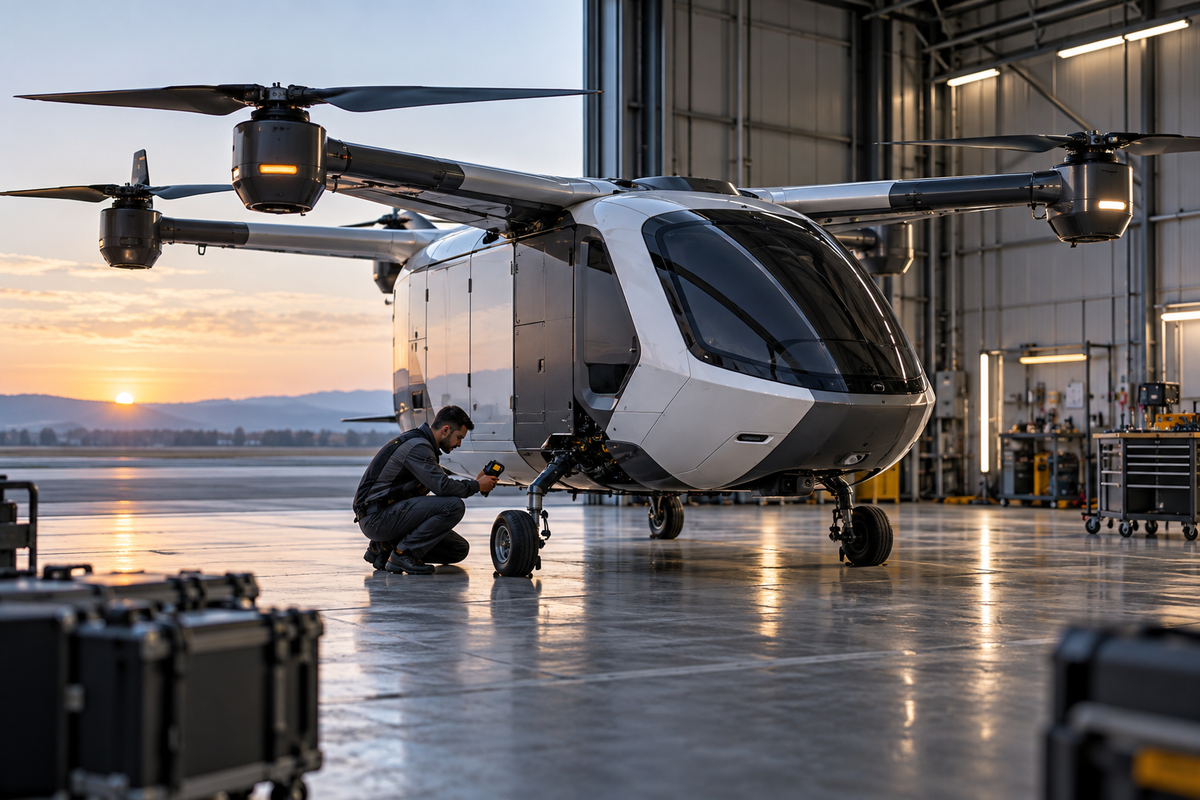
6-15 seconds: put the product in physical scale. An operator approaches the prototype and checks the door, cargo restraint and landing gear. Material detail, hand movement and mechanical sound connect the design language to an engineering state.
15-27 seconds: present evidence. Use authorised ground tests, controlled flight or system-validation material, and state only what the material supports. Hover-test footage should not be paired with claims about a complete service range.
27-38 seconds: close the application chain. Loading, dispatch, take-off-zone coordination and receiving actions form a coherent mission. If 3D connects the flight portion, the visual language or caption should make its demonstrative status clear.
38-45 seconds: return the brand promise to the current stage. The close can express ambition, but it should land on the next credible step, such as validating a particular mission with partners, rather than presenting the roadmap as a completed result.
Product detail, operator actions and controlled interiors can be captured at U-STUDIO in Shenzhen, then combined with authorised location footage, test archives and 3D environments. Set adaptation, equipment, sound conditions and availability remain project-specific.
Regulation is a creative input, not an end-card disclaimer
Rules vary by aircraft class, weight, purpose, airspace and jurisdiction. China's Interim Regulations on the Administration of Unmanned Aircraft Flights took effect on 1 January 2024 and cover classification, registration, airworthiness and flight activity. In April 2026, the Civil Aviation Administration of China also explained the scope and transition arrangements for a mandatory national standard covering registration and activation of civil unmanned aircraft. The current CAAC interpretation should be read in the context of the specific product and operation. In Europe, EASA maintains dedicated VTOL airworthiness material, reflecting the need to treat certification stages precisely.
None of those sources proves that a particular project has permission to fly. They do show why filming permission, compliance status and marketing language must be verified separately. When a film depicts real flight, urban operations, passengers or cargo missions, the responsible project owners should confirm conditions, authorisations and approved public wording. A creative team should never infer a certification conclusion from a test clip.
Stage-specific communication is also visible in public company reporting. For example, Vertical Aerospace's April 2026 SEC-filed announcement described tethered hover, thrustborne, wingborne and transition testing as distinct phases. That is a useful communication pattern, not independent proof of wider commercial readiness: name the phase that the footage supports.
Review more than spectacle
When the first cut is ready, ask brand, product, engineering and legal or compliance owners to answer five questions:
- After 15 seconds, can a viewer name the task the aircraft serves?
- Can every performance or progress statement be traced to a source, document or accountable owner?
- Are the prototype, test record, 3D demonstration and future concept easy to distinguish?
- Does the application scene show a workflow rather than only a beautiful location?
- Do voice-over, captions and images refer to the same product version and the same point in time?
The acceptance standard is not that every department appears once. It is that the viewer can move through one clear logic: from a brand promise, to credible evidence, to a specific application possibility.
Prepare a one-page evidence brief before production
Before production starts, assemble one page covering the audience and channel, the trust the film must earn, the current product version, completed tests that may be disclosed, restricted data, real actions available to film, future elements requiring demonstration, the target market and compliance owner, launch timing and budget range.
ONCE can then decide what belongs in the live-action list for product video production, what needs 3D or AIGC extension, and what should be removed or qualified at script stage. To turn an existing prototype, test archive and application goal into an executable brand film, submit those details through the project enquiry page. The more accurately the evidence state is defined, the more confidently the film can show the future.
Source review: checked in October 2026 against China's Interim Regulations on the Administration of Unmanned Aircraft Flights, the CAAC's April 2026 interpretation of the relevant mandatory national standard, and EASA's public VTOL airworthiness material. Project decisions should use the latest rules applicable to the aircraft, activity and jurisdiction.