An empty sofa can look beautifully sculpted on camera and still fail to answer the questions a buyer actually has. Where does the body settle? How generous does the seat depth feel? What happens to the upholstery under weight? How does the cushion recover when the person stands? A smiling actor saying “comfortable” does not answer those questions either. A stronger home product lifestyle video turns subjective language into observable actions and lets the viewer interpret what happens.
This article uses a hypothetical three-seat modular sofa to demonstrate the method. Its example dimensions—2.2 metres wide, a 45-centimetre seat height and a 60-centimetre seat depth—are creative planning assumptions. They are not a client product, an industry standard or a universal ergonomic recommendation.
The sofa may not look small; the film may lack a useful action reference
When a sofa looks undersized in an early edit, the first response is often to use a wider lens, reveal more of the room or move the talent farther away. That may make the set feel larger without making the product clearer. A wide lens can stretch foreground and background distance, while a high angle can flatten the seat. If the talent remains in the distance, viewers still cannot judge how body and furniture relate.
Start with three diagnostic questions:
- Is there a continuous action that places the person and product in one clear spatial relationship?
- Does that action reveal seat height, seat depth, arm position and material deformation at the same time?
- Does the edit retain the moment before contact, the load itself and the state afterwards?
If not, the project may not need a larger living-room set. It may need a small group of relationship shots. ONCE’s existing guide to spatial styling and true scale in home product videos covers the broader foundation. This article takes the narrower next step: making sitting feel legible through action.
Build the demonstration around four continuous actions
Assume the sofa’s intended message is “made for unwinding after work without looking shapeless.” That line cannot simply be filmed. It must be translated into behaviour. Shoot a four-action sequence with relatively stable direction, exposure and pacing before creating the separate brand hero shots.
1. Approach and pass: establish body-to-product scale first
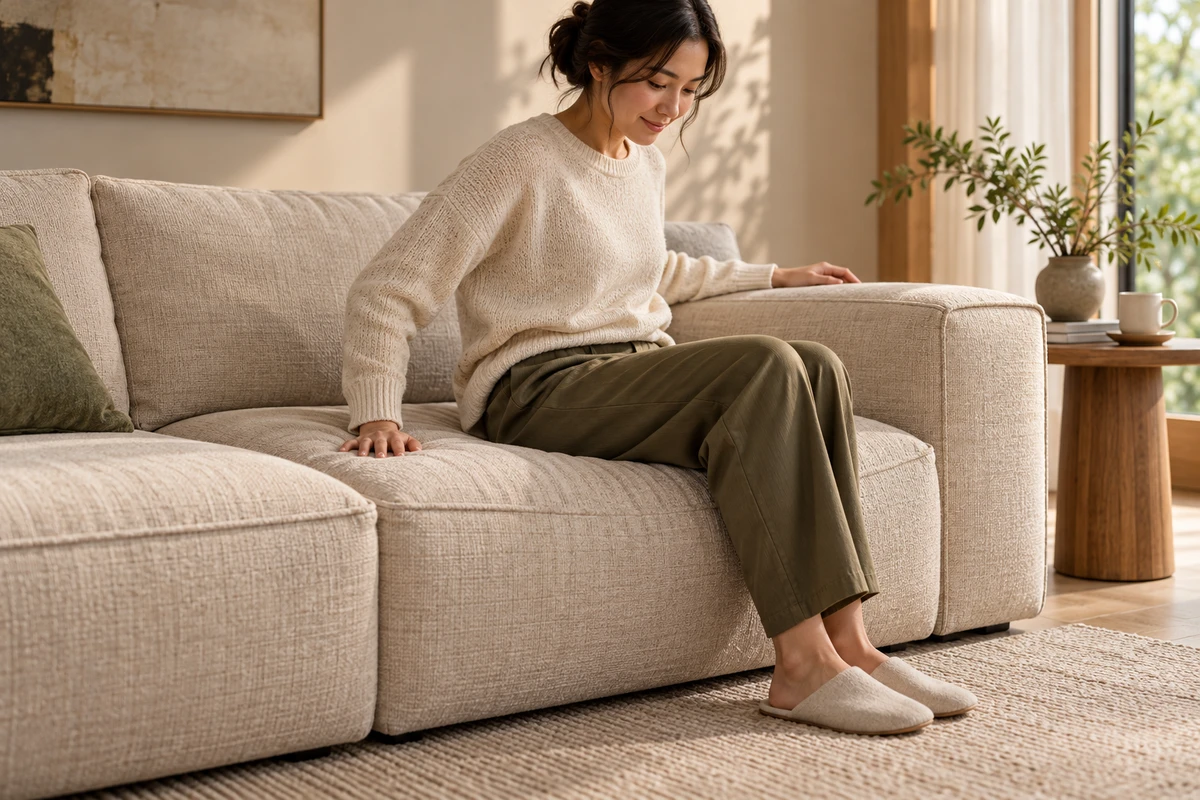
The person enters from the front side of the sofa rather than cutting straight to a seated pose. They pause beside the arm, place a book on a side table, turn and sit. This reveals the sofa’s height relative to the knees and hips, its relationship to the side table, and whether the route around it feels plausible.
The frame does not need to be extremely wide. A medium view near seated eye level often preserves furniture and body proportions more clearly. Keep feet, knees and the armrest visible because they are useful reference points. The shot can communicate relative scale; it cannot replace accurate product dimensions on the product page.
2. Sit and settle: keep the loading process intact
Do not cut from standing directly to a smile. Retain first contact with the seat, the gradual transfer of weight, cushion compression and the final settled position. A three-quarter view from the side is more likely to show seat depth, backrest and leg relationship together. A face close-up alone hides the product’s part in the action.
Performance needs restraint. Throwing the body backwards with an exaggerated sigh turns demonstration into advertising theatre; dropping too quickly can make the upholstery and structure appear unstable. Ask the talent to move at a genuine pace, then leave a short beat of natural breathing. A clean take of fabric friction and cushion movement can add tactility, but sound should not have to rescue missing visual information.
3. Lean and reach: use a task to explain depth and arm position
The third action should not be merely “remain seated.” The person leans back, reaches for a book and returns it to the same place. That small task reveals whether the body must pitch forward sharply, whether the armrest interferes with the movement, and how the upholstery changes as posture changes.
Set the prop distance during rehearsal. Do not place it somewhere unrealistic just to make the gesture look elegant. If the product genuinely has an adjustable headrest, movable cushions or modular connectors, record the real operation in full. If the sample does not have a feature, editing must not imply that it does.
4. Stand and recover: give material change an ending
Keep the camera rolling after the person stands so the cushion’s recovery remains visible. If the brand wants to communicate a tidy appearance, the product owner should first confirm the sample condition, styling method and wording approved for public use. Reverse playback, concealed jump cuts or inconsistent replacement components should not be used to manufacture a recovery result.
This shot can show the visible behaviour of one sample under one set of filming conditions. It does not automatically prove long-term durability, weight capacity or medically meaningful support. Those claims require the relevant tests, standards or approved documentation, not a performance.
Give texture and colour separate lighting jobs
Home brands often want one setup to deliver soft texture, accurate colour and a premium silhouette. The most effective light for each job may differ. Separating the tasks is usually more reliable.
The first setup is texture light. A relatively large source placed to graze the surface can reveal weave, nap direction or subtle leather variation. Keep exposure and white balance stable while a hand brushes the fabric, the cushion takes weight or a back cushion moves. Excessive contrast may reduce dark upholstery to an outline; light that is too flat can remove the tactile cues.
The second setup is colour reference light. Reduce the influence of decorative colour and stylised contrast, then record a neutral product view and material details for version confirmation and grading. It may not be the most emotional image, but it helps the brand confirm that viewers are seeing this upholstery rather than a different colour invented in post. Screens, compression and viewing conditions still vary, so video should not be treated as a physical swatch.
In a controlled set such as U-STUDIO in Shenzhen, the lifestyle action can be filmed in a living-room environment before the same product state is used for texture and colour coverage. Sets, equipment, sample condition and availability still need project-specific confirmation.
A practical action card for the shot list
| Action | What to approve in the review |
|---|---|
| Approach, place the book, turn | Person and sofa share one readable space; feet, knees, arm and side table create useful references; the room is not enlarged through an extreme wide angle |
| Sit and settle | Contact, compression and final position remain continuous; seat depth and legs are visible; performance stays restrained |
| Lean, reach and return | Prop distance is plausible; arm, back cushion and body relationship remain visible; editing does not invent a feature |
| Stand and wait for recovery | The sequence remains continuous; product and exposure stay consistent; no reverse playback or replacement component creates the result |
Record at least one uninterrupted evidence take for every action, then add tighter material details. The continuous takes may not all appear in the hero edit, but they remain useful for product pages, sales training, approvals and future cutdowns.
Approve the hero image and evidence shots separately
The brand hero image is judged by silhouette, atmosphere, performance and memorability. It may use more expressive light, quieter movement and compressed editing. Evidence shots are judged by complete actions, consistent product versions, visible material behaviour and whether the picture suggests more than the product facts allow.
Using one approval standard for both weakens each. The hero film begins to look like a manual, while the evidence edit becomes too fragmented in pursuit of polish. Define the job of both groups before the shoot, then decide which shots can genuinely serve both.
Use these questions in review:
- Without narration, can the viewer understand the relationship between body and seat?
- Do the before, loaded and after states show the same product in a consistent condition?
- Which words—soft, supportive, quick to recover—describe an observation, and which require test evidence?
- If the actor’s smile disappears, what product information remains?
- Has a beautiful hero image hidden a detail required by the product page?
When the person should not dominate the hero frame
Some sculptural furniture loses its defining outline when a person covers it. Some prototypes cannot withstand repeated loading. Some projects have not yet approved the target-market casting or lifestyle cues. In these cases, the person does not need to lead the hero film. Shoot the clean product visual first, then add hands, partial body references, dimensions or a separate demonstration.
Removing the full person does not give generated imagery permission to change the structure. If 3D or AI is used to extend a non-functional environment, the product silhouette, stitching, module count, material and load behaviour still require shot-by-shot approval. Once an image is expected to prove a feature or material response, real samples and real actions should take priority. ONCE’s ecommerce product video production service can scope hero visuals, demonstrations and channel versions as one connected production plan.
A useful home product lifestyle video does not have to declare that a sofa is comfortable for everyone. It needs to show what happens when a specific person approaches, sits, leans, reaches and stands. The buyer keeps the judgement; the film prepares the information needed to make it.
If you are planning a sofa or upholstered furniture film, send ONCE a project brief with the product version, drawings, material samples, approved performance language, target market and channels, sample condition, launch timing and budget range. We can separate the impression the hero visual needs to leave from the facts the demonstration needs to make visible before planning the set, actions and versions.