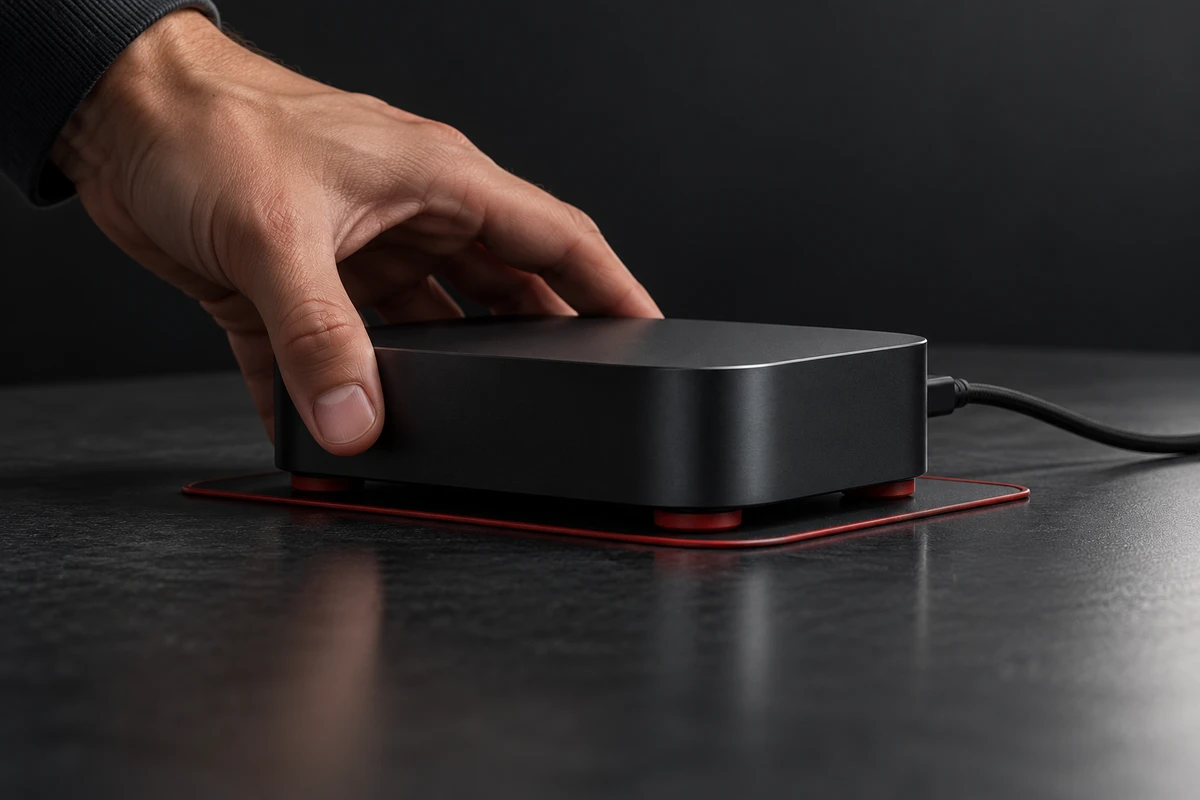
A product is placed on a table. The lighting, camera and finish all look clean, yet the object feels like a weightless model. The problem is often the contact itself: the base shows no change under load, the shadow does not tighten, the fingers do not decelerate, and the sound never lets the action truly land.
Weight in product ads does not come from making every movement more forceful or adding a low-frequency hit to each landing. It comes from several cues agreeing with one another: how the object approaches a surface, how speed is absorbed, how the contact surface responds, and how a person redistributes force. One clearly inconsistent cue can make even a polished image feel as if it is floating.
Weight begins before the moment of contact
Viewers first judge weight by watching motion end. When a heavier device is set down, the wrist usually slows early, the fingers continue to guide it, and the grip releases only after the base has made contact. A lighter object can stop faster and leave the hand more cleanly. If a performer handles products of different sizes and materials with the same speed, the movement contradicts what the objects are telling us.
There is no need to exaggerate this in slow motion. Preserve three complete stages: approach, load and release. The approach lets viewers anticipate weight; the loading moment transfers force to the surface; the release confirms stability. Our article on hesitation in product advertising performance considers the choice before an action. Here, the question is when the action becomes physically complete.
Contact shadows should describe pressure, not just outline
While an object is suspended, its shadow sits apart from the base. Once it lands, the shadow closest to the contact point becomes narrower, darker and more defined. The change may be small, but it is a strong cue that the product has settled. Removing every trace of shadow for a cleaner finish can make the object look as if it rests on an invisible stand.
Hard surfaces need a clear contact point
Glass, metal and painted tabletops do not visibly deform, so weight must be expressed through the contact shadow, the position of reflections and the end of motion. If the product has feet, let them touch and carry the load. Making the whole bottom edge meet the table at once may contradict the construction. Reflections must also stop with the object instead of sliding after it has settled.
Soft surfaces need controlled deformation
Fabric, sofas, mattresses and foam can show compression, but more deformation does not automatically create better weight. Excessive sinking implies either a heavier product or an unrealistically soft surface. Test the real product first, then decide whether a closer angle, side light or short pause is enough to make the response visible.
Sound confirms contact but should not invent weight
A single placement can contain at least three sounds: the first contact with the surface, a small response from the product structure, and a brief resonance from the table or room. A plastic shell, a metal body and a device with silicone feet should not share the same impact. When sound feels heavier than the visible action, the audience notices oversized sound design before it believes in a more substantial product.
Record both a close contact sound and a slightly more distant room response. The close layer identifies material; the distant layer places weight in the environment. A dry library impact can detach the action from the room, while reverberation alone makes the contact vague. Their balance should change with shot scale rather than being copied identically into every version.
Locked-off shots reveal physical relationships
With a still camera, the movement path, tabletop line and contact point are easy to compare. Viewers see where the object comes from, where it slows and where it finally stops. This is why locked-off product shots can make actions more credible: camera energy no longer disguises the movement, so the product must complete the change through its own state.
A moving camera can still express weight, but its movement should have a separate job. If the camera drops, shakes and racks focus while the product lands, it becomes hard to tell whether impact belongs to the object or to the camera. Let the camera finish approaching before the product lands, or let the product settle before the camera moves to inspect the result.
Hands reveal scale and centre of gravity
Finger placement should follow the real balance point
The easiest grip for the frame may not match the real centre of gravity. A long device held at one end without any downward rotation can feel hollow. If a product has a handle but the wrist carries no torque, the design feature loses meaning. Rehearse the pickup at normal speed first, then preserve the hand position that best explains balance instead of posing the hand for composition alone.
The release often reveals more than the pickup
During a pickup, the hand actively supplies force and can hide weight cues. After placement, the order in which fingers leave, a short wrist pause and a slight rebound show that the object has transferred its load to the surface. Keep a few extra frames at the tail of the movement instead of cutting on the first instant of contact.
Cables, lids and accessories must obey the same gravity
A main unit may settle while its cable remains in an impossible floating curve. A lid may open without any tendency to fall back. A detachable accessory may snap into place without decelerating. These small contradictions undermine the product as a whole. Showing cable reach, flexibility and storage requires real action references because accessories expose both scale and the gravitational environment.
Before production, divide the product into the main body, moving parts, flexible accessories and packaging. Confirm the balance point, travel, rebound and stopping position of each. They do not need to appear in one shot, but they should belong to the same physical world throughout the film.
CG and AIGC often fail in the aftermath of contact
Generated images can create elegant floating, rotation and landing. The reveal often comes afterwards: the shadow does not change with pressure, a soft surface does not compress, an accessory continues moving at the wrong rhythm after the product stops, or fingers pass through an edge. The issue is larger than a visual artefact. The action has left no credible result.
In a hybrid production, CG or AIGC can handle difficult spaces, transitions and large-scale movement while live action preserves hand loading, real contact, structural closure and material response. Another option is to shoot physical action reference first and make generated shots follow its speed curve and stopping point. If a feature depends on real closure or attachment, show the crucial contact clearly instead of replacing it with particles and an impact sound.
Review weight in three passes
- Watch without sound. Check approach, deceleration, contact and release, and whether the grip follows the centre of gravity.
- Cover the upper half of the product. Judge only the base, shadow and surface response. Does the object actually sit in the space?
- Look away and listen. Check whether contact material, room distance and action strength agree, without a low-frequency effect exaggerating the object.
You can also remove one contact shot temporarily. If the film merely loses a pretty image, the shot may not carry information. If the product suddenly loses its scale, weight or use state, contact has become part of the story. Like using a small mistake to explain recovery, credibility comes from visible consequences rather than uninterrupted perfection.
Weight is the effect a product has on its surroundings
A product feels substantial because the table, cushion, hand, accessories, shadow and soundtrack all respond to it logically. A lightweight product can still have clear weight. The essential test is whether movement and consequence agree.
If you are planning a product commercial, a studio hero film or a hybrid live-action and generated product video, ONCE product video production can place the centre of gravity, contact surfaces, action tails and sound responses into storyboards and camera tests early, so the final texture grows from physical relationships rather than a last-minute attempt to make everything feel heavier.