On set, one of the easiest ways to reassure a team is to say, “That camera move is smooth.” The camera slides from the side of the product to the front, a hand enters on cue, and the lighting changes during the move. Yet in the review room, when the team pauses on the seconds in which the product actually works, a simpler question often appears: the frame contains plenty of movement, but did the audience clearly see what changed?
This is where a locked-off product shot earns its place. When the camera stays still, the frame becomes a stable measuring tool. Changes in the product, hand, props, and space are no longer offset by a moving viewpoint. The action, result, and product cause become easier to judge. A locked shot is not “doing less.” It gives the responsibility for change back to the objects inside the frame.
A stable frame creates a basis for comparison
To believe a change, viewers need to understand the state before it. A locked shot can preserve the table texture, product position, human distance, and background relationship. When one element changes, the elements that remain still become references.
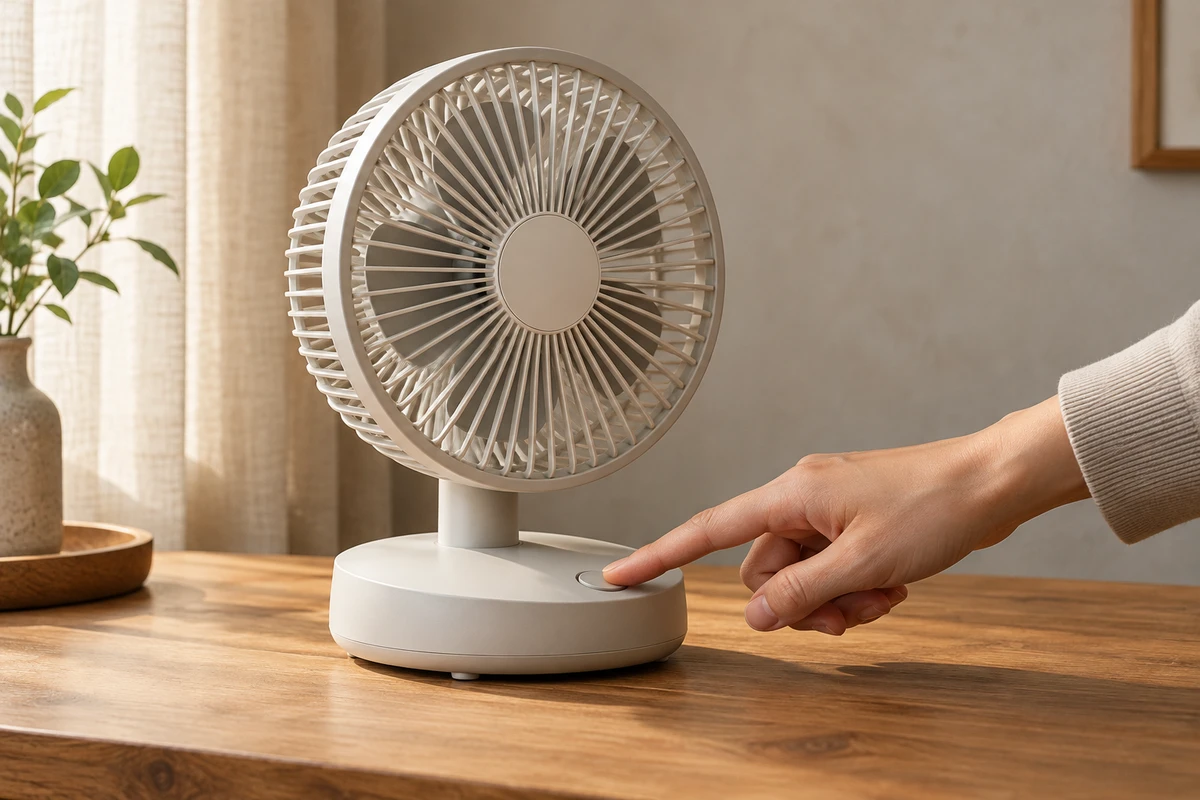
Imagine an unbranded air-circulation device on a table near a window. Before it starts, a light paper ribbon hangs naturally. After a person presses a physical control, the ribbon begins to move. If the camera stays locked, the viewer can compare the ribbon, product, and table. If the shot also pushes forward, changes focal length, and brightens the light, the result may feel stronger but its cause becomes harder to isolate.
This does not prove product performance or replace proper testing. It only makes the visual cause easier to read: establish one state, show one physical action, and reveal one visible result. A fictional advertising scene should still avoid suggesting unsupported airflow, speed, or efficacy.
When the frame stays still, action needs clear zones
A locked camera cannot chase the performer and repair the composition. The entry point, operation area, and result location must be assigned before the take. A useful approach is to divide the image into three action zones instead of designing only one polished hero frame.
Entry zone: give the action a source
A hand or person does not need to appear suddenly beside the product. Let it enter from the edge, travel along a readable path, and then make contact. The viewer understands who begins the action and gains a sense of body scale. If the hand is already resting on the button when the take starts, we see the press but not the approach or choice.
Operation zone: keep the product structure readable
The operation zone must hold the hand, the important structure, and the product silhouette. If the wrist blocks the control, a locked camera cannot move around it. If the product drifts to the edge, recognition may disappear at the moment the function completes. During rehearsal, mute the sound and ask whether the movement still explains where contact happens, how the operation works, and when it is finished.
Result zone: do not let the change happen offscreen
The product result may appear away from the body of the product. Air moves a ribbon. A lamp creates a new pool of light. A storage mechanism clears a group of loose objects. A sound makes another person turn. The composition needs room for the result before filming begins. If the frame only serves a product close-up, the cause may remain visible while the consequence is pushed away.
Show both the start and the finish in the same take
Product advertising often trims actions too tightly: filming begins after the hand has already gripped the product and cuts away as soon as feedback appears. These fragments work in a fast montage, but they are weak as independent explanations. A locked shot benefits from a small amount of time before and after the key action.
The lead-in establishes the original position, inactive state, and human intention. The hold after the action lets the result remain long enough to confirm. An opening or closing mechanism needs three states: before, during, and after. A placement action should show contact with the surface, the hand releasing, and the product settling.
A separate moving shot can still express weight, portability, or distance. The locked frame serves as the baseline that answers what physically happened.
A still camera does not require a still performance
A locked camera should not turn the actor into a display stand beside the product. In fact, when the camera does not follow, changes in body distance become more visible. Approaching, pausing, reaching, and stepping back continuously redistribute the relationship between person and product.
Let the performer observe from the midground, enter the operation zone, and then respond after the product gives feedback. The response does not need an instant smile. A shift in gaze, breathing, or posture can come first. See how product ad reaction shots move from attention to judgment. A locked shot can preserve this entire order without cutting every response into a separate close-up.
Distance also organizes multiple people. One person operates while another remains in the background. When the result appears, the second person steps forward. The camera has not moved, but the relationship has. Entry and exit should each add information.
Locked shots make differences inside repeated actions easier to see
When the same composition appears twice, viewers naturally compare it. The first action may be hesitant and the second confident. The first surface may be cluttered and the second clear. The first use may be private and the second shared. Because the frame remains stable, the differences become legible.
Repetition does not mean cloning the take. Direction, pause point, and product destination can stay consistent while the person, time, or use context changes. The fixed composition becomes a memory reference instead of a production-line template. For a related approach, see how repeated product gestures build brand memory.
Sound can expand the frame but cannot invent the result
A locked shot shows only what sits inside its boundary. Sound can keep the world beyond it alive. Footsteps may arrive before the person enters. A product sound may make someone in the background turn. When a device stops, room tone can become noticeable again. Sound gives a static composition depth and sequence.
It should not fabricate performance that the picture does not support. An exaggerated low-frequency impact, oversized mechanical hit, or unrelated startup sound can turn an ordinary action into a different capability. Begin with real contact, structure, and environmental response, then decide whether music adds anything.
Edit locked shots without breaking the state change
A locked shot does not require a single take. It can work with close-ups, reaction shots, and camera movement, but the edit must respect product state. If one shot ends while a product is still opening and the next begins after use, viewers need enough information to understand what happened between them. If the mechanism is itself the selling point, the crucial step cannot hide inside the cut.
Check geometry across multiple locked views. If the product sits on the right in one shot and suddenly appears on the left in the next, the direction shift may look like product movement. Repeated entrances from the same side create a clear spatial rule. The edit can change scale without accidentally changing the direction of the action or the location of the result.
During review, compare a version with the baseline shot against one built only from moving shots and close-ups. If viewers cannot describe the product state change after the baseline is removed, the other images may provide atmosphere without providing a complete cause.
Horizontal and vertical frames need different locked boundaries
Once a locked shot is set, the edges become hard limits for the action. A horizontal frame can hold the product, performer, and result zone together. A vertical crop can remove the side entry path. Automatic reframing may keep the product centered while deleting where the hand came from or why another person reacted.
Draw the entry, operation, and result zones separately for horizontal and vertical versions. In vertical, a hand may enter from below and the result may develop upward. Horizontal can preserve lateral movement and relationships between people. The location can stay the same, but camera height, product position, and performer start point should be confirmed for each format.
Know when the camera should move again
Locked shots are useful for comparison, waiting, and visible physical action. They are not right for every task. If a rear structure must be revealed, a person crosses several spaces, or the product value depends on travel distance and speed, a camera move may add necessary information.
The choice is not between “locked equals truthful” and “movement equals premium.” Ask who carries the main change. When the product and performer already provide a clear event, the camera can become an observer. When only a new viewpoint can reveal the next piece of information, the camera should join the action.
If you are planning a product ad, functional demonstration, or lifestyle video, ONCE VISUAL can help move from sample testing and action rehearsal to locked baseline shots, camera movement, and multi-format versions. Explore our product and brand film production approach, then send a project brief with the sample, core action, and required formats.