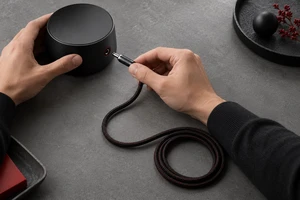
A product ad can show someone getting something wrong. The mistake, however, needs to be small, recoverable, and useful. The point should not be, “How could this person fail at something so simple?” It should be: how does the product reveal the problem, how does the person understand it, and what brings the action back to the correct state?
A flawless demonstration explains the ideal path. A carefully designed mistake can explain what happens when real use drifts from that path. The ad must not invent a safety system, automatic correction, or level of tolerance the product does not have. It also cannot show the error and then remove the recovery from the edit.
A mistake earns its place when recovery adds information
Imagine a fictional modular desktop organizer. A person lowers a removable tray into the wrong groove, leaving one edge slightly raised above the frame. They pause, notice the orientation of the slots, lift the tray, rotate it, and lower it again. This time the edge sits flush. The scene is a production example, not a real product claim or performance test.
If the ad shows only the second attempt, viewers learn that the tray can be installed. If it keeps the first small mistake, they can also read the groove, direction, finished state, and basis for correction. The mistake itself contributes little. The recovery reveals the product relationship.
A useful script question is: if we remove the mistake, what product knowledge disappears? If the answer is merely “a little drama,” the mistake is unnecessary. If viewers would lose the feedback, direction, or definition of completion, it may carry real information.
Separate recoverable mistakes from dangerous and ambiguous ones
Not every error belongs in advertising. Before filming, classify what the scene is asking a performer to do.
Recoverable mistakes have a visible state and a low cost
A piece that is slightly misaligned, an accessory placed in the wrong slot, or a folding structure that has not fully opened can often be corrected immediately without damage or risk. The camera can show both the incorrect and correct states, making the difference readable.
Dangerous mistakes should not become dramatic material
Errors involving heat, blades, power, load bearing, infants, medication, or protective equipment can cause real harm. They may also be remembered after the corrective context disappears in a short edit or silent viewing. These actions should follow the actual instructions, warnings, and operating conditions. Risk is not a pacing device.
Ambiguous mistakes leave the wrong question behind
A performer frowns, the product does not work, and the next shot suddenly shows success. Viewers cannot tell whether the cause was a product fault, user action, connectivity issue, or missing edit. If the source of the problem cannot be understood accurately on screen, uncertainty attaches itself to the brand.
Write recovery as five connected beats
A clear correction usually contains five beats: the person has an intention; they complete an incorrect action; the product or physical state provides feedback; the person pauses and judges; they correct the action and confirm the result.
These beats do not require five shots. One medium view may hold the whole sequence: the hand lowers the tray, the edge lifts, the hand releases for half a second, the person looks toward the slot, and then lifts, turns, and lowers the tray until it sits flush. The pause is brief, but it gives discovery a place inside the action.
If the performer looks confused before the mistake occurs, the performance reveals the setup. If the correction immediately touches the mistake with no observation time, the edit appears to think on the person’s behalf. Our article on reaction shots in product ads distinguishes attention, judgment, and expression. Recovery needs the same order: notice first, then respond.
Feedback should point toward the next action
Feedback does not need to come from a screen or alert tone. A shape that does not align, an exposed slot, a part that cannot settle naturally, or a marker that stops in the wrong position can explain the current state. Useful feedback does more than announce failure. It gives a clue about what should change.
The production must not add feedback that the real product lacks. A crisp click added in post can imply a positive lock. A changing indicator can suggest a visual warning system. A performer who instantly discovers a concealed mechanism can make a difficult step look effortless. Sound, art direction, and animation may clarify a real relationship, but they cannot invent a feature.
Before filming, run both the mistaken path and the recovery with the actual sample. Confirm that the wrong state is visible and the correction can happen within a believable amount of time. This is shot rehearsal, not user research, and it does not prove that everyone will find the product intuitive.
Protect the user’s dignity
The most damaging choice is often not showing a product problem, but turning the person into the joke. Exaggerated confusion, repeating the same mistake, or inviting another character to laugh can position the product as something only a clever person can use.
A stronger performance keeps the person purposeful. They notice a mismatch, inspect it, adjust, and continue the original task. They do not need to celebrate success toward the camera. The product value appears in the readable relationship; the human value appears in the ability to judge and act.
A mistake can be funny, but the humor should come from timing or circumstance rather than humiliation. Our guide to product ad humor argues that the product must sit inside the causal structure. A recovery scene adds another requirement: the joke cannot hide the correct operation or make the wrong version more memorable than the repair.
Keep the wrong state, clue, and recovery visually connected
Recovery scenes become confusing when they are cut into unrelated fragments. The error happens in a hand close-up, judgment moves to a facial close-up, and recovery appears from a new angle. Each image may look polished, but viewers cannot confirm that the same state was corrected.
Start with a stable baseline view that preserves the product position and human action, then add only the close-up needed to clarify the structure. Our article on locked-off product shots explains why a stable frame supports comparison. That value matters here: the raised edge before correction and the flush edge afterward should be visible from compatible viewpoints.
Framing cannot simply chase the hand. If the mistake involves overall orientation, an extreme close-up removes front, back, top, and bottom. If the clue is a small groove, a wide shot may conceal it. Decide what viewers must compare, then choose the baseline and insert shots around that comparison.
Short versions must not keep only the error or the sudden success
Six- and fifteen-second cuts can easily break a recovery structure. Remove judgment and correction, and the ad becomes a product failure. Keep only the correct attempt, and the scene loses the reason it was designed.
A short cut still needs three nodes: an incorrect state that is immediately legible; feedback or observation that changes the action; and confirmation of the correct state. The entrance, second character, and explanatory dialogue can disappear, but the causal middle cannot.
Horizontal and vertical versions also need separate checks. A horizontal frame may hold the person, product, and raised edge together. An automatic vertical crop may leave only a hand moving an object back and forth. If vertical cannot preserve the comparison, change the product orientation and hand path during production.
Show the mistake once, then let correct use become the conclusion
Repeating the same error three times can turn difficulty into a product attribute. Unless the content is specifically about training, troubleshooting, or repair, most ads need only one clear mistake, one credible recovery, and one smooth continuation.
After recovery, the person should complete the original goal. Once the tray is aligned, objects move into place. Once a stand is adjusted, use begins. Once an accessory is reseated, the next action follows. The correct state is not merely a signal; it allows life or work to continue.
If proper use requires lengthy instructions, professional installation, or strict safety conditions, a light recovery scene should not simplify those requirements. A tutorial, training film, or service explanation may be more honest. Advertising can compress time, but it cannot remove the conditions that determine safety and result.
Product value appears at the moment the action can restart
Product advertising does not need to show everyone succeeding on the first try. One small, reversible mistake can bring product feedback, structural logic, and human judgment into the same scene. The point is not failure. It is why the issue becomes visible, how recovery works, and what can continue afterward.
If you are planning a product demonstration, lifestyle ad, or launch film, ONCE VISUAL can help rehearse the real sample, design the error and recovery, direct the performance, and preserve the sequence across horizontal and vertical edits. Explore our product and brand video production approach, then share the sample, instructions, and intended use scene in your project brief.