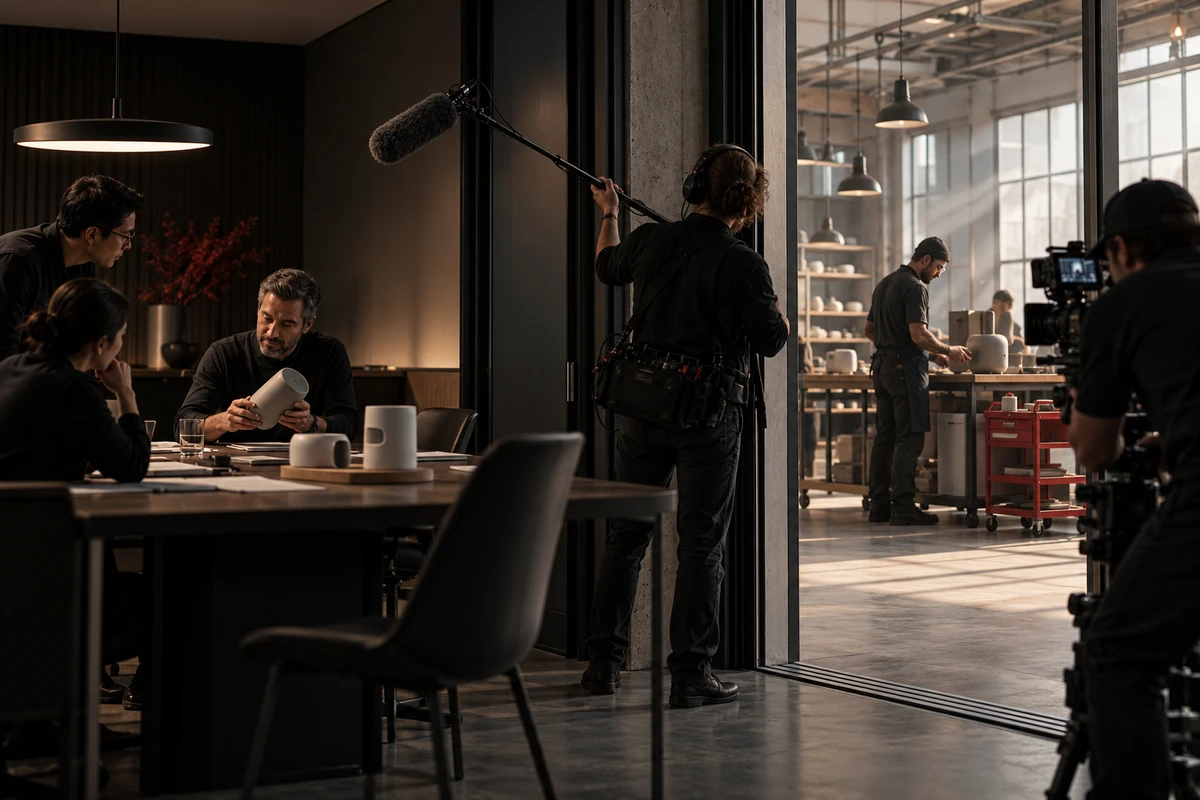
The most common note on a rough cut is that a transition feels abrupt. The quick response is often to add music or a whoosh. The cut may feel smoother, yet the two scenes still have no relationship. A useful sound transition in a brand film does more than cover an edit. It helps the audience understand why the next space appears and what effect the previous action leaves behind.
J-cuts and L-cuts are two basic ways to build that relationship. A J-cut introduces sound from the next scene before its image arrives. An L-cut lets sound from the previous scene continue after the picture has moved on. Both separate seeing from hearing, but the point is not technique for its own sake. The offset reorganises expectation, causality and emotional after-effects.
Begin with the question the transition must answer
Before sound crosses an edit, define its job. Does an early sound tell us that the next destination is approaching, or does it create pressure from a result we cannot yet see? Does a lingering sound preserve a character's judgment, the result of a product action, or the sense that two locations belong to one process?
Without a specific answer, a sound bridge becomes generic atmosphere. Rain, machinery or city noise may be present, but the same track could sit under another film. A brand film needs a concrete relationship: how a meeting-room decision reaches the production floor, how an action at home changes the following morning, or how a product feedback sound affects what a character does next.
J-cuts let the ear reach the next scene first
A J-cut creates expectation. While the image remains in the current scene, sound from the next one begins. The audience instinctively searches for its source, giving the visual transition a direction.
Use ambience to establish a destination
Imagine a designer approving a drawing in an office before the film moves to a factory trial. A distant machine rhythm can enter before the picture changes. It is not simply an “industrial” effect. It tells us that a decision on paper is entering production. When the film cuts to the equipment and crew, the factory feels like the result of the previous scene rather than a disconnected beauty shot.
Use product sound to establish a problem
Sound from the next scene can also pose a question. A faint irregular vibration, alert or incomplete latch can appear while a character is still arranging tools. Before the product is shown in close-up, the audience already knows that something needs attention. The demonstration enters with a task instead of beginning without context.
The sound must still come from a visible, intelligible product state. Exaggerating it beyond the real action turns anticipation into misrepresentation. Giving every product moment the same emphatic cue also removes its ability to distinguish one event from another.
L-cuts preserve an effect after the image leaves
An L-cut is well suited to after-effects. The picture enters a new scene while the previous sound remains briefly, placing both moments in the same causal chain.
Carry the consequence of a line
In a corporate brand film, the line “stop and check it first” does not need to end on the speaker's face. The picture can cut to another team measuring the product again while the end of the line, the room reflection or a breath continues for half a beat. Organisational judgment becomes an action that changes someone else's behaviour. The longer the sound remains, the stronger the sense of influence, but if it outlives the visual relationship it will feel attached to the wrong scene.
Carry the result of a product action
A lid closing, a machine stopping or a lock engaging can continue to decay after the picture cuts to a reaction or a later use case. The audience carries the result forward. Our earlier article on silence and low-level sound in brand films examines how reduced sound redistributes attention. Here, the concern is how the tail of a sound crosses an edit and hands its weight to the next shot.
Product sound, ambience and dialogue should do different work
Each type of sound has a different narrative strength. Ambience establishes space and tells us where we are going. Product sound establishes physical cause and tells us what happened. Dialogue carries a person's judgment and tells us why the previous scene still matters. Music shapes the broader sense of time, but it should not flatten these three specific relationships.
One film may use ambience for its first transition, a product sound for the second and the residue of dialogue for the third. The story task creates variation. If every scene is forced onto the same musical beat, the edit may flow while different spaces, actions and decisions collapse into one mood.
Prepare sound transitions on set, not only in post
A convincing J-cut or L-cut depends on material captured during production. For every important location, record stable room tone, the complete tail before and after an action, and a natural ending before anyone calls cut. The reflection after a door closes, the residual vibration after a machine stops and the breath after a line may become the most useful part of a sound bridge.
Add one sound note beside each key storyboard frame: where the sound originates, when it enters early and when it finally leaves. This can work with the visual approach discussed in using doorways and thresholds to structure a scene change. The image tells us what boundary a character crosses; sound decides whether the next space approaches before the door opens or whether the previous space still exerts influence after it closes.
Four failures turn a sound bridge into decoration
- The sound has no source. It arrives early but has no relationship to the space, object or person we subsequently see, so it reads as a stock effect.
- The overlap lasts too long. The visual relationship has changed, but the sound bridge refuses to end and makes the space confusing.
- Music covers the specific sound. Ambience and product feedback become ornamental, removing the causal relationship the transition was meant to carry.
- Every transition uses the same device. A recurring door, footstep or alert quickly changes from brand language into a formula.
During review, mute the music and listen only to dialogue, ambience and action sounds. If the connection between scenes remains clear, the bridge is doing narrative work. If the relationship disappears immediately, the music may be hiding an edit that has not yet made its point.
Silent viewing still needs a minimum visible cause
A sound transition can deepen a relationship, but it should not be the only way to understand the story. With the sound off, the character's attention, the beginning and result of a product action, and the change of space should still be visible. Composition, continuing action or a short caption can preserve the minimum information; the soundtrack can then add expectation and aftermath.
A short-form series may develop a sound bridge into a memory cue, but it should not simply repeat one file. Our piece on building continuity across episodic brand videos looks at relationships between episodes. Within one film, J-cuts and L-cuts behave more like conjunctions between sentences: each use must explain why this moment leads to the next.
A good sound transition turns an edit into a relationship
A J-cut lets the next scene create invitation or pressure before it is visible. An L-cut lets a previous decision or action continue to have consequences. The useful measure is not the number of frames by which sound leads or lags. It is whether the audience more clearly feels that two scenes belong to the same event.
If you are developing a brand film that moves across people, spaces and product actions, bring the script, storyboard and key sound moments into the same early conversation. ONCE brand film and TVC production can prepare ambience, product sound and action tails during production so that sound transitions carry real cause in the edit instead of relying on a last-minute music patch.