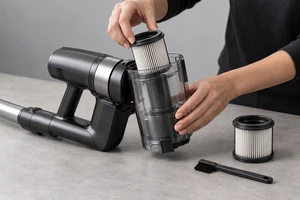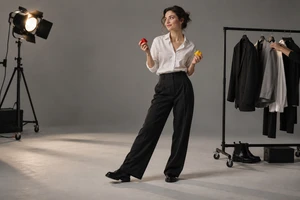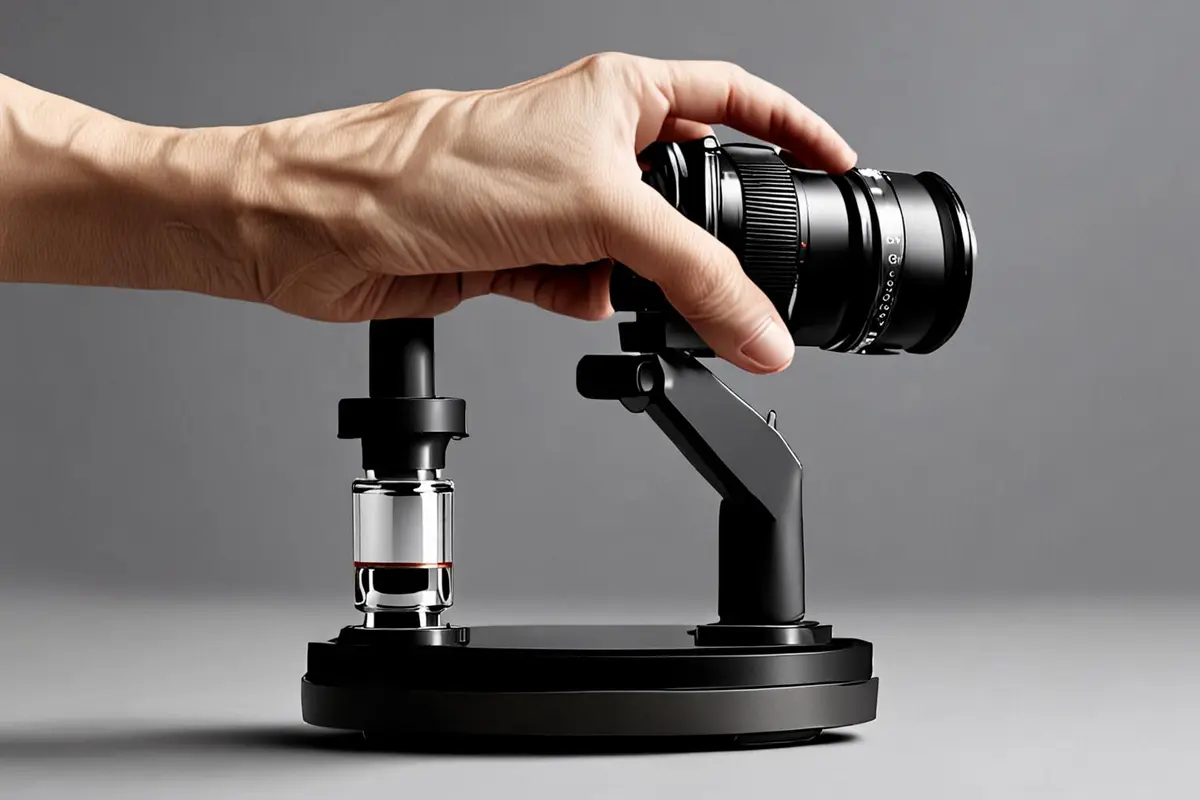
A wireless earbud film opens with the charging case sharp in the foreground. A thumb lifts the lid and a small status light appears. Focus then travels across the table to a person in the background. She says nothing; she simply looks up as a voice arrives in her ears. The focus pull has done more than make the shot feel cinematic. It has transferred the right to explain the scene from what the product does to what that action means for a person.
The common mistake in product video production is to treat shallow depth of field as quality and a rack focus as decoration. A useful focus pull answers a specific question: why should the viewer stop reading A and begin reading B at this moment? If the only answer is that the frame needs movement, a cut, camera move or compositional change will often communicate more clearly. Focus movement earns its place when action, consequence and judgment need to remain connected within one continuous piece of time.
A focus pull transfers meaning
Depth of field describes the range that appears acceptably sharp. A focus pull describes how that range moves over time. They are related, but they are not the same. A static shallow-focus shot can isolate a product without creating any narrative transfer. A pull establishes a reading order: what the viewer sees first, when a second layer becomes available, and which subject remains in memory at the end.
This is why a rack focus should not be improvised only after the camera is built. It belongs to the storyboard, performance, product action, lighting and edit rhythm. Arrive half a second late and the viewer may miss the product response. Move too slowly and the action loses its causal link to the result. Move too quickly and the technique registers while the meaning does not.
Write causality into the focus route
“Foreground to background” is a physical description, not a creative reason. Product films become easier to plan when the route is described as a relationship between pieces of information.
Product to result: give a feature a consequence
Begin on a button, valve, display edge or material change, then move to the visible result of that action. A purifier starts and focus travels from its control surface to a light object moved by the airflow. A kitchen appliance completes a step and focus leaves the operating area for the changed texture of the food. The second mark is not attractive background; it is evidence of consequence.
This structure suits benefits that a beauty shot cannot explain alone. The product action, the focus move and the result need a tight temporal relationship. If the result appears too early, the lens merely chases it. If it appears too late, viewers may assume the shot has already said everything it has to say.
Person to product: turn a need into a choice
The shot can begin with a person sharp enough for a glance, gesture or hesitation to establish a need, then give focus to the product. Eye line matters. When the person has already indicated the destination, the optical move feels motivated. When their attention points elsewhere, the camera appears to be making up its mind for the viewer.
This structure sits close to the role of a reaction shot in product advertising, but the jobs are different. Reaction shots use behavior to interpret an experience. A focus pull uses continuity inside one shot to bind the need to the product response.
Within the product: turn structure into operating order
For products with layers or sequential controls, focus can move within the object: port to connection, dial marking to outlet, condensation to a sealing edge. No performer is required; the viewing order becomes the operating order.
The distances can be small. Close and macro work makes the sharp zone narrow, so tiny camera movement, sample tolerance or variation in a hand position becomes visible. Our guide to macro product advertising and perceived scale explains how to keep small objects believable. A moving-focus shot adds the further problem of carrying that believable scale across time.
Start, finish, speed and hold determine legibility
Every focus pull has at least four narrative parameters. The start must be clear enough to establish the current subject. The finish needs sufficient shape, contrast or performance to catch attention. Speed determines whether two facts feel causally linked or slowly discovered. The final hold determines whether the destination can actually be read.
On set, it helps to give both ends repeatable marks and write the action in executable beats. “Begin when the lid reaches its stop; arrive as the performer finishes inhaling; hold for twelve frames” is more useful than “slowly pull to the face.” Playback should also be judged at normal viewing speed. A technically accurate move may still fail if neither endpoint receives enough time.
Speed does not have to be uniform. A quick departure followed by a slower arrival can feel like attention being caught and then settled. A constant move feels neutral. A deliberately delayed arrival can create anticipation. The curve should belong to the action rather than applying the same musical gesture to every product.
Aperture and distance determine whether there is room to pull
Canon’s official depth of field guide explains that a wider aperture produces shallower depth of field, while a smaller aperture expands it. Focal length, focus distance and format also affect the result. In commercial work, the goal is not maximum blur. The goal is a change in sharpness that viewers can perceive and the crew can repeat.
When depth of field is too shallow, the brand face, functional detail and important material may not hold together, and a small lean can take the performer out of range. When it is too deep, moving from product to person creates almost no visible transfer. The solution can include changing aperture, subject distance, camera angle, focal length or the exact landing point.
Camera height also changes the relative authority of both subjects. A high view can clarify product layout, eye level can connect person and object, and a lower camera can add product presence. Plan that choice with the principles in our product video camera-height guide, rather than inventing a focus pull after the position has been locked.
Focus breathing can make a product appear to change size
Some lenses change angle of view or magnification as focus changes, an effect commonly called focus breathing. Canon’s Cinema Lens World describes the change of viewing angle during focusing. In a 2026 interview about Aatma optical design, ZEISS also discusses the behavior of focus transitions as part of how a lens supports storytelling.
Minor breathing may pass unnoticed in a character scene. In a product film it can make a bottle, watch face or package edge seem to expand or contract, weakening confidence in its geometry. Test the entire planned focus range and watch the silhouette, background lines and negative space. The practical answer may be a different lens, a shorter focus span, more crop allowance, or a small camera move that turns the size change into an intentional reframing.
The test needs to include every delivery ratio. Breathing that is harmless in a wide frame can push a face against the edge of a vertical crop. A generous hold in a hero film may be impossible in a six-second cutdown. A safe composition does not require putting everything in the center; it requires enough area and contrast for the landing mark to survive each version.
Performance, hands and focus share one beat
A pull is not an isolated job for the focus puller. Eye line, the entrance of a hand, the product’s mechanical feedback and any lighting cue share the same rhythm. If a hand blocks the product before focus departs, viewers lose the first mark. If the performer completes the reaction before focus arrives, the experience looks reconstructed. If product feedback and facial reaction happen at exactly the same time, neither may be properly read.
A low-fidelity blocking rehearsal can establish the reading order before the team commits to a very shallow stop. ARRI’s Lens Data System FAQ explains how lens data can display focus, iris and focal length and calculate depth of field dynamically, helping the camera team judge whether a subject remains within range. The tool improves repeatability, but the marks still need to come from the real sample, performer and final camera position.
Some relationships should not use a focus pull
When viewers must compare two pieces of information at once, such as two ports, two product states, or the relative scale of a person and object, keeping both readable is often more honest. A cut can also be more robust when the action is fast, occlusion is unpredictable, or the footage must survive aggressive reframing: show the product action in a close view, then show the human result.
The decision can be framed simply. If viewers need to understand sequence, a focus pull may help. If they need to understand equivalence or comparison, deeper focus and clear composition usually work better. If the scene needs to cross space or time, an edit is usually stronger. Declining an unnecessary pull does not reduce production value; it gives the one meaningful transfer more weight.
CG and AIGC still need spatial logic
CG can control blur and focus curves precisely, while generative tools can quickly produce a shallow-focus look. Neither capability guarantees believable space. The focal plane should agree with lens distance and object geometry. Transparent components, reflections and fine type cannot be treated as one soft mask. As focus passes a product edge, the contour should not melt and the package proportions should not change.
A more reliable hybrid workflow establishes the start, finish, duration and frame ratios through live action or previsualization, then uses CG or AI to extend the environment or create transitions that are impractical to shoot. The product body, hand contact and critical functional feedback retain verifiable reference. Focus logic can then travel across photography, compositing and multiple versions without eroding product identity.
Design one pull as a reusable shot asset
A mature rack-focus shot can serve more than the hero edit. Capture a stable hold at each endpoint, a clean version without a hand or performer crossing the product, and framing that has been tested for vertical delivery. Ecommerce pages, short-form openings and social cutdowns can then use the complete move or begin directly on either sharp endpoint.
For a new launch or an ongoing product-content system, ONCE can connect sample action, performance, lens testing and multi-format delivery through one focus design within our product visual and video production service. Share the sample, critical action and target ratios. We will first identify which transfer of attention deserves to remain in one shot, then plan aperture, distance, speed and post-production extensions. You can also contact ONCE.
The optical facts in this article draw on official materials from Canon on depth of field, focal length and focus breathing; the ARRI Lens Data System FAQ; and ZEISS’s 2026 discussion of Aatma lens design. The creative judgments and production methods are ONCE’s editorial analysis of commercial video workflows.