One of the easiest things to overestimate on set is the power of a new outfit. An actor moves from a suit to sportswear, and the background changes from an office to a gym. The monitor already looks different. Yet mute the sound and shrink the frame, and both characters may still stand, look, and speak with exactly the same rhythm. The audience sees a costume change, not a new character.
On September 2, 2025, the LEGO Group published an official release for its fall “Never Stop Playing” campaign. It describes Tom Holland clicking two LEGO bricks together and appearing as a range of characters, with AC/DC’s “High Voltage” on the soundtrack. The useful lesson is bigger than the celebrity or the number of costumes: when the same face keeps returning, how can each transformation read instantly while every scene still belongs to one brand world?
Character difference starts in the body
Viewers usually read the body before they read the wardrobe. A character is first revealed through weight, stride, and the way they occupy space.
Someone accustomed to control may keep their weight balanced, then locate a target before turning. Someone eager to prove themselves may lean forward before speaking, with gestures crossing the center line of the body. A relaxed player may let shoulders and hips move independently and allow a pause to last half a beat longer. These are not rigid acting labels. They are movement rules that keep a character legible in silent playback, a vertical crop, or a very short shot.
Before the shoot, create a compact “body passport” for each role: where the weight sits, which body part initiates an entrance, how close the character gets to the product, and how they react when interrupted. It does not need a fictional biography or a page of adjectives. It only needs to answer questions the camera can see.
Rhythm and eyeline prevent roles from bleeding together
The most common problem in a multi-role performance is not too little acting. It is that every role is performed at maximum intensity. Everyone blinks quickly, snaps their head around, and attacks each line. One repeated energy erases the intended difference.
A more useful approach assigns each character a different order of response. One looks at the product before looking at another person. Another checks the room before touching it. One acts as soon as a sentence ends; another needs a short pause before deciding. Eyeline order and response delay are small decisions, but they establish psychology in a close-up and give the editor clear cut points.
The director also needs to protect that tempo across shot sizes. If a cautious character approaches slowly in the wide shot but suddenly grabs the product in the close-up, accurate wardrobe and facial expression will not repair the break. The internal speed should remain consistent from entrance to attention, decision, and action.
Wardrobe creates silhouette, not character by itself
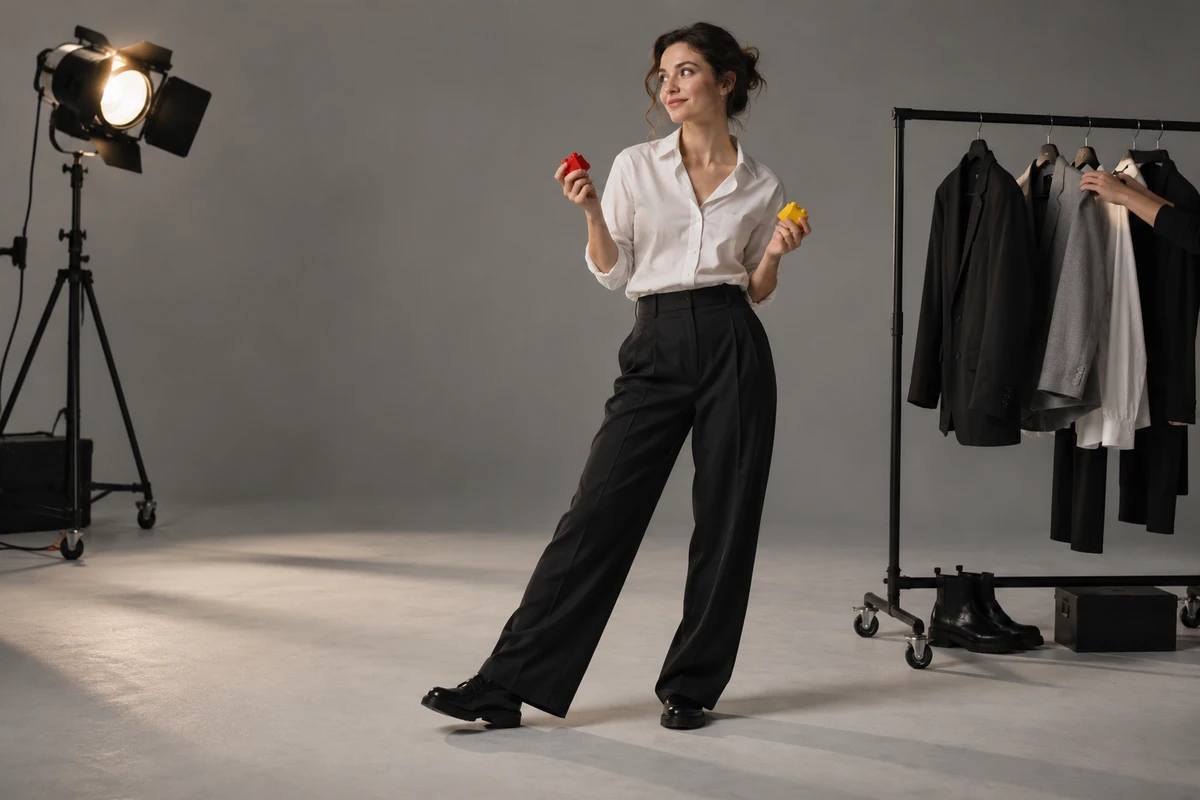
Wardrobe matters. It can identify a social setting in half a second and make a rapid montage easier to follow. Its most useful contribution, however, is often silhouette rather than an accumulation of accessories.
Shoulder width, hem length, sole thickness, and fabric stiffness directly affect stance and range of motion. If the only goal is to make every outfit different, production may end up with a beautiful lineup that has no causal connection to performance. A stronger approach lets clothing help the body become the character: a structured jacket restricts the torso and makes turns feel complete; loose knitwear lets the shoulder initiate a move; different shoes change stride and therefore entrance speed.
Limit the number of recognition devices. One strong silhouette and one supporting detail are usually enough for each role. Performance, lighting, and setting can carry the remaining difference. The character will then read as a person rather than an itemized wardrobe display.
Every transformation needs one invariant
A multi-role film needs change, but it also needs a stable memory anchor. Without one, the piece feels like several unrelated spots. If the anchor is too dominant, every role collapses into one template.
The anchor can be a product action, a sonic rhythm, a camera distance, or a shared direction of movement. In the LEGO Group’s official campaign release, two bricks trigger the transformation. That makes the product action useful: the role changes, while the cause of the change remains clear. The product is not waiting for a beauty shot. It performs a verb in the story.
In production terms, establish an action chain that stays constant: notice the product, pick it up, combine or activate it, and let the world change. Each character can alter the attitude and speed of that chain without rewriting the product function. Brand memory comes from repeated causality; character freshness comes from different bodies and emotions.
For a closer look at product action as story structure, see “Make the Product Do One Irreplaceable Action.” The distinction here is performance: how the same causal action changes when it enters a different character’s body.
A transition should carry motion, not only costume
One-actor, many-role films often rely on rapid transitions. The simplest version holds the actor in place while wardrobe and background change. It works once, but repeated visual replacement can quickly feel like a technique demonstration.
A more alive transition lets movement cross the scene boundary. The speed of a raised hand, the height of an elbow, and the direction of a glance in one role find an answer in the first shot of the next. Wardrobe and location may change, but the kinetic energy remains. The edit then suggests one person entering new possibilities instead of a sequence of character posters.
This shares some craft with an ensemble action relay, but the communication task is different. An ensemble needs to show that different people share one action. A single performer in multiple roles must make viewers feel both that the people are different and that the transformation comes from one subject. “Ensemble Ad Editing: Carry One Action Through Every Character” explores the first task. The second depends more heavily on bodily contrast on both sides of the cut.
Complete each role before chasing the magical transition
Complex match cuts can pull all attention toward camera position, floor marks, and wardrobe continuity. Technical accuracy matters, but a performer who is merely waiting to align with a frame can lose the character’s initiative.
A more reliable order is to film a complete performance pass for every role. The actor moves from a neutral state into the character, completes the product action, then returns to neutral. That reset gives the performer a clear boundary and lets the director test whether each role truly has its own rhythm. Only then should the team lock hand position, eyeline, camera height, and movement speed for precise transition frames.
During playback, watch once without sound, then listen once without looking at the image. Silent playback tests silhouette, weight, and action. Audio-only playback tests breathing, speech pace, and pauses. If the roles remain distinct in both modes, wardrobe and editing are amplifying the performance rather than concealing it.
The roles should still share the brand’s emotional range. A brand built around imagination, play, and creativity can support many identities without suddenly introducing hostility or cynicism that breaks its tone. “Where Does Conflict Come From Without a Villain?” offers a related way to think about conflict that serves the brand instead of manufacturing a cheap opponent.
A cutdown should preserve at least one complete transformation
A long film may introduce many roles. A six- or fifteen-second social cut can easily collapse into costume flashes. The cutdown does not need every character, but it should preserve one complete transformation: who the person was before, what action triggered the change, how they behave afterward, and why the product still matters.
If a role survives for only half a second, the viewer cannot read body, wardrobe, and setting at once. Reduce the number of roles instead of compressing every shot. Two transformations that can be understood usually carry the concept better than six outfits that merely appear. Reframe the action for each format as well. Vertical video can use eyeline and upper-body weight in close shots; widescreen has more room for stride, blocking, and environment to shape the character.
The method has limits. When the concept requires major changes in age, body type, specialist skill, or a credible cultural identity, multiple performers may be the more honest choice. Casting one actor should support an idea such as “one person contains many possibilities,” “the product unlocks different states,” or “the brand world keeps transforming.” It should not be a shortcut to fewer casting decisions.
Character can change while brand memory holds
The real challenge is never the number of outfits. Each role needs its own body, rhythm, and choices in very little time, while one product action and one emotional world connect them. Establish contrast through performance first, let wardrobe clarify silhouette, and carry motion across the transition. The edit will feel light because the underlying rules are clear.
If your brand is developing a film with multiple character transformations, a celebrity performance, or a product-triggered narrative, ONCE can help shape the concept, performance direction, commercial video production, and multi-format edit as one system. Contact us through the ONCE website with your current script or storyboard, and we can identify whether each character difference should be carried by performance, wardrobe, or camera language.