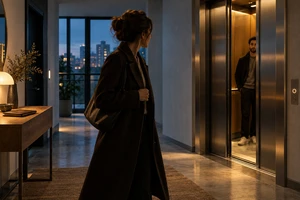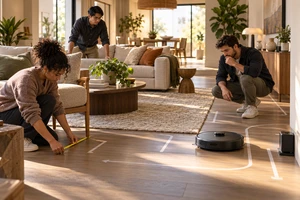
Imagine a film with five people: an office worker, a student, a designer, a father and a runner. Each person picks up the product, completes an action and smiles. The casting is broad and the locations are varied. Yet if any section can disappear without changing the others, the film is still a moving audience catalogue, not an ensemble story.
Ensemble editing in a brand film creates relationships that may never become literal meetings. Characters can live in different cities, but one person's action, result or sound should change how we understand the next scene. The product then stops being a prop repeated five times. It becomes one of the conditions connecting separate lives into a shared brand world.
First decide whether you have characters or a chain
Multi-character commercials often begin with audience segments: a young adult scene, a family scene and a workplace scene, each followed by the same feature demonstration. This may show that many people can use the product. It rarely explains why those people belong in the same film.
An ensemble needs a shared proposition that every character answers differently: how people protect one another's time, how a shared space keeps working, or how connection survives distance. This proposition is not a slogan. It is a rule that the film repeatedly tests, with each character changing its meaning.
Ask one question: after the second person appears, do we understand the first person's action differently? If the answer is no, the scenes are parallel examples. If the later scene reveals a cost, use or emotional consequence that the earlier scene could not supply alone, a relationship has begun.
This connects with our discussion of conflict without antagonists in brand films. An ensemble adds another task: each character must leave a consequence for someone else to inherit.
Relay an action across the cut
The clearest connection is an action that crosses a scene boundary. One person pushes a drawer shut from frame left; another pushes open an equipment panel in the same direction. A cup lands on a table; a different hand lifts another object from a similar place in the next shot. The movements do not have to match perfectly, but direction, speed or resistance should make the previous event feel unfinished until the next scene begins.
An action relay should carry purpose, not merely show off a match cut. One character quietly closes a device to avoid waking someone. The next scene shows a person continuing a call because their office environment stays calm. The characters never meet, but the rule of reducing disturbance has moved between them.
Production must protect the entrance and exit of each action. If the camera captures only the most attractive middle beat, the editor has nowhere to connect. Keep preparation, contact, result and release. Record direction, hand position, object height and speed. Our article on motivated blocking in brand films focuses on movement inside one scene; here the movement continues to grow across different scenes.
Let one scene answer a question left by another
Causal echoes are stronger than visual matches. The first scene creates a condition. The next reveals what that condition means in another life.
Consider a hypothetical smart-home film. A father lowers the living-room lights late at night. The film cuts to a child turning over and remaining asleep. The product does not need a second demonstration; another character carries its consequence. Morning arrives, the child opens the curtains, and natural light wakes the father. The relationship returns the gesture.
This approach suits product families and brand ecosystems, but it must not invent connectivity. Only real product relationships should be presented as direct technical causes. When products are not linked, use a thematic echo instead: different people may each make room for someone else without implying that their devices exchange data automatically.
A product does not have to receive the same close-up in every character's section. It can change a condition in the first scene, leave a result in the second and return as a visual anchor in the third. Repeating an identical feature shot simply turns five lives into five copies of one demonstration.
Let sound arrive before the next character
The next location can enter through sound before it appears. An elevator tone begins while we still see a home, then the picture cuts to an office lobby. Laughter continues across a cut before we discover a different group. A mechanical product response repeats in several spaces, each time completing a different action.
A sound bridge does more than lay one music track over every scene. Music may unify mood while leaving causality untouched. Keep a distinct environment around each character, then choose one sound that can travel. The audience knows the location has changed while feeling that the previous scene is still active.
Adobe's guide to crosscutting defines it as moving between separate scenes and recommends making each scene legible on its own before joining them through motion, music or overlapping sound. For ensemble advertising, this means sound design should enter the storyboard stage. It should not be asked to hide disconnected sections after the rough cut is complete.
Shoot relationship material, not only hero shots
An editor can build only the relationships that production captures. Alongside each main action and product close-up, keep four kinds of coverage:
- the reaction before and after a character notices a change;
- short holds before an action starts and after it resolves;
- establishing shots that preserve direction, light and social distance;
- clean actions without dialogue, captions or brand graphics for horizontal, vertical and short versions.
Multi-character productions often divide time equally among performers. The result is a complete miniature commercial for everyone and no fragments that can interlock. A better schedule identifies three to five essential relay points first, then protects the angles, reactions and sound needed around them.
Characters do not need equal screen time. An ensemble is not a fairness exercise. One person establishes the rule, another introduces resistance, a third shows the consequence and a fourth completes the echo. A few seconds can be enough when each role has a distinct narrative job.
Run the deletion test in the rough cut
Temporarily remove one character's section. If the film only becomes shorter, that person may still be decorative. If an action no longer connects, a sound loses its source or a product consequence has no recipient, the character is part of the structure.
Then shuffle the order. If every sequence works equally well, music and copy may be doing all the unifying work. If changing the order breaks the timing of information, the expectation between characters or the final echo, the ensemble has a narrative.
Finally, hide the captions. Can a viewer use direction, object state, environment sound and performance to understand why these lives belong to one brand? Text can add information. It should not invent relationships that the images never established.
A fifteen-second cut should not preserve the full cast
A master film with five characters does not require five three-second appearances in a fifteen-second edit. Keep two people, one relay and one shared result. Once the relationship is visible, the viewer can infer the rule of the larger world.
A six-second version can preserve one cross-scene action: the first person initiates a change, the second space shows the result, and the brand enters after the cause is complete. This is not a compressed cast list. It is the shortest proof of the ensemble structure.
Plan these versions alongside the product launch content matrix. The master film builds the relationship network, a feature film explains one product cause, and a social cut selects the cleanest relay. The formats share a world rule without sharing every character.
Generative AI can extend locations, but it cannot replace a role map
Generative video can make individual scenes attractive while losing identity, wardrobe detail, object state and movement direction between shots. NVIDIA Research's 2024 project, Video Storyboarding: Multi-Shot Character Consistency for Text-to-Video Generation, addresses the challenge of preserving the same subject across generated shots. The work also describes a tradeoff between maintaining identity and retaining natural motion.
An ensemble is harder because the team must record more than what each person looks like. It must record what each person changes. A hybrid workflow should keep at least four references: character identity, scene state, relay objects and movement direction, and the change each scene creates for the next one.
Live action remains especially useful for eye-line exchange, simultaneous reactions, physical handoffs and fine performance timing. Generative tools can extend cities, time of day, weather or difficult environments, and can help previsualize matches. But if the causal relationship exists only in a prompt rather than in shot states and edit points, the final film will still feel like a collection of strangers.
An ensemble brand film does not squeeze more demographics into limited time. It lets different people prove one brand rule together. One person's action becomes another person's condition. Sound moves ahead of the image. The product changes a relationship instead of repeating its entrance. That is when separate scenes begin to inhabit the same world.
If you are developing a multi-character brand film, product story or cross-platform campaign, bring the character goals, the shared rule and the three relay points that must survive the edit to ONCE's brand video production team. We can turn them into a structure that can be performed, photographed and edited.
Source note: This article draws on Adobe's public production guide to crosscutting and Atzmon et al.'s 2024 Video Storyboarding research, later presented as a Best Paper Talk at the ICCV 2025 Workshop on Generative AI for Storytelling. The research describes editing and generation problems; it does not predict campaign performance.