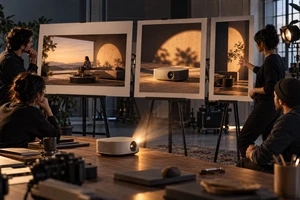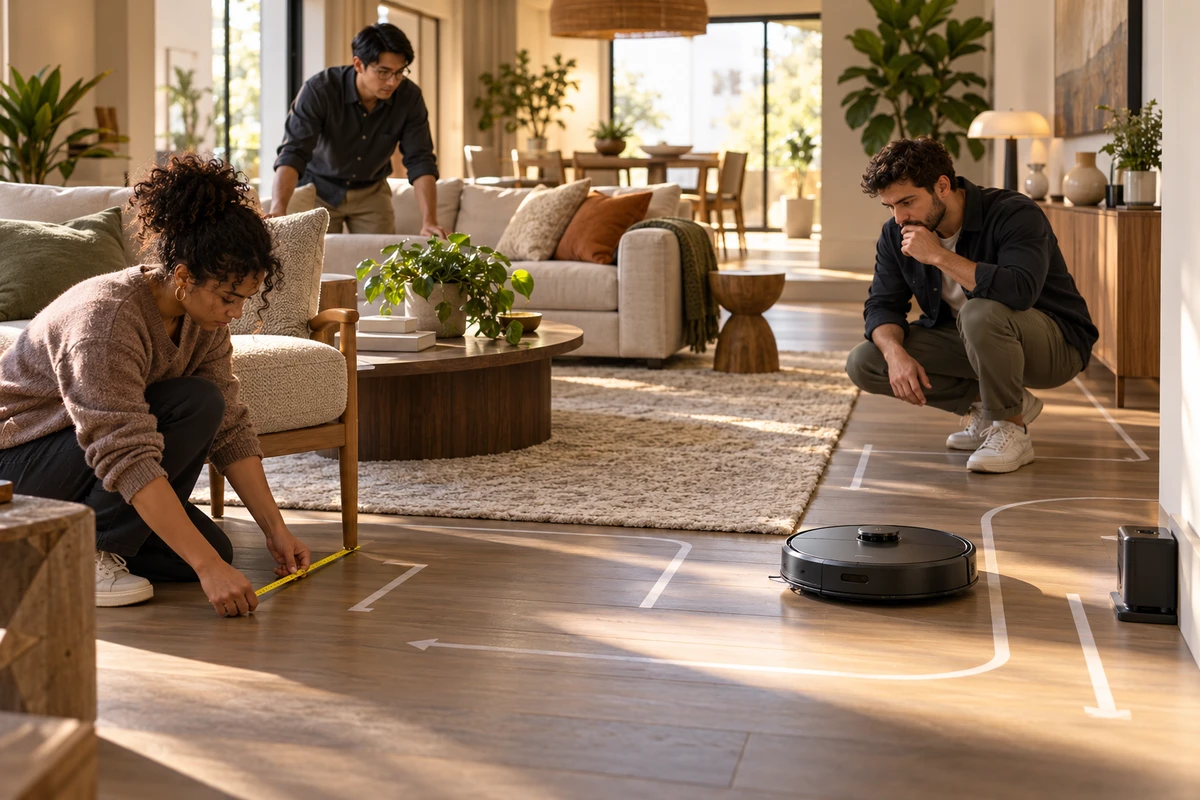
A robot vacuum enters a beautifully styled room. The sofa, rug, plants and books all suggest an international home. Then the camera pulls back: the charging dock has been squeezed into a corner, the dining chairs leave no turning radius, and the product never actually crosses the threshold. The set may look appealing, but it has not made the product believable.
In global product advertising, a home is more than a container for cultural atmosphere. It determines whether the product can be used, what friction it encounters, and whether the promised benefit produces a visible result. Before asking whether a living room looks like a particular country, ask a harder question: if the cast and decorative cues disappeared, would the space still explain why the product matters?
Space Is Half of the Product Cause and Effect
Product value rarely lives in a beauty shot alone. It becomes credible when three things connect: what the product does, what constraint the room gives it, and what result the viewer can observe.
Consider a cordless vacuum turning around narrow table legs. The swivel is only an action. The leg spacing, edge of the rug and storage position give that action difficulty. The visible difference before and after cleaning supplies the result. If an ad keeps only the rotating close-up and flying particles, function can become a visual effect. A wide shot that establishes geometry, a medium shot that shows the action, and a close-up that proves the outcome turn capability into cause and effect.
This is the essential difference between a home scene and an isolated tabletop shoot. A tabletop can remove the environment to concentrate attention on the object. A home must let the environment ask the product a useful question. Good production design does not scatter signs of life across every surface. It selects relationships that affect use.
Four Kinds of Spatial Evidence
Scale shows whether the product belongs
Wall width, the distance between a sofa and a wall, counter depth and product volume tell viewers whether an object fits real life. A projector demonstration needs viewing distance, wall dimensions and ambient light if brightness and image size are to mean anything. A kitchen appliance should not hide lid clearance or usable counter space and then claim to be compact.
Scale evidence does not require a ruler on screen. Doorframes, seated bodies, familiar furniture and hand movements can provide reference, as long as those references agree with one another.
Circulation shows whether use can flow
Where the product travels, where people cross, and whether doors, drawers and chairs compete for the same path are closer to lived reality than a regionally coded cushion. A domestic robot encounters thresholds, chair legs and a route back to its dock. An air purifier needs wall clearance, airflow and a human activity zone. A pet feeder must accommodate the pet's approach, the owner's refill path, food storage and routine cleaning.
Storage shows what happens after use
Many ads show a product being taken out and switched on, then end before it has to return anywhere. Charging, drying, folding, refilling and storing all shape long-term value. A credible home gives the product a resting place and gives its accessories and consumables somewhere plausible to go.
Coexistence shows who makes room for whom
A home rarely serves one person at a time. Children, older relatives, flatmates, pets, remote work and rest can share limited space. Noise, light, footprint and operating paths may explain value more clearly than an isolated specification. The goal is not to turn one household structure into a market label. It is to find the friction the product resolves when multiple lives overlap.
One Home Is Not a Template for a Country
IKEA's Life at Home Report 2026 examines the home as a source of stability, comfort and possibility, combining broad research with individual home visits. Its visits include a three-generation household in Portugal, a connected home shared by seven people in Japan, and a German flatshare balancing shared and private space. These examples raise useful questions: which areas are communal, where privacy matters, how household members coordinate time, and how rooms adapt when life changes.
They are prompts for research, not national templates. One Portuguese family does not stand for every Portuguese customer, and one Japanese home does not automatically represent a market. A more reliable process converts individual examples into interview and location questions, then lets the audience, price position, local housing conditions and product task shape the set.
Localization therefore involves more than adding nationally recognizable objects. It asks whether the living relationship is coherent: how many people share the home, who controls common space, when the product appears, where it goes after use, and which particular friction it resolves.
Work Backward from Product Action
Before location scouting or set construction, draw a simple space-action map. It only needs to answer four questions: where the product starts, which obstacles it meets, who interacts with it, and where the result becomes visible.
For a smart projector, the central action may be the transition into viewing. The scene has to test viewing distance, wall conditions, light control and seating direction. A robot vacuum needs turning, threshold crossing, obstacle avoidance and docking, which makes furniture legs, door sills and dock clearance part of the story. A pet feeder needs the animal's approach, the owner's refill action, food storage and cleaning to coexist. A charming animal cannot carry all of that evidence alone.
The map then suggests the shots. The wide shot establishes the constraint, the medium shot shows the action, and the close-up proves contact or outcome. If a product claim cannot create an observable change in any of those views, it may still be copy rather than filmable value.
Build Variable but Truthful Homes in One Studio
Multi-market production does not always require an entirely new house for every territory. It is often more useful to divide the scene into three layers.
The fixed layer includes walls, window positions, power, controllable light and camera movement. The variable layer includes furniture proportions, surface materials, textiles, everyday objects and door or cabinet structures. The evidence layer contains measured clearances, object states, traces of use and the visible result of a product action.
The fixed layer supports production efficiency. The variable layer expresses relevant market differences. The evidence layer creates credibility. That third layer is where shortcuts are most dangerous: the gap between a dock and a wall, whether a cabinet door truly opens, whether reflections match the lighting, or whether product weight changes the performer's hands. These relationships can be measured and prebuilt in U-STUDIO before the team decides which walls and backgrounds need to be physical and which can be extended.
The same set should establish horizontal and vertical storytelling zones in advance. A vertical version is more than the center crop of a horizontal frame. It rearranges the depth relationships among people, product and obstacle. If spatial cause and effect remains legible, furniture, materials and daily objects can change by market without forcing every version to reinvent product value.
AIGC Can Extend Atmosphere, but It Cannot Certify Spatial Facts
Current platforms and generative tools are making language and market adaptation easier to scale. Google's AI Campaign Localization beta focuses on translating and adapting Search campaign text, images, keywords and landing pages. A TikTok for Business case study shows one game publisher testing localized creative across markets. These examples show that localization assets can become a managed workflow. They do not verify the physical relationships inside a filmed home.
Adobe's Firefly Custom Models documentation, updated on September 21, 2026, explains how trained models can help preserve subject and style characteristics. In home-scene development, that can support visual exploration, exterior extensions, weather variants and noncritical decor options. It does not automatically guarantee furniture scale, product contact, shadow direction or usable clearance.
The right role for AIGC depends on risk. Atmosphere, distant backgrounds and replaceable decoration offer room for experimentation. Geometry that affects function, hand contact, product deformation and causal results deserve verifiable live action or precise CG. Hybrid production earns its value by preserving the budget for relationships that must feel true.
Remove the National Cues and Test the Product Again
When reviewing a localized home scene, temporarily remove the obvious national cues. Can viewers still understand why the product suits this home? If the answer is no, the scene may be producing foreign atmosphere rather than product evidence. If scale, circulation, storage and coexistence still support the action, the localization has a stronger foundation.
Space does not deliver the brand line, but it can testify for the product. It makes function confront a constraint, lets use leave a result, and helps viewers see how an object enters their life before they finish reading its specifications.
If you are planning a global product ad, send ONCE VISUAL the target markets, product dimensions, key actions and available location material. We can start with a space-action map, then decide which scenes need live action, a practical set, precise CG or AIGC extension.