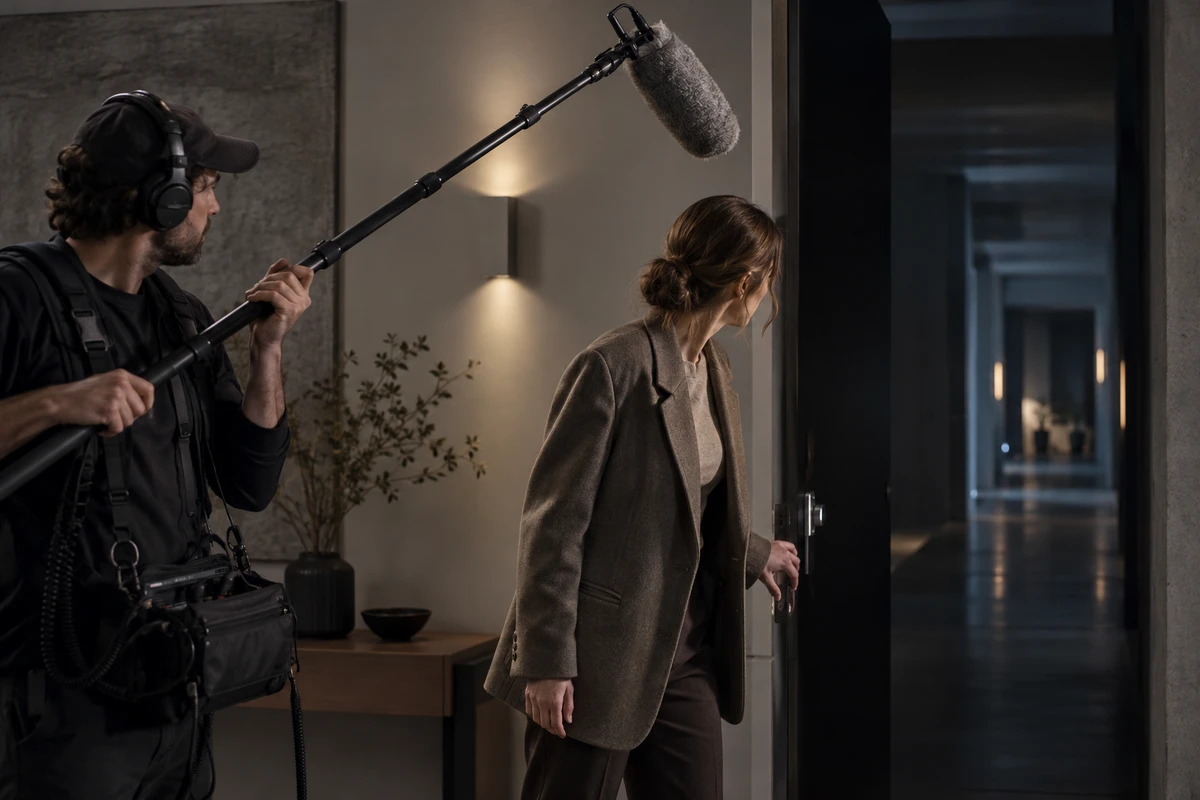
A closed door fills the frame. Before the character turns, an elevator chime sounds outside. Farther away, trolley wheels cross a floor joint. We have not seen the corridor, yet we already know that someone is approaching—and that the arrival may change the relationship inside the room.
This is where off-screen sound becomes useful. It does more than add atmosphere to an empty image. It keeps arranging space, people and events beyond the frame. When a brand film treats sound as a collection of music, voice-over and button clicks, the image must explain everything. Sound merely makes the final cut feel fuller. When sound carries narrative action, the camera can be more selective and the audience can imagine the world that has not been shown.
Off-screen sound is a deliberate choice, not missing coverage
A source outside the frame does not automatically create an off-screen world. A useful off-screen sound answers at least three questions: where the source is, how it relates to the person or product we can see, and what changes after it is heard.
Continuous keyboard noise may simply establish an office. If a meeting pauses, a bank of equipment starts behind a glass door, the character looks up, and the next shot reveals an illuminated production line, the sound has done more. It expands the perceived space, redirects attention and motivates the cut.
This is why a storyboard should not say only “ambient sound.” It can specify that a source enters from behind and to the left, moves from distant to near, causes the character to stop on its second appearance, and remains unseen until the next shot. Direction, distance and consequence turn the sound into a producible story line.
Give the unseen source four coordinates
Direction: where the audience hears it first
Left-right placement can suggest direction, but every effect does not need an exaggerated sweep. Adobe’s current Premiere Pro documentation distinguishes panning—the movement of audio across output channels—from balance, which sets a more static relationship between channels. The practical lesson is simple: spatial movement should answer the visual story.
If a character looks toward the left edge of frame, a modestly left-biased source may be enough to establish an object or person. A fully centred source can make the eyeline ambiguous. An extreme pan can pull attention away from the performance, especially on headphones.
Distance: the doorway, the corridor or the floor below
Distance is not volume alone. A nearby sound often preserves sharper transients and material detail. A distant source is reshaped by reflections, obstruction and the surrounding bed of noise. A metal clasp closing at the table should reveal contact and hardness; the same event at the end of a corridor becomes a cue that something has happened elsewhere.
For an important source, build near, medium and distant versions, then compare them with the character’s reaction. Distance becomes dramatic only when it changes recognition or action.
Material: sound tells us what the product is
Post-production can make a product sound “more premium” while quietly changing it. Light plastic acquires the mass of steel; a small assembly becomes heavy machinery. Off-screen sound demands restraint because the audience cannot inspect the source. They infer weight, friction, rebound and scale from what they hear.
Break a product action into contact, movement and stop. What does the hand touch? How does the structure move? What feedback remains when the motion ends? Sound may clarify an observable product character. It should not substitute for performance evidence.
Consequence: what changes inside the frame
Weak off-screen sound merely exists. Strong off-screen sound changes a decision, a camera direction or a visible state. A signal interrupts a gesture. Applause reveals a crowd beyond the wall. A machine starts and air, light or fabric in frame responds.
This is related to a sound bridge in editing ellipsis, but the reader’s problem is different. Ellipsis uses sound to complete an omitted action. An off-screen sound field keeps a locatable world alive outside the frame.
Draw a sound map before deciding what to film
A useful sound map can be a simple overhead sketch. Mark the people, product, walls, doors and windows, then locate every important source. For each sound, decide:
- whether it begins on-screen or off-screen;
- whether the character hears it or only the audience does;
- whether it moves and how its distance changes;
- when its source is revealed, if ever;
- whether it carries space, relationship, rhythm or product evidence.
The map exposes two common failures. In one, every sound is synchronous with a visible action, leaving nothing for the audience to imagine. In the other, many off-screen events exist but none changes a reaction or result, so the mix feels like a sound-effects library.
It also changes production planning. A direction the camera never shows may still need location recording. Footsteps outside a door, adjacent equipment, a distant group and the acoustic bed of a room can be captured separately or at least documented as a reference for post-production.
Location sound should preserve choices for the mix
Dialogue, room tone, physical action, environmental events and music need different treatment. If they are captured as one inseparable layer, post-production can only raise or lower the whole mass.
Frame.io’s post-production workflow describes room tone as the continuous ambient sound of the recording environment. When dialogue is cut, a mismatched background can appear and disappear with every line. What seems like “nothing” is maintaining spatial continuity. Record a clean version whenever the microphone position, door state or operating equipment changes.
Treat action sound in two groups. Product facts—real switches, latches, motors and material friction—form the base. Narrative reinforcement can improve readability, but it should not turn a slight movement into a performance claim the product cannot support. Environmental events allow more freedom, provided their direction and the character’s perception agree.
Music should not cover the whole spectrum too early. First listen to dialogue, action and space without a score. Confirm that the event still makes sense. Then let music handle emotion and progression instead of becoming a blanket over every spatial clue.
A sound-off version should preserve the same causality
The more important off-screen sound becomes, the more easily a muted version loses the relationship. The answer is not to turn every effect into large on-screen text. Decide which sounds are required for comprehension and which merely enrich texture.
W3C’s guidance for prerecorded synchronized media says captions communicate not only dialogue but also speaker identity and meaningful non-speech information. If a second knock or a distant machine start changes the story, represent it in captions or a visible reaction. An irrelevant air-conditioner hum does not need equal treatment.
Run two mute checks. First, switch sound off entirely and ask whether the character’s pause, the product’s change and the next cut remain intelligible. Second, keep the film muted with captions on. Check that the text identifies the essential source without covering the reaction or product action. Sound-on and sound-off versions do not need to feel identical, but they should preserve the same central cause and effect.
If a benefit exists only in one unseen spoken line, captions cannot repair the underlying problem. Put the product fact back into a visible action, result or necessary text. Let sound expand the world rather than secretly carrying all the proof.
Generative audio cannot decide what the brand should hear
Generative video and audio tools can help previsualise atmosphere, test source direction or fill low-risk environmental layers. They can also over-score every action: a whoosh for each turn, a beep for each interface and a mechanical impact for every product movement.
Keep three constants before generating or replacing anything: the sound the product can actually make, what a character can plausibly hear from their position, and the event the film wants the audience to anticipate. Review each layer for source existence, spatial continuity, credible material and any unproven functional implication.
Off-screen sound and a sonic logo have separate jobs. A sonic logo establishes ownership and recognition. Scene sound makes this particular world believable. They can share a tonal language, but one should not be asked to replace the other.
The world should continue when the camera stops
Good off-screen sound makes the frame feel like a choice, not the edge of the world. We hear a person outside the door, a machine next door, a city in the distance or a product action that has not yet appeared. The character belongs to a larger set of relationships.
On the next storyboard review, turn the music off and ask one question: what is happening outside the frame, and why is it worth hearing? “More atmosphere” is not yet a story function. If the sound changes space, judgment or expectation, the unseen world has begun to exist.
If you are planning a brand film, campaign short or a family of platform versions, ONCE VISUAL can develop the sound map, location recording and post-production as part of a practical brand film production plan.