A vacuum glides across the floor and the dust disappears. A shaver moves cleanly over skin. A pet fountain runs quietly in soft daylight. Product advertising often ends the moment the device completes its task. Ownership begins after that moment: bins need emptying, filters need washing, blades wear, rollers collect hair, tanks retain residue, and consumables must return in the correct orientation.
Maintenance is not automatically unattractive. It can answer a question that a hero shot rarely can: what does this product feel like on the fiftieth use? A launch film that only shows first activation sells an expectation before purchase. A film that handles maintenance well begins to show the longer relationship.
Maintenance is the second act of the product relationship
Maintenance footage tends to fall into two extremes. One hides every speck of dust, strand of hair, and water mark, leaving a beautiful product with no lived reality. The other films the instruction manual step by step, delivering complete information with no advertising rhythm.
The more useful middle ground treats maintenance as the second act of product value. In the first act, the device completes the task. In the second, the user deals with what the task leaves behind and returns the product to a ready state. Viewers do not need every support step, but they should understand how the product opens, where the residue goes, what the hand touches, and how readiness is confirmed after reassembly.
The principle resembles our discussion of home scenes in global product ads: space is not background, and maintenance is not an appendix. Both show how a product occupies real life.
Four kinds of long-term value need four kinds of action
“Easy to maintain” is too broad for a camera. The phrase must become a physical relationship that viewers can read.
Access: can the hand reach what it needs?
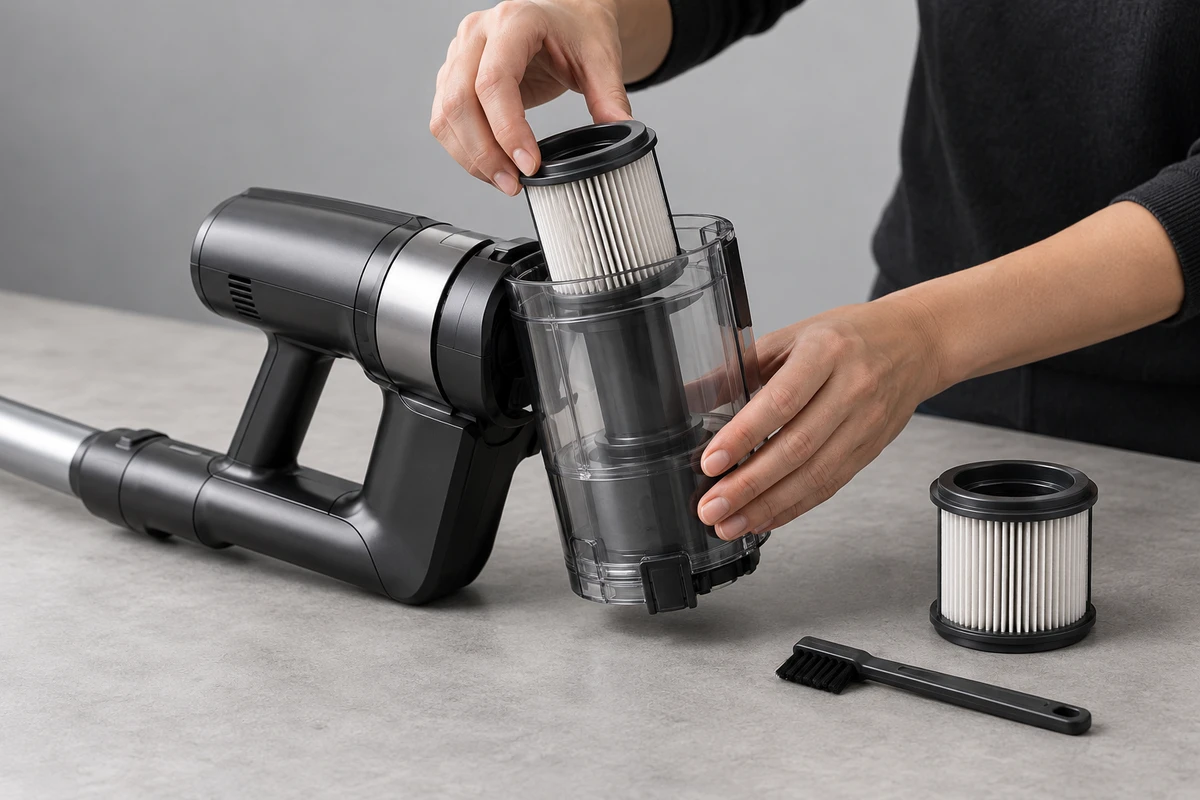
Where is the filter? Which direction releases the bin? How does a shaving head unlock? Does the whole device need to be turned over to remove a tank? These choices shape the first impression of maintenance. Do not rely only on floating component shots. Keep the transition from normal use posture to maintenance posture.
If a performer twists a wrist into an unnatural angle to protect the camera view, the product may look more difficult than it is. Start by completing the real task according to the product guidance. Then choose an angle that shows the thumb, latch, and opening direction together.
Containment: where does the unwanted material go?
Dust bins, hair chambers, wastewater tanks, and used consumables all manage material people may not want to touch. An ad does not have to magnify every contaminant, but it should show whether debris escapes during opening, reaches the hand, or forces the entire assembly onto a counter.
A clean emptying action is not only a capacity claim. Its value comes from the rim, opening, gravity, receptacle, and hand working together. Keep that relationship in frame instead of making residue disappear through a cut with no destination.
Feedback: how does the user know the part is secure?
Clicks, magnetic seating, color marks, arrows, indicator lights, and mechanical stops are maintenance feedback. They may last half a second, yet they determine whether a person feels safe applying force.
If a soft click confirms reassembly, music should not bury it. If the geometry prevents incorrect insertion, show the difference between the right and wrong approach. Do not invent an interface cue in post that the real product does not provide.
Recovery: how does the product return to work?
The end of maintenance is not merely a part returning to its cavity. It is the product becoming usable again. That may be a status light returning to normal, a roller moving, airflow resuming, or a shaving head operating smoothly. The claim must stay precise: the film can show that the prescribed maintenance was completed and the product restarted. It should not imply a quantified performance improvement without a real test.
Six beats make maintenance complete without making it slow
A maintenance passage can follow six beats: used state, access, removal, treatment, return, and renewed operation. This is a causal line rather than a fixed template.
The used state explains why maintenance begins: a bin reaches its fill line, hair wraps around a roller, visible dust collects on a filter, or the device gives a genuine prompt. Without a cause, disassembly looks like purposeless handling.
Access establishes the route in. The control, hinge, rail, and force direction should be legible in one relationship. Removal shows how the component separates, whether a second hand supports its weight, and which surface faces the user.
Treatment may mean emptying, rinsing, wiping, or replacing. It must follow the specific model guidance. A production should never place a non-washable filter under water simply to create a consistent visual. Return should preserve orientation, resistance, and confirmation. Renewed operation closes the loop, showing that the preceding sequence was a complete use cycle rather than a disassembly performance.
In a fifteen-second cutdown, the six beats do not need equal duration. Access and removal may merge, and treatment can become one unmistakable action. Removing both cause and result, however, leaves viewers with a part that vanishes and reappears.
Official care guidance reveals the product facts an ad cannot skip
Manufacturer support pages show why maintenance cannot be reduced to a universal rinse-and-reinstall montage.
Dyson's cordless vacuum filter care guidance separates removing loose dust, rinsing with cold water, shaking out excess water, and allowing the filter to dry fully before it returns to the machine. For a creative team, the implication is simple: a beautiful rinse cannot cut directly to immediate operation when a real drying condition sits between them.
iRobot's Roomba bin and filter guidance separates bin removal, filter removal, debris disposal or cleaning, and reinstallation. Whether a component can be rinsed and how it should be cleaned must be checked on the page for the exact model. Putting every part under water may produce one neat shot and one inaccurate product.
Philips' shaver head guidance describes cutter and guard pairing, retaining-ring direction, cleaning, and reassembly. Even tiny parts can have relationships that should not be rearranged for a prettier flat lay.
These sources do not mean an ad should repeat the manual. They reveal the conditions that cannot be beautified away: which parts may contact water, which require drying, which orientations are not interchangeable, and which actions require the device to be powered off.
Hands, camera position, and sound should preserve real resistance
Maintenance gets much of its character from small physical feedback. Make every action too light and the device feels like a prop. Emphasize effort too heavily and the film creates burden.
Let the hand complete the task before making it elegant
The performer should learn the real operation before refining gesture. Finger position, support from the second hand, and the release of stored resistance all shape the cut. A director can reduce repetition, but should not build a gesture that only becomes physically possible through editing.
Follow the relationship, not the loose component
An overhead shot can explain part location. A side close-up can reveal a latch and its depth. A first-person angle can clarify direction. The clearest frame is often the one that retains the hand, interface, and main body together. A macro shot of an isolated filter shows material, but not how that filter belongs to the product.
Use sound to make half-second feedback tangible
Granules falling, a latch seating, magnets meeting, hair releasing from a brush, and water flow stopping can all punctuate maintenance. Sound may be cleaned and strengthened, but it should follow the real material logic. Replacing it with an unrelated heavy impact merely to feel premium creates a new false sense of weight.
Real residue, clean stand-ins, and mechanism animation solve different problems
Real residue offers the strongest credibility and the weakest continuity. Every bin empties differently. Hair wraps with a new shape. Water marks change under lights. When a result needs to be demonstrated, define the residue mixture, quantity, placement, and reset method before filming.
Clean stand-ins are useful when hygiene, safety, or continuity is difficult to control. A traceable material may simulate debris while protecting the performer and device and allowing several camera angles. Its color, density, movement, and adhesion still need to resemble the real condition. Visual beauty should not secretly change the difficulty of the task.
CG or AIGC can explain hidden airflow, fluid paths, and filtration layers, and can bridge live-action handling with internal mechanisms. It should not replace physical questions such as whether a latch is comfortable, a bin spills, or a component can be grasped. Generated imagery is especially prone to plausible but incorrect threads, hinges, pleats, and finger contact. Any shot carrying operational meaning should be checked against the real sample.
Let the hero film sell the relationship and the product page explain the action
The hero film does not need every maintenance step. It can choose one action that best represents the long relationship: a bin emptying without hand contact, a shaver head opening for rinsing, or a filter sliding out clearly after the task. A product-page film can then expand the actual order and limitations. A short cutdown can focus on one friction point: containing residue, using no additional tool, or preventing reversed installation.
This division also creates more durable source footage. One real maintenance shoot can capture the wide use relationship, hand close-ups, component macros, production sound, and clean plates, then support launch films, product pages, support content, and social cutdowns. ONCE plans those layers inside its product video production, keeping real handling, advertising expression, and mechanism animation in separate but connected shot groups.
Put maintenance into the creative brief
A product film does not need to present maintenance as a problem, and it should not pretend maintenance never exists. The valuable image shows how the product contains evidence of use, allows access, confirms correct handling, and returns to work after cleaning or replacement.
If you are planning a hero film and product-page content for cleaning appliances, personal-care devices, pet products, smart home hardware, or products with consumables, send the sample, maintenance parts, official instructions, and a real used-state reference to ONCE VISUAL. We can complete the real maintenance cycle first, then decide what belongs in the hero film, what needs a guided product demo, and what is better explained through mechanism animation.
Sources and scope
This article was checked against official Dyson cordless vacuum filter care, iRobot Roomba bin and filter care, and Philips shaver head removal, cleaning, and reassembly guidance. Washable parts, drying time, replacement intervals, power-off requirements, and installation direction always depend on the exact model and the manufacturer's current instructions. This article addresses advertising and production choices; it does not replace product safety, engineering, or customer-care documentation.