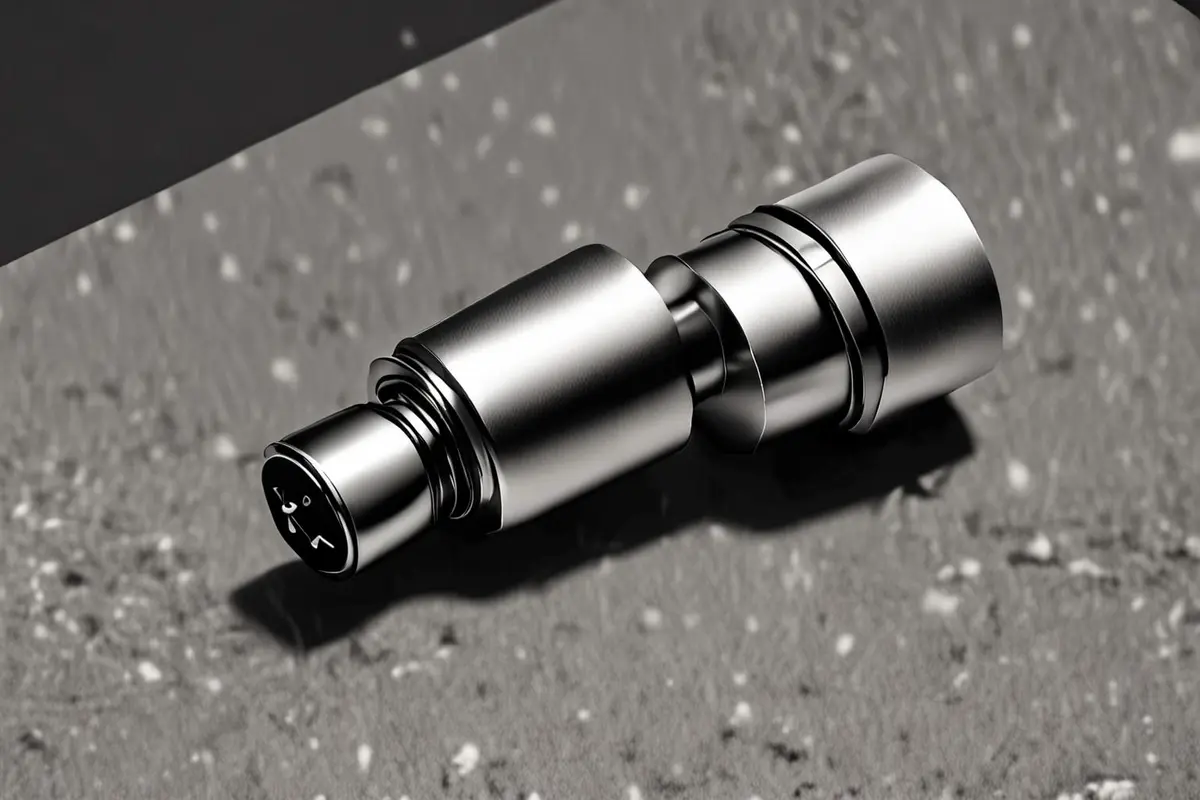
Place the same wireless earbud on a seamless white background and let a macro lens fill the frame. It can feel like a piece of precision architecture or a plastic model. The image contains more detail, yet its physical size may become less certain. Macro controls magnification. Scale comes from relationships.
Viewers do not judge size from frame coverage alone. They look for familiar objects, perspective, occlusion, texture density, motion parallax, contact actions and sound. The useful creative question is therefore not how close the camera can get. It is how large, heavy or precise this small object should feel at this moment.
A 1:1 reproduction ratio is an optical relationship
Nikon explains that a true macro lens can reproduce a subject at 1:2 or 1:1 on the imaging sensor. At 1:1, the projected image on the sensor is life-size. This does not mean the audience will perceive the product at its real size, nor that the final picture has merely been enlarged once. The same capture may appear on a phone, a retail display or an exhibition wall.
Lens specifications answer how much detail can be recorded. They do not decide what that detail means. A circuit joint enlarged to architectural scale can suggest engineering complexity. A cream texture can make touch almost visible. An earbud grille can become an abstract pattern before the product is revealed. All three are macro images, but they make different promises about physical scale.
Scale comes from comparison, not product area
An isolated product close-up could belong to almost any size. A 2022 study of distance inference in 2D scenes notes that pictorial information is limited and that viewers rely on cues such as perspective, size constancy and scene position. Familiar objects can also change judgments of size and distance. An advertisement does not need to place a ruler beside the product, but it does need to offer a relationship the viewer can understand.
The strongest reference often belongs to the product's use
A finger pressing a button, a cable entering a port, an ear tip sitting in an ear or a clasp closing around a wrist communicates function and size at the same time. These references feel more natural than a random coin because they participate in the product value.
Scale can also be encoded inside the object. Screws, ports, stitching, markings and type carry familiar proportions. If CG or generative imagery changes a port from one shot to the next, the silhouette may remain attractive while the product starts to feel like a concept model with no stable dimensions.
Texture density separates monument from toy
Macro photography enlarges bead-blasted metal, leather grain, brushed surfaces and moulded plastic. Coarse texture and deep local shadows can give an object the weight of rock or architecture. Surfaces that are too uniform, bevels that are too soft and contact shadows that are too light can make a real product feel miniature.
This is not a reason to invent roughness. Lighting should reveal material that actually exists. Raking light and controlled tonal changes can make real texture legible. Transparent and highly reflective products require a different decision about the environment they reflect; see our guide to transparent product lighting.
A camera move of a few centimetres can reveal more scale than a full product rotation
A static close-up easily loses space. A small lateral move makes near edges and distant structures travel at different image speeds, producing motion parallax. Research on relative distance cues and motion parallax shows that those cues contribute to how depth is scaled. In a macro product shot, movement is therefore a way to explain layers, not merely decorate them.
When the camera is extremely close, a short track can create strong parallax. Move too quickly and a seam becomes a canyon, giving the product monumental scale. A longer macro lens used from farther away creates flatter, more restrained relationships that can suit precision hardware. Focal length changes the field of view, but camera position is what changes perspective relationships. Test the observation position before debating lens character.
Movement also needs something stable. If product, particles, reflections and camera all drift at once, the viewer loses the reference that holds scale together. Keep a contact point, a fixed shadow or one structural edge stable while the rest of the shot moves around it.
Shallow depth of field can create a world, or a miniature
Canon's macro guidance notes that close focusing typically produces a very tight depth of field. This is both an optical constraint and a strong visual language. When only one button or bevel is sharp and the rest falls away quickly, the product can feel larger than the frame.
Very shallow focus is also associated with miniature photography. Remove familiar scale, contact shadows and a readable overall silhouette, and the viewer may interpret a real product as a model. A shallower image is not automatically more premium. It simply limits the area the audience can trust.
Before shooting, identify two points that must remain legible together. If a brand mark and a structural feature need to coexist, aperture cannot be chosen only for attractive bokeh. Still images can extend clarity with focus bracketing and stacking. Canon's focus-stacking example also depends on a stable camera and a controlled series of focus positions. In video, the product, reflections, liquid or camera may move, so stacked stills do not replace a designed focus plane, motion path and hold time.
Sound adds a kind of mass outside the frame
Scale is multisensory. Six studies reported in the 2017 paper Sounds Big found that lower-pitched voices or music associated with a product led participants to infer a larger product size. This is not a formula for putting a cinematic bass hit under every small object. It shows that sound can participate in cross-modal judgments of size.
Credible weight often begins with the action itself: the decay of a metal closure, the mechanical return of a button, the contact of packaging on a table, or the viscosity implied by a moving liquid. Record the real sound first. Then decide whether a lower layer, longer decay or deliberate silence supports the product instead of replacing it.
If the image turns an earbud into a spacecraft while the mechanism produces a weightless plastic click, the scale collapses. The opposite can also be valuable. Precision, lightness and quiet operation do not need to be disguised as heaviness.
A macro sequence must decide when to restore real size
Macro imagery is often most compelling when viewers briefly do not know what they are seeing. A texture can become terrain, a button can become architecture, and a droplet can become a planet. The issue is not whether an ad may create that misreading. It is when and how the image resolves it.
An effective sequence can begin with an abstract detail, restore physical scale through a port, hand or medium shot, and then return to the same detail. On the second viewing, the texture is no longer only spectacular. It belongs to a function or manufacturing choice. If the entire film remains in extreme close-up, viewers may remember the sensation while never building a coherent product.
Horizontal and vertical formats change the reveal. A wide frame can hold product and environment together. A vertical frame increases product occupancy quickly, so scale may be restored with a longitudinal hand movement, foreground occlusion or a purposeful pull-back. This is a new composition problem, not a mechanical crop.
CG and AIGC can produce beautiful detail while forgetting proportion
Generative imagery can quickly create microscopic metal, liquid motion and impossible camera paths. A strong single frame does not guarantee stable scale across shots. The more subtle failure is proportional drift: a port grows relative to the body, a finger changes size against a button, a bevel thickens during rotation, or depth of field changes without a corresponding shift in camera distance.
A hybrid workflow can lock three scale anchors before generation: the complete product, the real use relationship and the critical macro structure. Environments, particles and transitions should remain plausible at all three distances. Keep live-action product plates or controlled CG for identity-critical shots, while generative tools extend atmosphere and environment. This does not reduce imagination. It keeps the imagination attached to the same physical object.
Good macro work does not simply make a small product large
There is no universal answer to whether a product should feel monumental, light, precise or intimate. A watch movement can become an engineering world. A beauty device connector may need to return quickly to hand-held scale. Food texture can be enlarged for appetite, then restored to edible reality. The useful test is whether the scale shift helps the audience understand the product, rather than merely proving that the camera can get close.
If you are developing product imagery for electronics, beauty, jewellery or precision components, ONCE can use physical samples, lens tests and early sound sketches to define a scale strategy before product video production: which details should become a world, and which moments must return the product to the hand.
Source note: On October 25, 2026, this article reviewed official macro materials from Nikon and Canon, alongside published research on 2D size judgments, motion parallax and the effect of sound pitch on perceived product size. The creative recommendations are editorial analysis based on those sources and production principles, not a client case study or a performance claim.