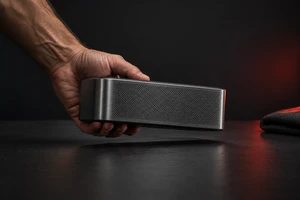
A common break in realism happens at an edit. One shot is an extreme close-up of a fingertip pressing a button, with a crisp mechanical click that feels inches from the listener. The next shot cuts to a living-room wide angle three metres away, but the click does not recede or enter the room. The image says the viewer has stepped back; the soundtrack still says the product is beside their ear.
This is more than a level problem. The sound perspective has stopped following the camera. Sound has close-ups, medium shots and wide shots too. Together, they determine whether a product action belongs to a believable space or floats above the image as a polished effect.
Auditory distance is more than loud versus quiet
Listeners in a room use direct sound, reflections, spectral changes and familiarity with the source to judge distance. Acoustic research often describes part of this perception through the direct-to-reverberant ratio: nearby sources tend to deliver a larger proportion of direct sound, while reflections from walls, floors and objects become relatively more prominent as the source recedes. A 2025 study in The Journal of the Acoustical Society of America found that, under its controlled virtual-listening conditions, direct-to-reverberant ratio and spectral balance were strongly related to distance judgments.
Lowering a close-up effect therefore does not automatically create a wide shot. A quieter click can still feel near if it remains dry, bright and unusually detailed. Adding a long reverb is no shortcut either; it can turn an ordinary living room into an empty warehouse.
Split one product action into three layers
Instead of searching for one finished effect that works throughout an edit, separate the action into three controllable layers.
1. The product itself
The contact inside a button, friction in a dial, the pull of fabric or the closure of a lid belongs to the action. A close-up can preserve transient detail and material character. When the camera moves away, those details do not have to disappear, but they should stop occupying the foreground.
2. The room's response
The same action produces different reflections in a bathroom, bedroom, office or studio. The official Adobe Audition reverb documentation and Apple Logic Pro guide describe predelay, room size, decay and the balance between original and reverberant sound as controls that shape the apparent space. They are not generic polish controls; they help answer where the sound comes from and how the room responds.
3. The continuous environment
Air conditioning, distant traffic, clothing movement and a small table resonance reconnect an isolated product effect to the image. Ambience does not need to demand attention, but it gives a wide shot scale. Without it, even refined Foley can sound like a detached asset.
A wider cut does not require an instant volume drop
The image can jump from macro to wide in one frame, while the auditory space often benefits from a short transition. There is no universal setting. The practical move is to redistribute the three layers:
- Reduce the product's foreground presence. Tame overly bright detail, narrow an exaggerated near-field stereo image or remove the smallest friction sounds.
- Let the room carry the edit. Keep the reflected tail of the action so the sound has somewhere plausible to go after the picture widens.
- Reveal the ambient bed. As the wide shot appears, a little more of the space that was already present helps the new distance feel coherent.
If an action continues across the edit, let the direct sound complete its decisive contact and allow the room tail to cross the cut. This keeps the product action legible without carrying an ear-level effect into a wide view. It follows a similar principle to action-match editing in product films: continuity comes from the relationship between actions, not from copying the entire first shot into the second.
Sound perspective must follow the set, not only shot size
A carpeted bedroom and a tiled kitchen will not sound alike at the same three-metre distance. Soft surfaces absorb more high-frequency energy; hard surfaces create more distinct early reflections. Openings, room size and furniture density also change the decay. A mix built from only two presets, close-up loud and wide shot quiet, can still contradict the production design.
A better starting point is to capture room tone and several short actions when the location or set is approved, and to record an impulse response when the project warrants it. Adobe's convolution-reverb guidance explains how an impulse response can represent a particular acoustic space. Even when convolution is not used in the final mix, a location reference helps the sound team judge how dry, bright or directional the room should feel.
When the sound may deliberately stay closer than the image
Sound perspective is not a rule that must always obey physical distance. A product film may need one action to move into the narrative foreground: a safety catch engaging, a lens ring turning or charging contacts snapping together. Keeping that hero sound slightly closer in a wide shot can tell the audience what matters inside a complex frame.
The deviation needs a clear hierarchy. One designed product sound can remain prominent while footsteps, clothing, reflections and ambience observe the wider perspective. The audience then reads the sound as emphasis. When every element is equally close, bright and full, the entire space collapses.
Sound can also build brand recognition, but memorability and spatial credibility are different jobs. For the first, see our article on building sound memory in brand films. This article focuses on how one sound remains believable as camera distance changes.
Put sound distance into the storyboard
An executable sound storyboard does not need dense terminology. For each key action, note four things: shot size, source position in the frame, narrative priority and the expected response of the room. If the same action moves from close-up to wide, specify which layer crosses the cut, which recedes and which is handed to the environment.
During production, collect a clean version of the product sound, room tone and reference recordings at several distances. Post-production can then combine real references with designed elements instead of searching for a universal effect that is somehow both intimate and far away. This matters even more when live action, CG and AIGC share a sequence. The image may invent a space, but the soundtrack still has to give that space one coherent scale.
The final test: does it remain one room with the picture off?
During review, close your eyes and listen through the camera changes. Do the balances of direct sound, room response and ambience change with distance? Then mute the soundtrack and identify the action the picture actually wants the viewer to notice. Restore both and decide whether closeness represents physical distance or intentional narrative emphasis.
When sound perspective works, viewers do not praise the amount of reverb. They simply believe the product is in that room and know when to lean toward it. If you are planning a commercial that depends on precise product actions, a practical set and coordinated sound design, talk to ONCE about the storyboard, space and key actions.