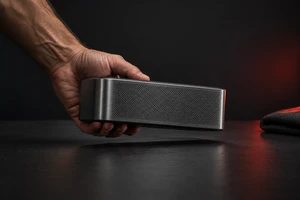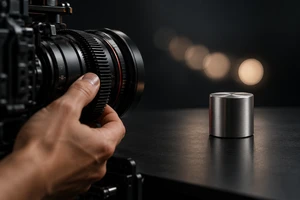
The most deceptive take on a product set is often the one where every action is technically correct. The performer picks up the device, finds the control, completes the operation, and looks up with a smile. The product faces the camera throughout. On playback, every information point is clear, yet the person feels like a trade-show demonstrator: they know what the camera needs to see, but they do not appear to need the product.
Performance problems in technology advertising are rarely just a lack of acting ability. More often, the storyboard specifies where the hand should go and how satisfied the face should look, but gives the character no task that matters in that moment. Without a task, movement serves the shot. With a task, the product can enter a person's life.
Demonstrating and using direct attention differently
A demonstration first takes care of the viewer: fingers avoid the mark, the product stays at an ideal angle, and each step waits to be seen. Use first takes care of the result: the person wants to finish something, their hand chooses a path based on experience, their eyes move toward the next target, and their body responds continuously to success or failure.
Both kinds of movement can belong in an ad. The problem begins when a brand presents a demonstration as an everyday moment. Someone interrupted by a call will not check whether the front of their earbuds faces outward before putting them back on. A regular coffee-machine user will not react to every button as a discovery. When the movement implies a different level of knowledge from the situation, the performer seems to be working for the advertisement.
Do not ask for surprise before giving the character a task
“More surprised,” “enjoy it more,” or “act as if you have just discovered the feature” sound like direct instructions. In practice, they push the performer toward a facial result. Eyes widen, a pause appears, and then comes the smile, even though the product has not changed anything yet.
Action verbs give an actor more useful material: catch, avoid, confirm, find, hide, share, finish. Instead of “be surprised when noise cancellation turns on,” try: “There is construction outside and you must hear the address the caller is giving you; when the sound drops away, you confirm that you did not write it down incorrectly.” Surprise becomes a physical response to a task becoming easier rather than a face added to the shot.
The task also needs a little resistance. Another object may occupy one hand, time may be running out, location sound may interfere, or the interface may not respond on the first attempt. Without resistance, the product is touched. With resistance, the feature creates a consequence.
Believable use lives in the order of reactions
Viewers may not consciously inspect a performance, but they can feel when cause and response are out of order. The person smiles before pressing the control. Their gaze relaxes before the sound changes. A device has just arrived, yet their fingers behave as if they have used it for years. These mismatches can turn polished footage into an instructional demonstration.
The eyes usually lead the hand
When people reach for or operate an object, their gaze usually confirms the target before the hand arrives. During a familiar action, the eyes may leave early to find the next step. If a performer watches their own hand throughout, the action feels unfamiliar. If the gaze follows only the camera's needs, it loses a real target. Our earlier article on gaze in AI product ads examines generated eye-line geometry; this article concerns the full behavioural chain of a live performer.
Hand rhythm reveals product familiarity
A first-time user confirms, tests, and corrects. An experienced user predicts positions and may begin moving before visual confirmation. The director must decide the character's relationship with the product before asking everyone for the same “elegant slow motion.” Once proficiency is defined, the speed of pickup, search, hesitation, and release has a reason.
Emotion must wait for the result
After a feature produces an effect, the body often changes before the face does: shoulders release, breathing returns, or the hand stops gripping. A smile may follow. Remove those transitions and keep only the large expression, and the performance becomes a reaction sticker. Technology products often remove friction; the honest response may be smoother action rather than sustained excitement.
Rehearsal should reveal unnecessary movement
Product-ad rehearsal is often treated as a way to make blocking precise. Its more valuable purpose is to identify movements that exist only for the camera.
Begin by letting the performer complete the task without protecting the product's front view. Observe where they naturally place it, when they look at it, which hand works better, and what happens after completion. Then move the camera, adjust props, or refine the gesture until the necessary information becomes visible. The photography adapts to behaviour before behaviour is refined for photography.
When a clear product view is essential, make the display a consequence of the task. The performer turns the device to check its status, raises it to pass it to another person, or brings it closer because they need to see a detail. The product faces the audience, but the movement still has a reason inside the scene.
Across takes, change conditions rather than expression levels
A familiar take progression is “normal, happier, then more exaggerated.” It produces three expressions but still only one behaviour.
More useful variation comes from changing conditions. Give the person time in one take and interrupt them in another. Make one attempt a first use and another an established habit. Let the result appear immediately once, then introduce a half-second wait before confirmation. Changed conditions generate different pace, gaze, and emotion, giving the edit meaningful choices rather than three smiles.
Add two columns to the shot list: what the person is trying to complete, and why they change at this exact second. Neither sentence needs to appear on screen. They help the director, performer, cinematographer, and editor share the same causal structure.
Different formats need different levels of visible performance
A brand film can let viewers infer character from detail. Performance can remain restrained while the product relationship develops across a sequence. A feature demonstration needs readable steps, so actions may be clearer, but the person still needs a reason to perform them. A performance cutdown often has only seconds to show problem and result; the reaction can be concentrated, but it cannot precede the feature.
Platform guidance supports the broader principle. Google's ABCDs guidance recommends making people core to the story and showing them using products to demonstrate benefits. TikTok's current creative advertising guide emphasises authentic, relatable creative and real people sharing product experiences in natural settings. The platforms express it differently, but the performer should be more than a face beside the product.
Product fluency has to exist before the camera rolls
Many performance problems begin with preparation. A performer meets the device for the first time on set, then must remember controls, protect the product angle, and follow direction. Stiff movement is almost inevitable. Products with defined operating logic, such as earbuds, coffee machines, smart locks, and cleaning appliances, deserve real handling time. The team should also decide whether the character is new, occasional, or experienced.
The prop must work. If button feedback, indicator states, weight, resistance, or sound differs from the final story, the performer receives the wrong physical information. For a related production problem, see how product ads make weight visible.
Watch once without sound and look for a goal
During review, mute the film and follow where the person came from, what they want, what resists them, what the product changes, and why they leave or continue. If the voiceover disappears and only a string of elegant gestures remains, the behavioural chain is incomplete.
Restore the audio and ask whether speech and music support the performer or explain everything on their behalf. This playback cannot prove advertising effectiveness or replace audience testing. It can expose a common production failure early: the feature is visible, but it never becomes part of human action.
Believable performance does not mean asking an actor to do nothing. It means giving every visible action an invisible reason. When a person genuinely wants to finish something, the product's value does not need an exaggerated face. It appears in the rhythm after resistance disappears.
If you are planning a technology or product commercial, ONCE can design product actions, performer objectives, and camera positions together at storyboard stage, so the feature and the behaviour work in the same shot. Explore our brand and product video services or contact us to discuss the project.
Sources and scope
This article draws on Google's ABCDs for effective creative, Think with Google's short-form creative guidance, and TikTok for Business's Creative advertising guide. These official sources support the platform-level principle that people should be central to the story and product benefits should be visible through use. The rehearsal, movement, and directing methods here are production judgments rather than a fixed performance formula.