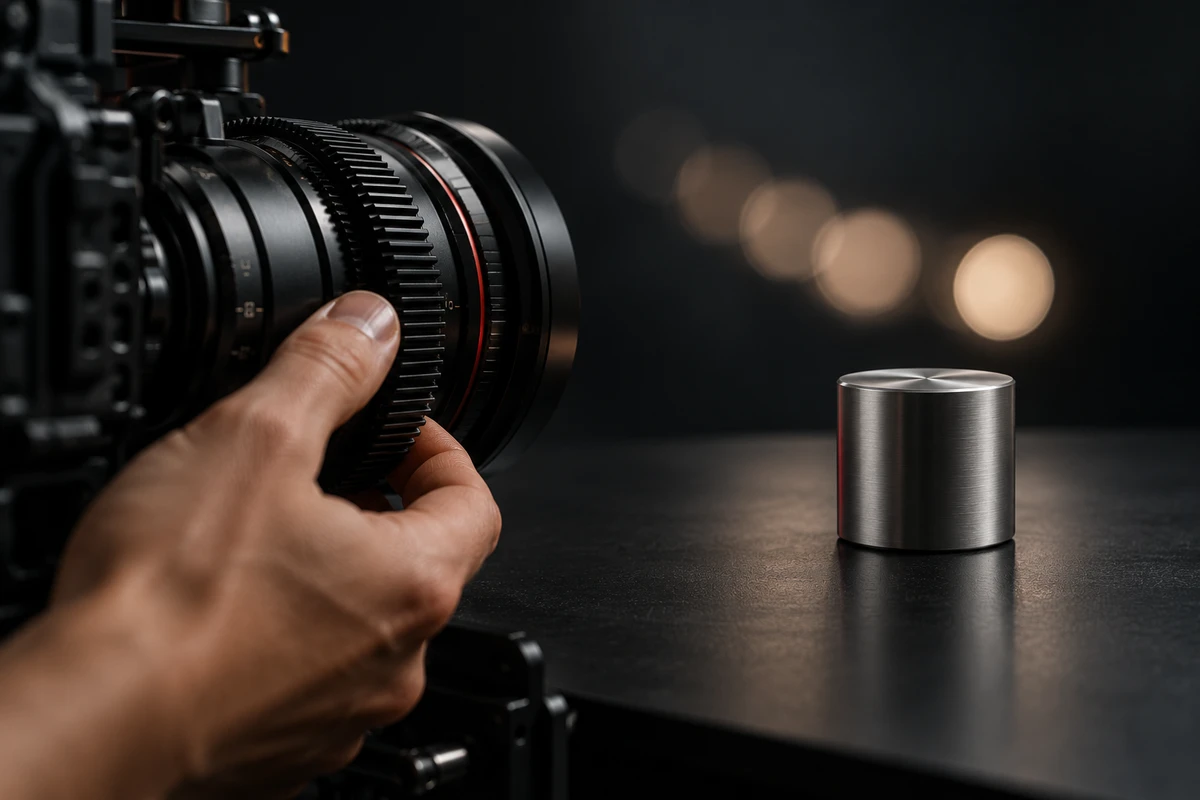
The camera is locked on a track. A metal control sits in the foreground and the product mark rests behind it. Focus moves slowly from the control to the mark. The camera never travels, yet the product seems to press forward: its edges move closer to the frame, the background relationship changes, and a stable composition acquires a subtle zoom.
This is focus breathing rather than an accidental edit. It is especially visible in product advertising because packaging edges, circular ports, markings, and type provide fixed references. Controlling focus breathing in a product ad does not mean removing every change. It means deciding whether the focus pull transfers attention or unintentionally rewrites the product's scale and position.
Focus breathing changes the angle-of-view relationship
Sony defines lens breathing as a shift in angle of view or focal length when focus changes. Canon's cinema-lens material describes the same phenomenon through magnification change. The image can resemble a slight push or pull even though the camera has not moved and perspective has not rearranged as it would during a real dolly move.
A physical push changes the relative position of foreground, product, and background, with near objects moving more strongly. An optical zoom primarily changes framing. Focus breathing follows focus distance. As focus moves from the front edge of a product to a mark behind it, the frame can expand or contract enough to suggest that either the camera or product has moved.
Identifying the source prevents the wrong repair. An unstable dolly move calls for camera work. A touched zoom ring calls for lens-operation checks. Focus breathing has to be evaluated against the specific lens, focus distances, and compensation method.
Product close-ups make a small change easier to see
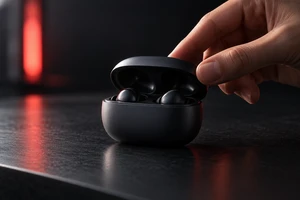
A face can absorb some framing change through expression and motion. Products often consist of explicit geometry. The distance from a bottle shoulder to the frame, parallel phone edges, a circular lens mount, or the corner radius of an earbud case all become reference points. When they shift through a focus pull, the product can appear to swell or step backward.
Macro and close working distances concentrate the issue into a short focus travel. The physical distance from package type to a nearby button may only be a few centimetres, yet the framing change can already affect the edit. A background grid, light strip, or tabletop edge makes the shift even easier to compare.
This is a different layer from general visual guidance. Our article on gaze and attention in AI product ads addresses where attention lands; focus-breathing control asks whether the product remains spatially stable while attention moves.
Test at the real working distances before the shoot
Racking a lens from minimum focus to infinity in a rental room does not represent the planned shot. Test the final camera, lens, recording format, and approximate aperture with the actual sample at the real camera position, then pull through the storyboard's start, middle, and end distances.
Watch the frame edges first
Place a product edge, tabletop line, or background light where it is easy to compare and complete a slow focus pull. If those references expand or contract together, the change comes from angle of view rather than from the sharp region alone.
Check identifying details next
Does package type occupy a different area? Does a circular port appear to grow? Do buttons and interfaces drift in relation to the frame? The optical change may be modest, yet it becomes highly visible on a centered mark or symmetrical composition.
Finish at the intended screen duration
A fast pull can make breathing feel like a sudden twitch. A slow pull can expose a continuous zoom. Test the timing planned for the cut and review it with product movement, camera movement, and sound rather than judging an isolated technical clip.
Compensation stabilizes framing by redefining it
Some Sony cameras and compatible lenses offer in-camera breathing compensation. Catalyst Prepare can also use supported clip metadata to compensate for breathing. Sony's current help materials make clear that availability and effectiveness depend on the camera, lens, recording mode, frame rate, and metadata conditions; some combinations cannot use the feature or cannot fully correct the shift.
Electronic compensation generally needs a crop to maintain a steadier angle of view, so the usable frame changes. Sony camera help also notes that angle of view and image quality may change slightly when compensation is enabled. A product composition should not be approved at the very edge of an uncompensated preview and then compensated at the last minute. Safe margins, move endpoints, and later aspect-ratio crops all need another review.
Compatibility cannot be inferred from the brand name alone. A menu item may exist while the chosen lens, firmware, frame rate, or recording setting limits the result. Check the current official compatibility information and run the exact production combination before treating compensation as a guaranteed fix.
Compose for the middle of the focus pull
Teams often approve only the endpoints: the product is correctly placed with the foreground sharp, and the mark looks right when focus reaches the rear plane. The largest framing change may happen in between, when an edge approaches the frame or a background highlight slides into the product outline.
Review the beginning, middle, and end. If the product already touches a safe margin, loosen the initial composition, choose a lens with lower breathing, shorten the focus range, or use a small physical camera move to redirect attention. Post-production scaling can correct part of the framing shift, but it also affects sharpness, grain, and scale continuity with adjacent shots.
Reflective black products introduce another layer. A narrow highlight may change from a soft block into a sharp line as focus moves. Our guide to lighting black products explains how reflections describe form. When focus and reflection change together, viewers may read breathing as a change in material or geometry.
A stable widescreen frame may still fail vertically
A small edge shift in 16:9 can become an obvious squeeze after a 9:16 reframe. Vertical versions often fill more of the canvas with the product, while compensation crops reduce the available area again. The same pull then moves much closer to the frame boundary.
Build landscape, vertical, and square versions after deciding how breathing will be handled. Do not approve a vertical safe zone on an uncompensated preview and export with a different compensation setting. If platform versions use different crops, they should still share the same approved breathing treatment so the product does not change size from one version to another.
Sometimes breathing is worth keeping
Focus breathing is not automatically an error. When a character first notices a product, or a product emerges from its environment, a slight expansion can strengthen the feeling of approach. It can also create a gentle visual intake in an abstract material shot. The change needs to coincide with a narrative action and avoid altering product structure or misleading scale.
Compare compensated and uncompensated versions with the sound muted. If the uncorrected image makes discovery, proximity, or pressure clearer without making the product look deformed, it may be the stronger choice. If viewers notice borders, package type, or background lines moving first, breathing has taken over the content.
A rack focus in a product ad should hand information from an action to a component, from a material surface to a brand mark, or from a reaction to a result. Breathing control keeps that handoff spatially credible. It does not demand a perfectly frozen image; it demands a reason for every change in scale.
If you are planning commercial product imagery with close-ups, macro focus pulls, and multiple aspect ratios, send ONCE the sample information, shot requirements, and target platforms. We can test working distance, breathing behavior, and safe margins during storyboarding and lens tests before deciding whether to compensate, change lenses, or redesign the composition.
Sources reviewed on November 2, 2026: Sony, “What is lens breathing and breathing compensation?”; Sony Catalyst Prepare Help, “Lens breathing compensation”; Sony camera Help Guides; and Canon Cinema Lens materials. Compatibility and limitations depend on the current camera, lens, firmware, and recording settings. The examples describe production methods, not a client project or a performance claim.