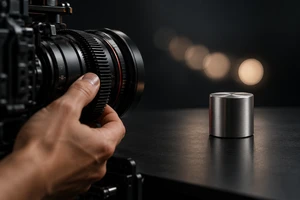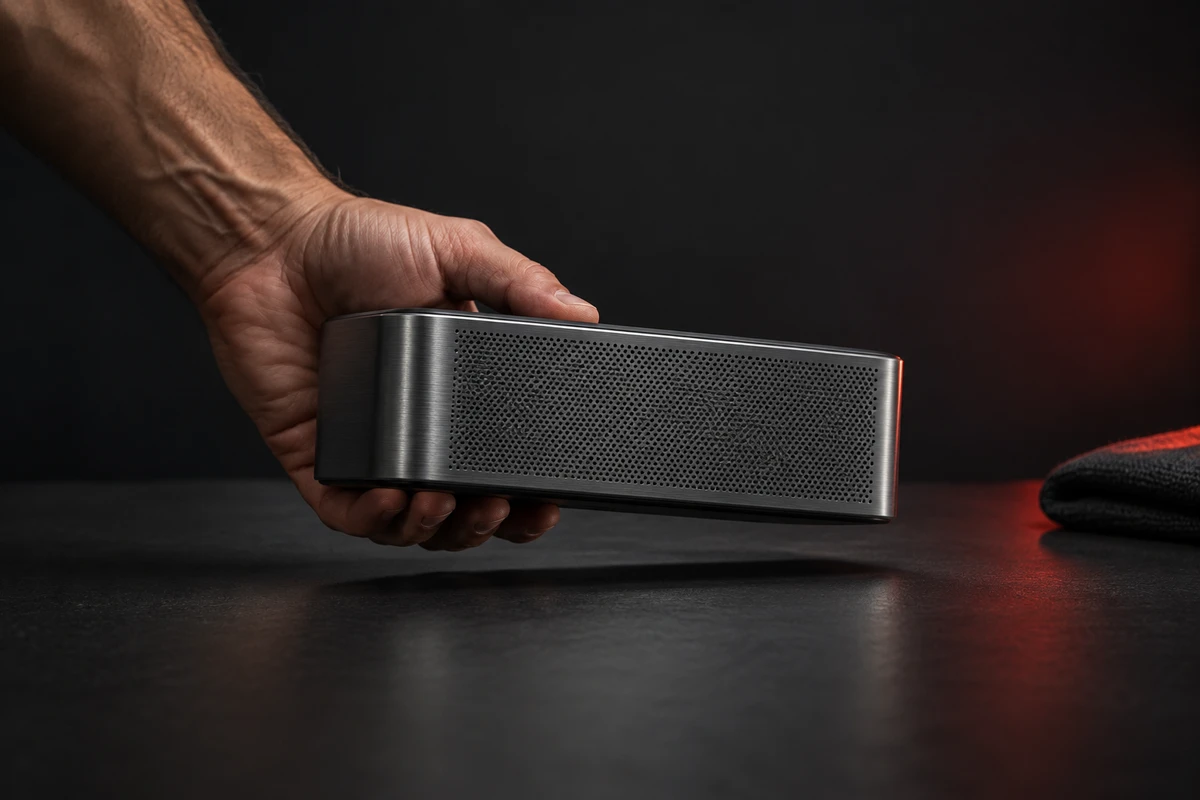
On a set, the same metal speaker can be made to feel like two different weights. If a performer catches the housing with one hand, barely prepares the wrist, and lifts it straight off the table, the object feels light. If the fingers secure their grip first, the arm shows a small transition at lift-off, and the tabletop answers clearly when the speaker returns, the same object feels grounded.
This is more precise than asking someone to “act heavy.” Filming weight in a product ad means coordinating several cues: how the body prepares, how the object leaves its support, whether its motion suggests inertia, how the environment responds at contact, and whether the sound belongs to the same material event. When one cue contradicts the others, portability can look cheap and solidity can look cumbersome.
Weight is an event, not a surface finish
Viewers cannot see a number of grams. They see a sequence: a hand approaches, the object overcomes rest, the body adjusts to the load, and a table, fabric surface, or mount receives it again. Weight lives across preparation, lift-off, transport, and stopping rather than in one attractive frame.
A foundational study on the visual perception of lifted weight found that observers could judge weight from lifting and carrying motion even when the actor and box were reduced to a small set of moving light points. Later work found that lifting kinematics and object size contributed independently to weight perception, with fuller visual information supporting better estimates. The production lesson is not to imitate a laboratory display. It is to avoid making the product shell or a written specification carry the entire sensation.
If an edit removes the instant when the product leaves the table and only shows it already moving, the viewer loses part of the force transfer. If the film shows only a dramatic landing, “substantial” can turn into “rough.” The shot should preserve the parts of the event that actually communicate mass.
The hand gives an answer before the object moves
Contact is not a decorative gesture
Approach speed, grip point, and contact area establish an expectation. A small light product may invite fingertip control and quick placement. A more substantial object often needs the thumb, fingers, and palm to form a stable support. If the performer lifts before the grip is secure, the product looks massless rather than conveniently light.
Lift-off reveals the transfer of force
The most useful moment may be the few frames in which the product leaves the surface. Heavy objects do not look heavy because they are filmed in slow motion. The body prepares, then the arm and shoulder coordinate when the load arrives. A portable object can enter motion more quickly, but it still needs a credible grip and controlled direction.
Stopping exposes false weight faster than cruising
During constant-speed movement, weight differences can be hard to read. Starts, turns, and stops make inertial cues more visible. Instantly freezing a supposedly substantial device, or making a performer lean back theatrically with a small light product, sets the performance against the product claim.
This is adjacent to our guide on action matching across product-video cuts, but the question is different. Match editing protects motion continuity; this article asks which parts of that motion tell viewers how light or heavy the object feels.
Scale, framing, and the support surface create expectations
Large objects often create an expectation of weight and small objects an expectation of lightness, although neither expectation proves actual mass. Product size in frame, its ratio to a hand, familiar reference objects, and visible material all make a prediction before the lift begins.
This is where framing can rewrite the proposition. A compact power station shot from a low angle, close on a wide lens, filling the frame and moved with two hands may lose its message of energy density and become cumbersome. A desktop device sold on stability can look like an empty shell when it floats against a seamless background without a contact shadow.
The support surface performs too. A slight textile depression, contact shadow, strap angle, or foam rebound shows how force reaches the environment. These responses need not be exaggerated, but they must agree with real material and load. A hard table should not bend to make an object seem heavy, and a synthetic shadow should not conceal an impossible force relationship.
Portable and substantial are different commercial values
Brands often ask for a product to feel both light and premium, then combine effortless tossing with heavy bass and slow, monumental camera movement. The result is not two benefits at once. It is uncertainty about the intended experience.
Portability usually connects to moving, packing, one-handed use, and carrying for longer periods. Let the product enter a bag, pocket, hook, or mobile workstation without burdening the body. The point is smooth, directed action, not throwing the object into the air to prove that it has no mass. When the product safely allows it, completing one real task with one hand says more than a beauty spin.
Substantial weight often supports stability, damping, durability cues, or the character of professional equipment. It does not require strained facial acting. A base can remain planted, a control can stop with deliberate resistance, or a device can stay put while it is operated. Those cues can strengthen a lock, tool, desktop speaker, or professional instrument while hurting the proposition of travel gear or wearables.
Sound should do more than enlarge the impact
When a product lands, locks, closes, or reaches the end of a rotation, sound completes information the viewer cannot touch. One study reported that auditory pitch affected perceived weight while loudness did not show the same effect. That does not create a universal rule that low pitch equals heavy. A 2025 open-access study also showed that people could learn a new audio cue to weight for motor planning, while its perceptual effects did not simply duplicate a natural visual cue. For production, frequency structure, onset, decay, and material resonance deserve more attention than volume alone.
A thin plastic enclosure paired with an oversized metallic thud makes the sound suspicious. A dense device with only a weightless high tick can weaken the image. Foley should begin with the real interaction: metal, wood, fabric, or rubber; a solid body or cavity; a slide, drop, latch, or stop. The sound should identify the physical event before it decorates it.
Music can also erase the evidence. If a musical downbeat covers the contact sound, the audience hears editing rhythm rather than object feedback. If several mechanical effects arrive on the same frame, one clear action turns into anonymous noise. Weight becomes credible when sound and motion describe the same physical event.
Cinematography and editing should not secretly change mass
A low angle, compressed perspective, slow push, and high-contrast light can all create gravity, but they alter the viewing attitude rather than the object’s actual mass. If the performance remains effortless while the camera tries to make the product monumental, those layers separate. Build a credible interaction first, then decide how much emphasis the shot needs.
Slow motion needs the same restraint. It can reveal contact, deformation, and particles, but it also makes a small light object feel more consequential. For a portability claim, excessive slow motion can rewrite the experience. For a stable product, slow motion without visible load exposes an empty performance.
Do not split pickup, transport, and placement into three unrelated beauty shots. Weight cues need cause and effect: where the hand grips, how the object leaves, whether the next shot carries the same load, and how the landing continues the direction. Our article on product action match editing shows how to protect that continuity across cuts.
Review silently, then listen without the picture
First mute the film. Without subtitles, can viewers distinguish lift-off, turning, stopping, and placement? Do the hand, shoulder, center of gravity, and product motion belong to the same load? If the weight disappears when slow motion and music are removed, the visible mechanics need more work.
Next hide the picture and listen. Can you identify the contact material and action type? Is it a latch, collision, slide, or landing, or has every movement become the same low-frequency boom? Bring both tracks back together and check that they support portability, stability, or precision rather than describing different product personalities.
This method has a firm limit. Advertising must not fabricate load ratings, drop resistance, or material performance. Specifications and safety capability still require evidence from the brand. Weight-focused production helps viewers understand a real use experience; it does not replace parameters, certification, or testing.
If you are planning a product film for an appliance, consumer device, tool, or cross-border launch, send ONCE the sample, actual weight, core handling actions, and target platforms. During storyboarding and a lens test, we can compare grip, camera position, support surface, and sound treatments so that “portable” or “substantial” becomes a visible product value.
Sources reviewed on November 2, 2026: Runeson and Frykholm, “Visual perception of lifted weight”; Grierson et al. on lifting kinematics and extrinsic object characteristics; Takashima on sound and weight perception; and Negen et al. (2025) on learned audio cues to weight. The research explains perceptual mechanisms and does not guarantee the performance of an advertising concept. The production situations in this article are method examples, not client results.