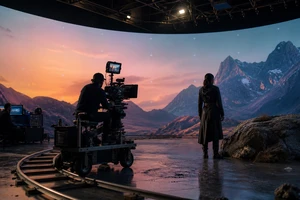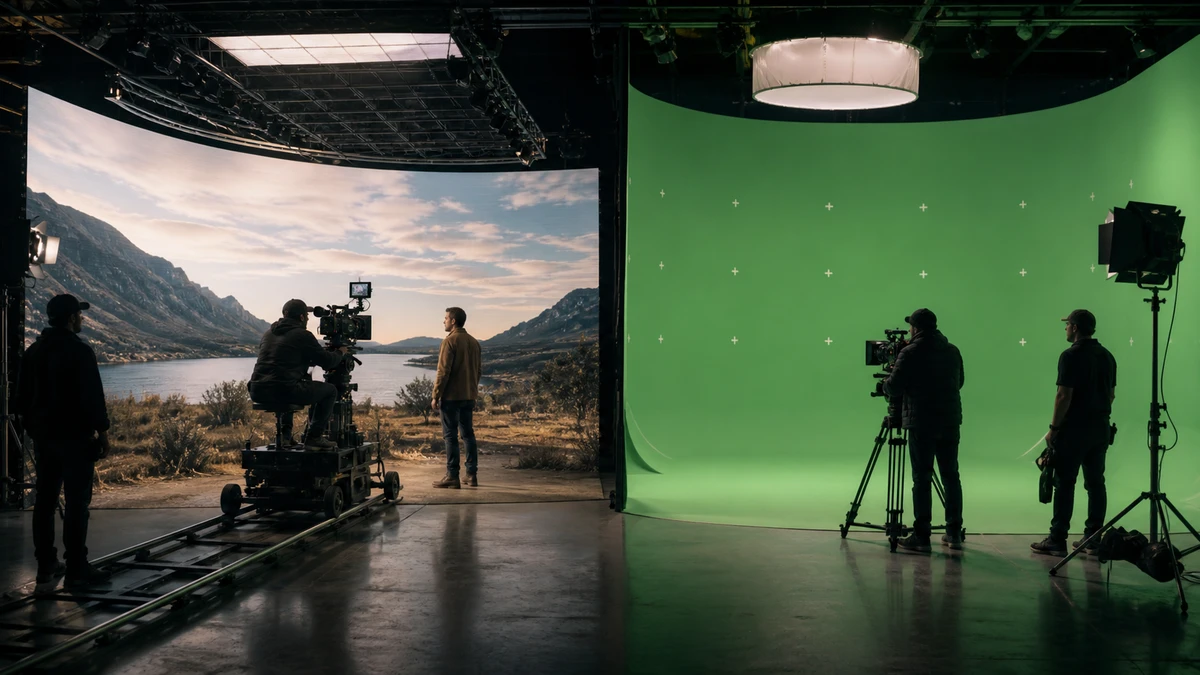
When selecting a production method for brand commercials, clients often ask if LED virtual production is expensive or if green screens are obsolete. This framing reduces the decision to a hardware contest, when the real comparison involves how shot goals, pre-production, on-set time, and post-production edits interact.
Both LED and green screen place actors in digital environments. The difference is that LED displays part of the final image and ambient lighting during filming, while green screen defers background separation and replacement to post-production. Projects should be evaluated shot by shot, and many commercials ultimately adopt a hybrid approach.
If you are still setting up an LED workflow, refer first to The Complete LED Virtual Production Workflow, as this article focuses on choosing the right approach.
The first factor is digital assets and previsualization.
LED stages require real-time digital environments ready before filming begins. Scenes must match the camera’s field of view, focal length, and movement range while maintaining stable rendering performance on set. Directors, DPs, and production designers can previsualize composition, lighting, and blocking in the virtual space, with revisions completed before principal photography.
Green screens have lower real-time demands for background assets. Backgrounds can be modeled, rendered, and modified after filming, making this approach ideal for projects where the creative direction is not yet finalized or when the same footage must adapt to multiple environments. This shifts the workload to post-production, simplifying pre-production scheduling.
If a commercial features extensive reflections, transparency, and close-up interactions, LED walls offer greater on-set reference value. The screen casts ambient light and partial reflections directly onto actors, vehicles, or props. However, if the shot simply shows talent against a plain background with frequent post-production environment swaps, green screen is often more flexible.
The second cost factor is on-set time and equipment coordination.
LED production requires coordinated operation of camera tracking, lens calibration, real-time engines, render nodes, display synchronization, and on-site technicians. Before principal photography, checks for moiré, viewing-angle color shift, brightness, focus, and latency are essential. Thorough digital scene preparation allows on-set time to focus on performance and camera adjustments; inadequate preparation turns the stage into an expensive debugging session.
Green screen setups are relatively straightforward: lighting, camera work, and performance are completed first, with backgrounds composited in post. They still carry technical requirements—screen uniformity, edge motion, green spill, wardrobe colors, and tracking markers all affect post-production. Without a real-time system on set, post gains additional keying and edge-refinement work.
Brand films often require rapid shooting of multiple versions. If LED set changes can be handled with pre-prepared scenes, switching between options may be seamless. If each version requires ad-hoc asset and render setting adjustments, on-set time will be consumed by version management. Clarify this on-set coordination separately when requesting quotes.
The third cost factor is post-production compositing and edge-related risks.
LED inner-frustum displays show virtual backgrounds synchronized with the camera’s perspective, allowing parallax and spatial relationships to be evaluated on set. Contact lighting between actors, props, and the environment also appears earlier in the frame, reducing post-production workload depending on the shot.
The advantage of green screen is that clean background separation provides greater control in post-production. Weather, architecture, framing, and motion can all be reworked, provided foreground edges, hair, transparent objects, and motion blur are captured cleanly. If complex edges lack sufficient on-set reference, post-production cleanup will still be time-consuming.
LED walls do not automatically eliminate post-production work. Screen stitching, moiré, color matching, reflection cleanup, and discrepancies between virtual backgrounds and practical elements may still require compositing. It is more accurate to view LED as shifting some workload to the set rather than eliminating post-production entirely.
The fourth consideration is the cost of creative changes.
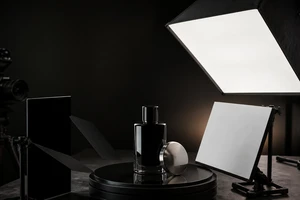
If a director needs actors to make decisions based on real ambient light, reflections, and ground interactions, LED enables earlier creative judgment. Metallic packaging, car paint, glass containers, and wet surfaces common in commercials can all benefit from visible on-set lighting and reflections.
If clients may change product colors, background locations, or seasonal atmospheres after filming, green screen or CGI offers greater flexibility. LED digital environments can also be modified, but changes must be validated against assets and equipment usable on set, and revision time must be factored into the production schedule.
Hybrid approaches are often more practical.
Current Unreal Engine virtual production documentation suggests a hybrid approach: use green screen within the camera frame while LEDs outside the frame continue displaying the virtual environment to maintain on-set ambient light and reflections, with background compositing completed in post.
This approach suits shots with complex foreground edges or unfinalized backgrounds. It also benefits reflective products and transparent props, as screen-provided environmental references reduce unnatural reflections that occur when actors and objects are surrounded by pure green. Hybrid workflows still require tracking, calibration, and sync testing; the workload does not automatically drop to zero.
Pre-Selection Shot Checklist
- Does the shot require on-set visualization of true parallax and spatial relationships?
- Do actors, props, or product surfaces rely on environmental reflections?
- Can background assets achieve real-time performance before filming?
- Is the client likely to request frequent background and version changes after shooting?
- Do foreground edges include hair, transparent objects, fine details, or heavy motion blur?
- Are tracking, rendering, display, and color management personnel available on set?
Neither LED nor green screen is inherently superior. Calculate costs for assets, on-set operations, post-production, and revisions per shot before choosing a single or hybrid approach, so equipment trends are not mistaken for production strategy.