When monitoring on set, I first check whether the tower fan is filmed within a "lifestyle" context, not just whether it rotates. The opening of the Dreo DR-HEC001 video places the white tower fan, interior decor, and an English headline in a single frame; instead of isolating the product like a sterile ID photo, viewers immediately understand which room it belongs in.
My preference is clear: appliance videos should establish the product, action, and space first, then use music and lighting to enhance mood. For Shenzhen appliance videos, this sequence directly affects whether visitors to the product page can skip unnecessary guesswork. The visuals are not a client report or performance spec sheet; their role is to clearly depict a single usage interaction.
First, let viewers identify the product's location.

In Dreo DR-HEC001 Cooling Humidifying Tower Fan Public Case StudyIn the opening, the first frame at 1s does not center the product against a pure white background; instead, it places the tower fan to one side of an interior space, flanked by a wall, seating, and plants. The overlay text “DREO DR-HEC001 / Stay Cool, Stay Moisturized” simply establishes the video’s context and should not be interpreted as a test conclusion.
This step may seem simple, but it actually addresses a fundamental issue in appliance videos: viewers see the product yet remain unsure how it relates to their own rooms. Framing the product within a space allows the camera to naturally convey scale, placement, and viewing angle; relying solely on a series of rotating hero shots before adding contextual scenes often leads to rework on spatial proportions, control orientation, and hand positioning.
ARRI's Lighting HandbookTreat Product Lighting as a distinct area of practice. My on-set understanding is that the primary goal of product lighting is to clearly reveal form, material, and control zones, with stylistic lighting taking secondary priority. For a white tower fan, the bright body, dark air outlet, and black top control panel require tonal separation and must not be flattened into a uniform white mass by broad, even lighting.
Control actions should align the visuals and on-screen text to convey the same message.
The shot at 9s is more informative: a finger rests on the black control panel atop the tower fan, with the circular icon, hand, and unit all visible in the same frame, while “Cool on command” appears in the lower right. The actual fact captured here is that someone is pressing a clearly visible control zone; claims regarding airflow, temperature, or perceived comfort must still be verified against client-approved specifications and test conditions and cannot be substantiated by screenshots alone.
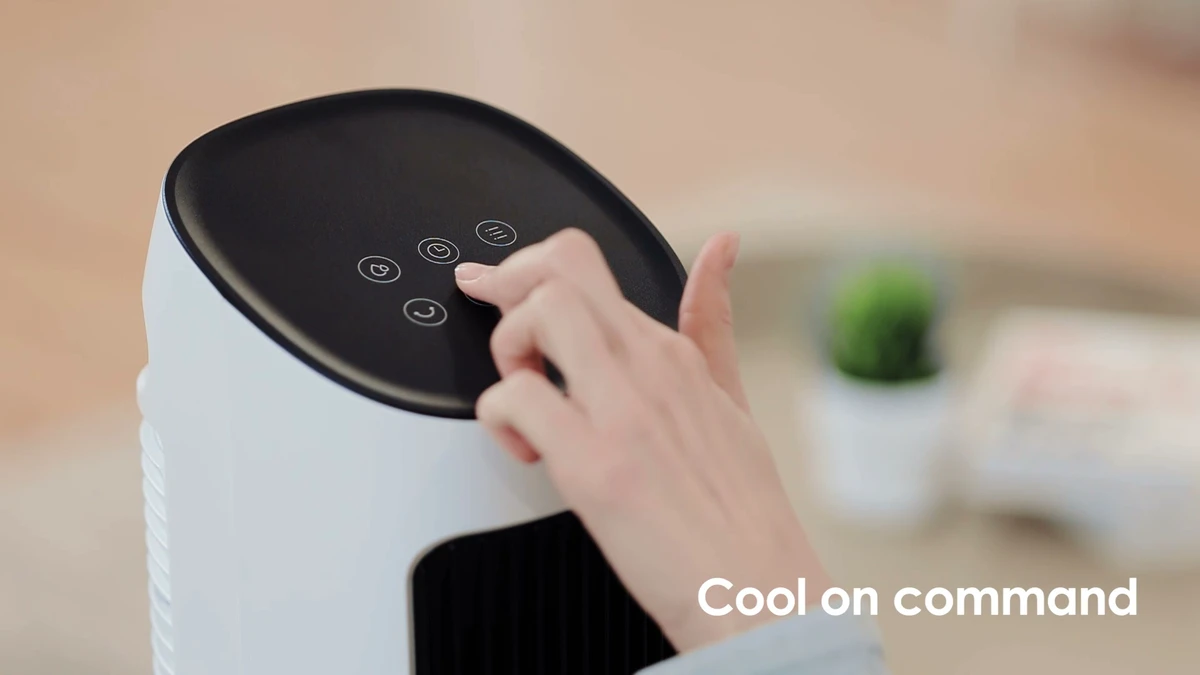
This is also a shot objective I insist on specifying clearly in the brief. The action is not merely a casual press by the talent, nor is the camera simply waiting for an attractive hand close-up. We must first confirm the panel’s orientation, the hand’s entry direction, whether the fingertip obscures any icons, and whether the press-and-release motion is fully captured before selecting the focal length for the close-up. Captions serve only to describe what is happening on screen and should not expand “Cool on command” into “instant cooling” or any other claim unsupported by documentation.
If the budget allows for only one round of pickup shots, I prioritize maintaining the continuous relationship of 'full panel view—hand action—product response area' over shooting an extra set of aimless orbiting shots. The key light establishes the subject's brightness and direction, while negative fill uses a black flag to absorb bounce light on one side, separating the black control panel from the white housing. Together, they often prevent more review disputes than adding another moving camera would.
Lifestyle shots demonstrate spatial relationships, not performance proof.
In this 19-second lifestyle shot, a woman sits reading on a sofa with a tower fan in the left foreground. It does not cut her expression into a 'comfortable after use' conclusion, nor does it relegate the product to the background as mere set dressing. The person, sofa, tower fan, and reading action form a legible relationship showing who the product is beside, which way it faces, and how much space it occupies.
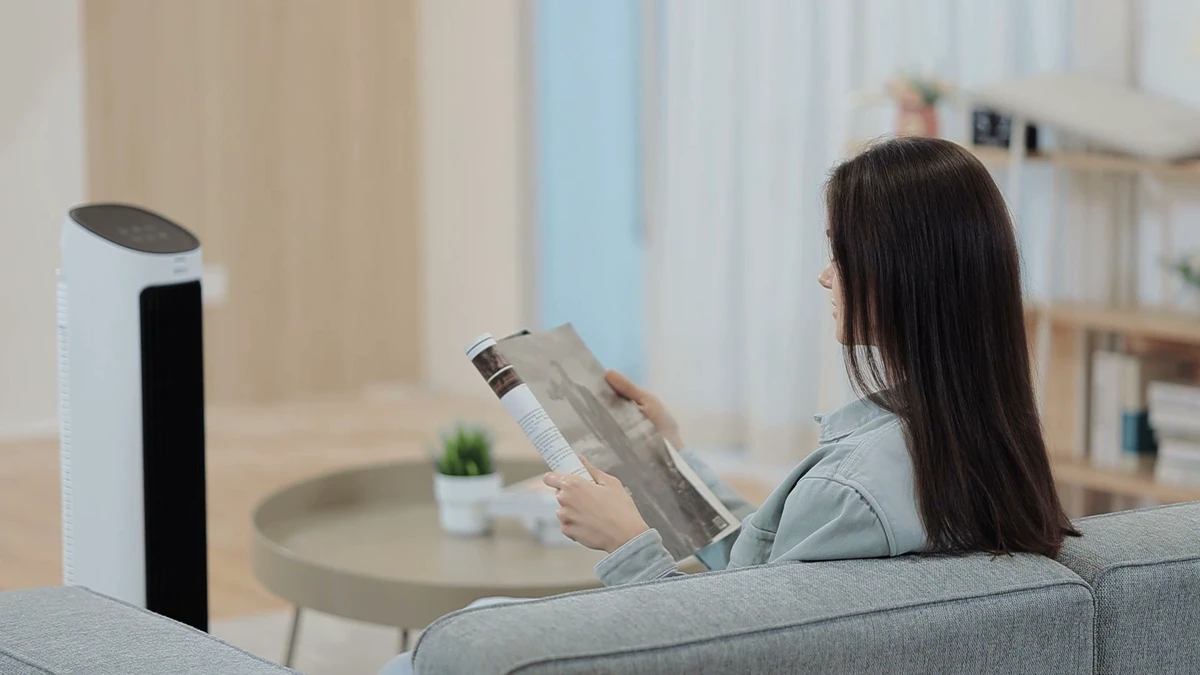
Such shots are worth including in storyboards for Shenzhen product video shoots, but their boundaries must be defined in the acceptance checklist. Amazon Seller's Product Video Guidelinesstate that videos can place products in usage and functional contexts to supplement details static images cannot convey. I interpret this as a narrower directive: help viewers understand 'who interacts with the product in what space,' without framing lifestyle shots as client results or performance proof.
There is an honest limitation here: the same footage can illustrate placement, action, and viewing paths, but cannot prove wind sensation, humidity, noise levels, energy efficiency, or long-term outcomes. Such claims require client-provided verified parameters, test records, and platform-compliant language. Screenshots serve solely as editorial illustrations for this article and do not constitute proof of client results or third-party rights clearance documents.
Three-Panel 'Action—Function—Space' Acceptance Card
To move on-set playback reviews beyond subjective aesthetics, I condense the first-round acceptance of appliance product videos into three frames. Each frame corresponds to a timecode in the shot list and a screenshot in the deliverables.
- Product and Space:Can the product, placement, and primary spatial relationships be identified simultaneously in the first frame? Subtitles must not obscure the product outline, and the shot cannot be merely an atmospheric empty scene.
- Controls and Actions:Is the hand movement complete from entry to contact to exit? Are control icons legible? Do subtitles describe only visible actions without inferring performance claims absent from reference materials?
- Talent and Usage:Do the talent and product share the same visual path? Does the action clarify who is using it, where the product is, and why the camera holds this position? Without client testing, do not edit expressions and lifestyle shots into performance promises.
This checklist also guides budget allocation: if Frame 1 fails, avoid renting a larger venue; if Frame 2 fails, prioritize reshooting control panels and hand blocking; if Frame 3 fails, then discuss adding talent or lifestyle scenes. This turns rework from 'reshoot for better vibe' into targeted pickup tasks.
Real FAQ
Are live actors mandatory for Shenzhen appliance product videos?
Not necessarily. If the product requires demonstrating buttons, opening mechanisms, installation, or accessories, hand-object interaction alone suffices to establish operational proof; real people are warranted only when spatial scale, usage posture, or lifestyle context is central to the decision. Real people are not mere atmospheric decoration; they must serve a clear shot purpose.
Can functional subtitles replace control actions?
No. Subtitles can help viewers understand terminology, but they cannot prove which area a finger actually pressed, nor can they replace performance specs, parameters, and test conditions from client documentation. Retain at least one unobstructed operation shot before deciding how to condense subtitles.
With only one prototype available, how can Shenzhen product video production costs be controlled?
First, create a "Product–Action–Space" shot list to schedule all wide shots, control close-ups, and lifestyle interactions within the same scene in one pass, then capture reflections, cables, and subtitle-safe areas separately. Avoid aimless orbiting shots; prioritize continuous actions that can be edited into e-commerce clips, as this typically facilitates version splitting in post-production.
Can case study screenshots directly prove product effectiveness?
No. They can only demonstrate the composition, action, or spatial relationships present in a specific public case; product effectiveness, client outcomes, platform performance, and copyright scope each require their own verifiable documentation. Screenshots used herein are solely for editorial illustration; actual publication remains subject to client confirmation and authorization documents.
For Shenzhen studio shoots, real-world usage demos, or cross-border e-commerce assets, please refer to ONCE VISUAL'svideo production services. Actual filming must adhere to the product manual, client-confirmed specifications, current platform guidelines, and final authorization documents.