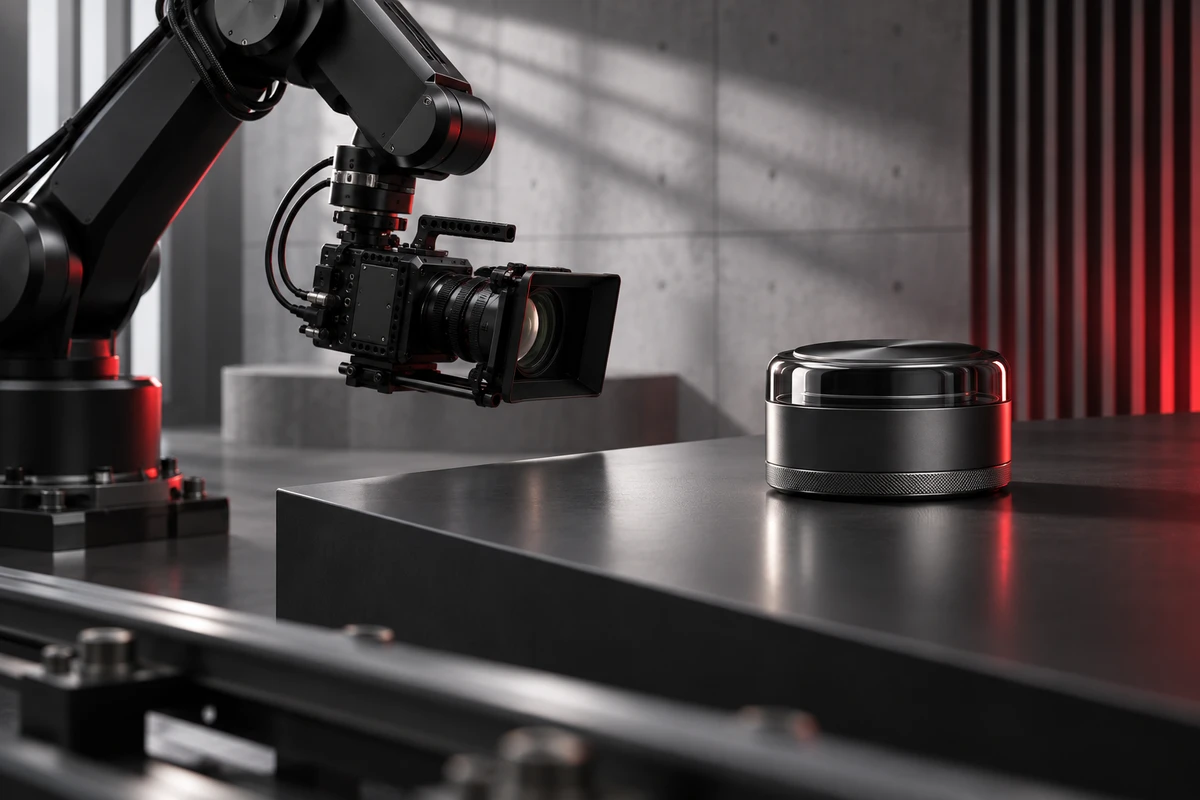
Camera movement can make a product film feel like an advertisement almost instantly. A dolly push, robotic orbit or macro slide adds energy, but visible production value is not the same as product information. Effective product ad camera movement should leave the viewer knowing something new at the end of the move: how thick the product is, which part operates first, where a hand will make contact, or how one change causes the next.
A useful question comes before any move is programmed: What relationship will this motion reveal that a static frame cannot show as clearly? If the answer is only “more premium” or “more dynamic,” the camera may be performing for itself.
Camera movement is a controlled reveal
A static shot lets viewers inspect a product. A moving shot controls the order of inspection. It can begin with one structure hidden and reveal it through a lateral move, travel from a surface highlight to the depth of the side wall, or follow an operating hand until the product produces a visible response. The value lies less in the complexity of the path than in the change in understanding.
A 2023 Journal of Vision experiment compared static viewing, expansive optic flow and lateral motion parallax. The study did not test advertising, but it provides a useful perceptual mechanism: lateral motion parallax improved depth estimates more than static viewing or expansive flow in the tested virtual scenes, while continuous motion provided additional benefits in several conditions. For product filmmaking, this helps explain why a short lateral move with stable reference layers often communicates depth more clearly than a simple push toward a flat background.
Choose the reveal before choosing the rig
The same slider, jib or robot arm can serve very different storytelling tasks. The move should begin with a product question, rather than a preset selected from the equipment's motion library.
Use lateral movement to describe thickness
When the selling point concerns thickness, front-to-back structure or distance between modules, near and far elements need to shift at different relative speeds. A product edge, port or translucent component can provide the foreground layer, while a stable background provides reference. Against a featureless background, the camera may slide without giving the viewer enough information to judge scale.
Parallax does not require a large orbit. A small side move can be sufficient if it separates two layers in sequence. Moving too far can make the silhouette change continuously, forcing viewers to identify the product again while the selling point disappears inside the spectacle.
Use movement to connect cause and effect
In a functional demonstration, the strongest move does more than follow a hand. The camera may track a finger toward a control, then transfer attention toward the state change, airflow or opening mechanism once contact occurs. The move hands attention from the operator to the product.
The action itself still depends on grip, resistance and contact order. Our article on product ad hand performance explores those details. Camera movement can organise attention, but it cannot create physical feedback that the product does not have.
Use relative movement to reveal a surface
Metal, glass, glossy plastic and curved coatings become legible when the relationship between camera, product and light changes. As the camera shifts, a highlight travelling across the surface reveals curvature and transitions. If the highlight moves too quickly, the material becomes a flash. If the light and camera travel together at the same rate, the reflection may barely change and the move adds little information.
Shadows carry a different job: they explain the product's relationship to the supporting surface. Before programming a move, check that contact darkness, cast direction and landing point remain physically consistent. See our guide to product ad shadow design for that part of the image.
A camera move, a zoom and a rotating product are different tools
A push-in makes the product larger in frame, but physically moving the camera also changes perspective, occlusion and parallax. A zoom mainly changes the field of view without producing the same spatial relationship. Both can work, but they answer different questions.
A 2019 EEG study comparing static shots, zooms and physical camera movement found different sensorimotor responses to these techniques. It does not prove that one method sells more effectively. It does show why treating a zoom and a dolly move as interchangeable forms of enlargement ignores a meaningful difference in the viewing experience.
- A physical push can move the viewer into the product's space and change the relationship between layers.
- A zoom can redistribute frame space from a fixed position or create deliberate visual compression.
- Product rotation can present the silhouette, ports and surfaces in a controlled sequence.
Depth can become difficult to read when the camera and product move in similar directions at the same time. A 2022 motion-parallax experiment found that scene-relative object motion could bias depth judgements during simulated observer movement. In a product film, a robot-arm orbit combined with turntable rotation may therefore create ambiguity: viewers can lose track of what is moving and where the structure extends.
A good move creates a clear information gain
Every move has three frames: a beginning, a transition and an end. The beginning poses a question, the transition controls the rate of reveal, and the end delivers the answer. If the first and last frames mean exactly the same thing, the middle may be atmosphere rather than information. If the end introduces an unrelated detail with no visual preparation, the move feels like an arbitrary transition.
Leave one piece of information unfinished at the start
Do not reveal every face, port and accessory in the opening frame. A foreground layer can temporarily cover a mechanism, an edge can continue out of frame, or the functional result can sit at the destination of the move. This is not artificial suspense. It simply gives the movement a reason to exist.
Match speed to information density
A clear silhouette with little change can support a faster move. Dense ports, complex reflections or an active state change need more viewing time. Acceleration and deceleration should also come from the event: settle after a magnetic connection, release speed as a lid opens, and finish when a value stabilises. Our article on waiting time in product ads examines how long a functional process needs to remain visible.
Make the end frame meaningful on its own
Many moves look elegant in motion but arrive at a weak composition. If the endpoint is merely the end of the rig's travel, the editor will have to cut early. Treat the endpoint as a key visual before shooting: the selling point should be complete, the light stable, the product posture clear and the hold long enough for confirmation.
Speed comes from relative relationships
The same camera speed feels faster near foreground objects and slower against a distant, plain background. Speed design therefore involves focal length, distance, foreground layers and product movement together. Increasing robot speed simply to make the equipment feel powerful can create motion blur, jumping reflections and focus pressure, leaving less usable footage in the edit.
For a product positioned around precision, quietness or reliability, a slow and decisive move may express the idea better than a rapid pass. A product built around response, release or lightness may support more speed, but the key structure still needs a readable beat. Camera speed should express product character, not production hardware.
Know when the camera should stay still
Not every product shot needs movement. A static frame gives viewers time to compare, confirm and inspect, while providing contrast for the next moving shot. Consider holding the camera when:
- ports, scales, controls or installation direction need to remain legible;
- the product is already performing an important action and another motion would create a competing centre;
- reflections, liquids or flexible materials already provide enough visual change;
- a strong preceding move needs a stable result frame.
A locked camera does not make the image lifeless. Light, product feedback, the release of a hand and environmental change can still carry time. Stillness also gives the next movement more meaning.
Four questions to test a move on set
- Does the move still explain the product without music? If rhythm is doing all the work, the selling point may not be inside the path.
- Where should viewers look during the move? If camera, product and performer compete for direction, remove one centre of motion.
- What does the endpoint reveal that the start did not? If there is no answer, test a static version.
- Is the camera still accelerating when the product gives its key feedback? The result often needs deceleration, a hold or a directional change to remain visible.
These questions do not judge how expensive the rig is. They test whether movement has become part of the product information.
Let the camera observe with a purpose
The core of product ad camera movement is to make the camera behave like an informed observer. It approaches to inspect structure, slides to read layers, follows to connect cause and effect, and stops to confirm. A complex path can be valuable, but only when it creates a meaningful information gain.
If your product film needs to organise function, material and scale into a coherent visual language, ONCE VISUAL can plan the selling points, motion tests, lighting, action and multi-format edit together. Contact ONCE with your product and core selling point, and we will identify which shots should move and why.
Research sources
This article draws on a 2023 Journal of Vision experiment on expansive optic flow and lateral motion parallax, a 2022 study of scene-relative object motion and depth judgements, and a 2019 EEG study comparing static, zoom and physical camera movement. The studies explain perceptual mechanisms; the production recommendations are ONCE's editorial translation for commercial filmmaking and do not imply that the research measured advertising conversion.