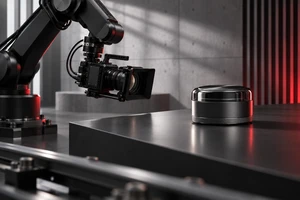
Place the same product on the same surface and change only one thing: keep the shadow attached to its base, or move the shadow backward. The object has not moved, yet viewers read two different states. The first feels grounded. The second appears to float. In product advertising, a shadow is more than the gray area left by a light. It explains how the product occupies space.
Highlights describe surfaces particularly well. Shadows often do more work in describing position, volume, and weight. Where a shadow begins, how hard its edge is, which way it extends, and whether it follows a moving product all affect perceived scale and physical credibility. Removing every dark area may make the image cleaner while also removing the product’s place in the scene.
A shadow first tells us where the product is
Vision research has repeatedly shown that cast shadows are strong cues to spatial layout. A 1997 experiment demonstrated that changing only a moving shadow could create a compelling illusion of motion in depth. A more recent study tested how shadow position affects distance judgments for objects above a surface. Shadows helped observers estimate spatial relationships, although their meaning also depended on light direction and surrounding cues.
This explains a familiar production problem: the contour and material look correct, but the product still feels composited. The failure may not be on the product. The shadow may not establish a believable relationship with the supporting surface.
The contact point creates grounding
Where a product meets a surface, a continuous contact darkening should grow naturally from its boundary. It does not have to be black. Researchers describe the contour junction in this area as an important cue to contact. An unexplained bright gap between object and shadow encourages the visual system to read separation instead.
Shadow separation suggests height
A floating product is not defined only by rigging or vertical displacement. As the shadow separates from the object and becomes softer, viewers are more likely to read distance from the receiving plane. That separation must remain consistent with source size, light direction, and object height. Otherwise, the shadow becomes decoration rather than spatial evidence.
Shadows also explain what shape the product has
Viewers combine contour, shading, and cast shadow when interpreting an object. Experiments published in 2023 found that the presence of a cast shadow made simple geometric forms look substantially more three-dimensional. Even when shading on the product is restrained, a directional cast shadow can restore volume.
Do not merely copy the silhouette
A hard frontal light can create a paper-cut shadow that only says something blocked the light. A slightly lateral source lets feet, handles, and raised details cast different lengths. Those differences tell viewers which parts are close to the surface and which extend outward.
Curves need gradients; edges need direction changes
A rounded product looks flat when its dark transition breaks abruptly. A faceted product loses structure when every shadow is softened in the same way. The shadow character should change with geometry. Source size, distance, flags, and fill all serve that shape.
Why shadowless images often lose scale
E-commerce stills often use nearly white backgrounds and highly filled shadows. Video teams sometimes inherit the same look: lift the surface, brighten every side, and keep the product uniformly visible. This can clarify details while weakening comparisons with the environment. Viewers see what the product looks like but struggle to judge its size, height, or stability.
Keep one familiar supporting reference
Scale does not always require a ruler. Surface texture, an edge, a hand, a packaging tray, or another familiar object can provide a reference. When the shadow reaches that reference, size and height become easier to read. Our article on product ad hand performance explores how contact also communicates weight.
Do not treat every dark area as a defect
The purpose of a shadow is not to make the frame darker. It gives direction to the highlights. If all sides of the product have equal brightness, viewers cannot infer where the light originates, and the form becomes flatter. Shadow detail can be lifted while preserving a hierarchy between key and fill.
Soft and hard shadows create different product characters
Shadow edges are not a simple choice between premium and cheap. A large source creates soft transitions that can feel approachable, clean, and calm. A smaller or more distant source strengthens geometry, speed, and precision. The choice should follow product structure and narrative.
A soft shadow still needs direction
A convincing soft shadow retains a darkest contact area, a readable direction, and an edge that gradually disappears. If the entire shadow is blurred into an even patch, the product floats over gray haze. Softness is a transition, not the removal of lighting logic.
A hard shadow must not become the hero
A hard shadow can act as a second graphic shape, adding tension to technology, tools, or sports products. If it becomes more complex than the object, viewers read the shadow first and search for the product afterward. Changing the light angle, letting part of the shadow leave frame, or reducing background contrast can control its presence.
In motion, the shadow must obey one physical model
Minor inconsistencies in a still become obvious in motion. The product travels along a track while its shadow slides at another speed. The object rotates but the shadow length never changes. A push-in makes the contact darkening disappear. These errors create the feeling of a composite. Research on moving cast shadows shows that shadow motion can even override other depth cues and change the apparent trajectory of an object.
Lock the source before designing the move
If the scene implies a fixed light, the shadow direction should preserve that logic while the product moves. When the shadow changes actively, the shot needs an understandable cause: a moving source, a passing blocker, or the product entering a new pool of light. Do not move the shadow to a convenient side independently in every shot.
Live action, CG, and AI need the same contact rule
Hybrid production often fails at the contact point. The live-action base shadow, CG cast shadow, and environmental light in an AI background must support one another in direction, softness, and density. Our guide to AI product ad background realism covers space and reflections; contact shadow is the physical information all three methods must share.
Test the design with three product states
Before production, show the same product securely placed, slightly lifted, and fully floating. Can viewers distinguish the three states without reading an explanation? If the shadows differ only in opacity, the source and spatial relationship have not been fully designed.
Then view the frame at thumbnail size. Material detail will recede, while the major light-dark relationship remains. If the product still has a clear contact point, shape, and direction, the shadow is carrying useful information. For spatial hierarchy inside packaging, see our article on product unboxing ads.
Make shadow part of the product’s physical credibility
Product advertising does not need the most ordinary real-world light. Shadows can be lengthened, softened, reduced, or used as graphic composition. The design should still answer three questions: what the product touches, how far it is from the surface, and how its shape and weight exist.
If you are planning a product film, studio visual system, or a live-action, CG, and AI hybrid, ONCE can design the shadow relationship from product analysis and lighting tests through compositing. Talk to ONCE about giving your product more volume and physical presence.
Research sources
This article draws on primary research into cast shadows and spatial perception: Moving cast shadows induce apparent motion in depth; The art of the float; General lighting can overcome accidental viewing; and Distance mis-estimations can be reduced with specific shadow locations. The production recommendations are ONCE’s editorial translation of those perceptual mechanisms.