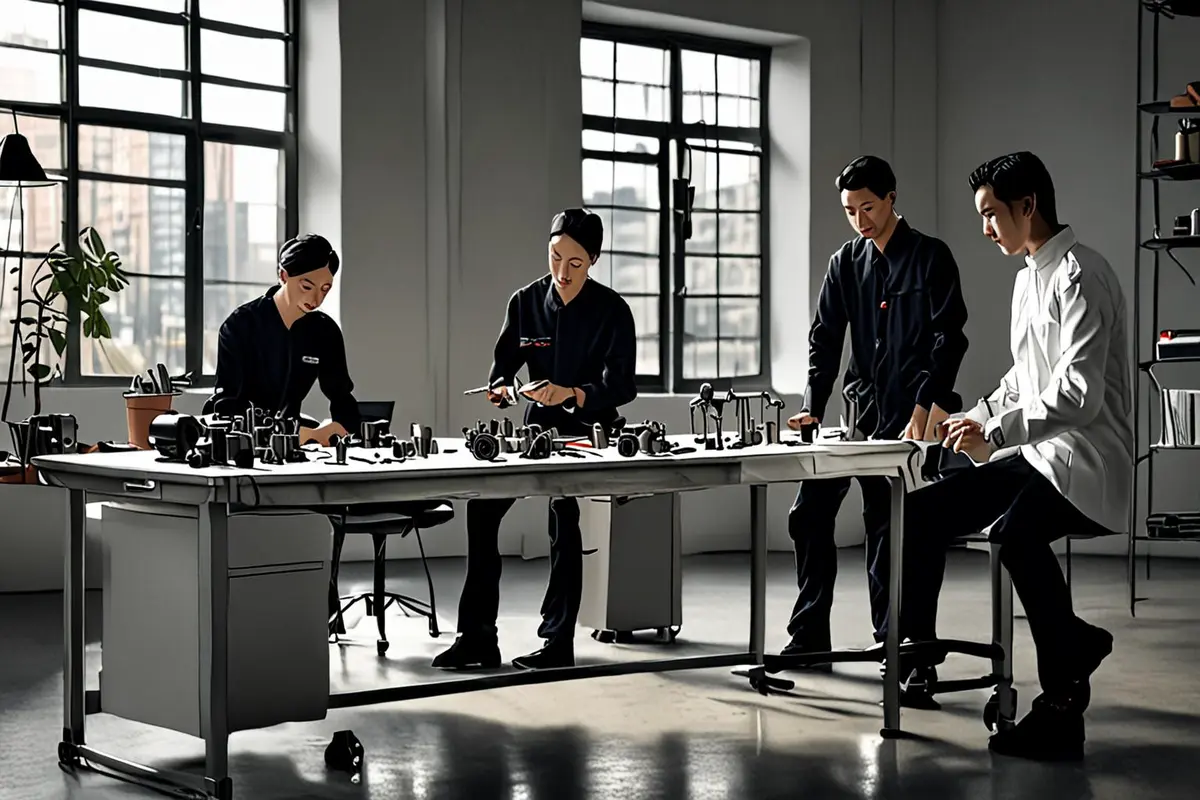
The most familiar teamwork shot in a corporate film puts several people around a table, all looking at the same screen. One person nods, another turns a page, and someone rests a hand on the keyboard. The frame is busy, yet collaboration never happens. Nobody notices something first, no action changes what a colleague does next, and there is no visible handoff of responsibility.
Credible ensemble blocking depends on making the flow of a task readable. One gaze reaches the target first. A document moves toward a colleague. That colleague changes an operation, and a third person responds to the result. The performers do not need to move in perfect unison. They need a clear chain of cause and effect.
Teamwork is a relationship between actions
A solo performance only has to answer, “What is this person doing?” An ensemble scene must also answer, “Whose next action changes because of it?” If every performer completes an isolated piece of business, the shot is simply several solo scenes placed inside one composition.
Research on joint action repeatedly links successful coordination to shared attention, prediction, and real-time adjustment. A 2021 study of joint control found more closely aligned gaze and movement during successful shared actions. A 2025 study of continuous cooperative manipulation observed that leaders looked ahead to future targets, while followers quickly identified intent and alternated between prediction and retrospective checking. For a director, the practical question is simple: can we see one person preparing because they understand what another person is about to do?
Map the task before placing the people
Many corporate scenes begin with a polished composition: a senior figure in the center, supporting staff at the sides, and enough background to establish the company. The positions look balanced, but the actions have no reason to exist. A better starting point is a four-beat task: notice, pass, process, confirm. Blocking should serve that chain.
Give each person different information
If everyone already knows the answer, nobody needs to collaborate. Let person A notice a problem in a prototype. Person B reads the location from A’s gaze or gesture. Person C then brings a parameter, tool, or sample into play. The information gap does not need dialogue. Eye lines, body orientation, and the movement of an object can make it legible.
Give every action a receiver
“Talk naturally” often produces repeated nodding and silent mouth movements. Direct the transfer instead: rotate the tablet toward the person on the right; after speaking, look at the colleague recording the decision; when the result arrives, lower the waiting hand onto the controller. A specific receiver allows one performance to affect another.
Gaze works like invisible editing
Viewers follow a character’s gaze to locate the next piece of information. When the eyes reach a target before the hand, the shot quietly prepares the next action. When the eyes move only after the result, the performer appears to be waiting for a cue. Shared attention does not mean that every person stares at the same point. It means that one person’s attention can guide another person’s choice.
Separate looking at people from looking at the task
A speaker does not need to maintain constant eye contact. People solving a problem move their attention among colleagues, products, screens, and tools. A useful pattern is to confirm the shared target, briefly check the partner, then return to the task. It keeps the human connection without turning the scene into a meeting-room portrait.
Do not make everyone react at once
Perfectly synchronized nods look rehearsed. Let reactions travel through the group. The nearest person notices first, the operator acts next, and the others confirm through the result. That small delay is evidence of information moving from one person to another.
Actions should be predictable without becoming mechanical
Joint-action studies show that people often reduce uncertainty in their movements when they need to coordinate. Direction, speed, and pauses become easier for a partner to predict. A 2017 study described successful synchronized movement as smooth, low in jitter, and mutually predictable. On set, that does not mean making actors raise their hands like dancers. It means giving the initiating action enough clarity for a partner to read and continue.
Choose one initiator for each shot
One person should make the first change to the situation. The initiator may be the most junior engineer or simply the first person to touch the product. Status is less important than causality. Other performers can then respond in different ways, creating hierarchy without forced posing.
Keep the half-beat of preparation
Real collaboration rarely jumps from stillness to completion. A receiver turns, clears a hand, or moves a cup before taking a document. An operator checks the control location before committing. These preparatory movements make prediction visible. If the edit preserves only the passing and receiving endpoints, the coordination feels assembled rather than lived.
Props must participate in the task
Corporate films often use props as professional symbols: a blank drawing, a computer frozen on its home screen, or a display that never changes while people point at it. Performers cannot respond truthfully to an object that provides no feedback, so they compensate with facial expressions.
Build one visible change into the scene
A light switching on, a test value updating, a sample turning to reveal another side, or a drawing moving from the annotation page to the structure page gives the ensemble a shared event. The change can be small, but it must explain why the next person acts. Software and device interfaces should be prepared in a usable demonstration state instead of relying on a static screen replacement later.
Move one object across roles
An object that travels from A to B and changes purpose is direct evidence of cooperation. Its path should be visually clear and physically credible. Passing a heavy item across an impractical distance or asking a specialist to grip a tool incorrectly immediately damages trust. For more on contact and handling, see our guide to product ad hand performance.
Camera and editing should protect relationships
If an ensemble sequence is cut into unrelated close-ups too quickly, viewers lose the spatial relationship between people. Establish the task flow in a medium-wide frame, then use close-ups to enlarge the decisive handoff. A close-up is not equal screen time for every participant. It should answer which detail changed the next step.
Leave space for an action to be received
When a gaze or object travels out of frame, the composition should leave room in that direction, and the next shot should preserve the movement axis. Otherwise, the connection feels broken. Avoid placing every close-up straight toward the lens, because that erases the relative positions that make a group readable.
Cut after intent appears and before the result is complete
Cut too early and the receiver seems to know the task magically. Cut too late and both shots repeat the same information. A useful edit point comes after the initiator’s intention is clear and just as the receiver starts preparing. The first shot poses the problem; the second completes the response. Related timing choices are explored in our article on pauses in corporate interview editing.
How to test whether an ensemble shot feels true
Watch it once without sound. Can you identify who noticed the issue, where the information went, and who changed the state of the task? If the only conclusion is that everyone looks busy, the actions are still happening side by side rather than together. Then remove one performer mentally. If the task chain remains unchanged, that person is probably filling the frame rather than contributing to it.
A corporate brand film does not need to reproduce work in documentary time. It may compress time, rearrange positions, and strengthen gestures. The compressed scene should still preserve attention, prediction, and response. When the film crosses markets, interpersonal distance, gestures, and workplace conventions also need localization; our guide to global brand film localization offers a related framework.
Let viewers see how the team completes one task
Good ensemble blocking does not ask everyone to compete for attention. It gives each role one clear contribution and lets gaze, objects, and outcomes move through the group. Viewers remember more than a polished team portrait. They see how this company notices, coordinates, and moves work forward.
If you are planning a corporate brand film or a workplace sequence, ONCE can help shape the task, performance, location action, and shot design. Talk to ONCE about making real collaboration visible.
Research sources
This article draws on primary research into joint control, gaze coordination, and interpersonal movement: Joint control of visually guided actions involves concordant increases in behavioural and neural coupling; Analyzing gaze and hand movement patterns in leader-follower interactions; and Synchrony in Joint Action Is Directed by Each Participant’s Motor Control System. The production recommendations are ONCE’s editorial translation of those mechanisms for commercial filming.