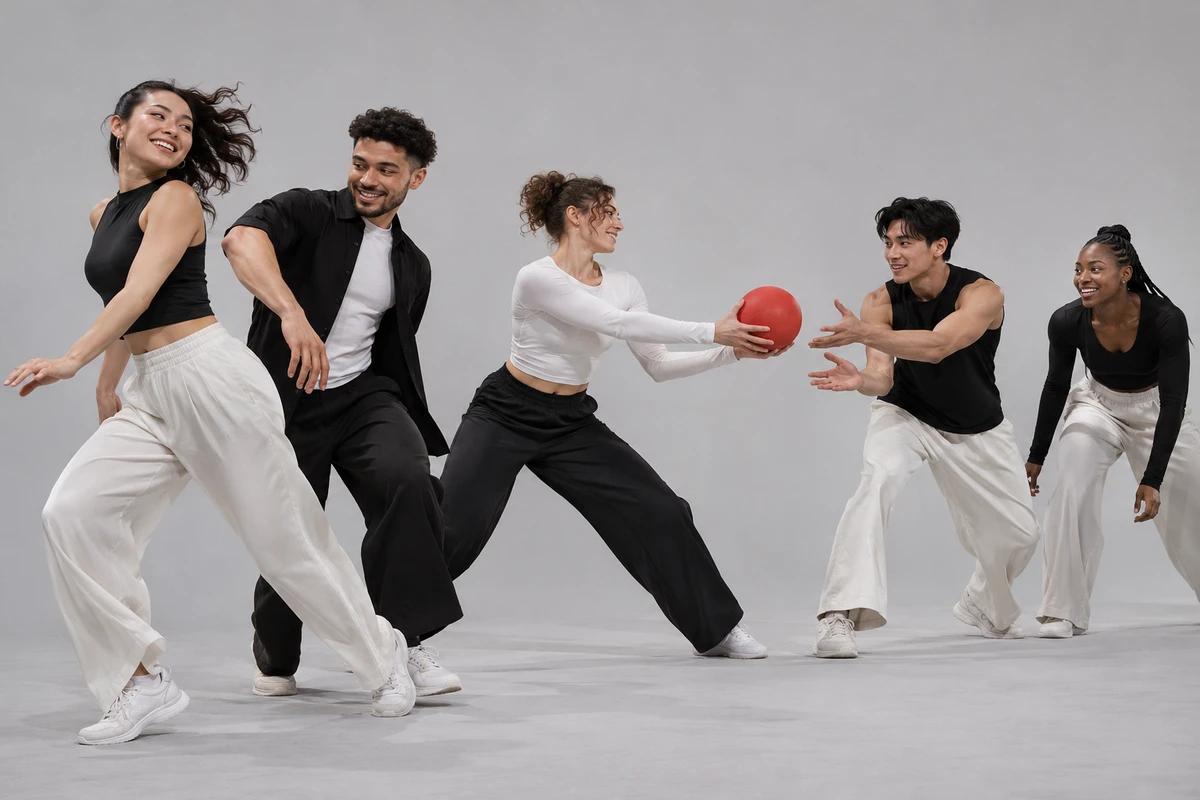
A group turning, raising their hands, or stepping forward together can give an image immediate force. Yet when every performer uses the same amplitude, expression, and timing, the cast can collapse into a moving background. Group choreography in advertising is therefore not a question of whether everyone is perfectly synchronized. It is a question of whether viewers can read two things at once: these people belong to the same situation, and each person still has a task and a response of their own.
This decision appears in sports, automotive, home appliance, technology launch, and brand purpose films. It shapes rehearsal, camera placement, edit points, and whether the soundtrack turns every action into a single beat.
Start with the reason everyone moves
Synchronized action is most convincing when the group shares a trigger: a light comes on, a door opens, a race begins, a train arrives, or a product changes the state of the space. Viewers see the cause before they see multiple responses, so coordination feels like a consequence of the relationship.
When a script merely says that everyone gets excited, the set often defaults to simultaneous cheering, pointing, and head turns. The timing may be accurate, but the performers have no object. A better rehearsal asks what each person notices first, who reacts immediately, who needs confirmation, and who is influenced by someone nearby. The event remains shared while the route into it differs.
Three timing relationships create three kinds of group
Unison creates rules, force, and a decisive turn
Completing one action on the same beat suits moments of ceremony, competition, or mechanical precision. A row of riders fastening helmets together, or several car doors closing on a musical accent, can produce a clean statement. The shorter and clearer the action silhouette, the stronger unison becomes. If an entire performance stays in unison, however, viewers may remember only the formation.
Staggered timing lets one event move through different people
A delay of half a beat or several beats preserves a shared direction while giving each performer time to observe and respond. One person notices, another follows the gaze, and a third acts last. The image still has order without looking duplicated. This relationship suits homes, offices, streets, and other lived settings, where real people rarely complete every action at exactly the same moment.
Relay timing turns a group relationship into a story
A relay is more than performing actions in sequence. One person's action changes the conditions for the next: passing an object, clearing a path, lighting the next area, or transferring attention to another character. This can place product function inside a human relationship while creating clear units for a horizontal master, vertical cutdowns, and still frames.
Research suggests coordination is not the same as uniformity
A 2018 study in Topics in Cognitive Science used wrist accelerometers to distinguish unitary synchrony, in which everyone moves together, from distributed coordination, in which members respond to one another. Distributed coordination predicted how much participants liked one another and identified with the group, while unitary synchrony did not predict prosocial behavior.
The study used small-group choreography tasks. It was not an advertising effectiveness experiment, so it cannot show that a blocking pattern will increase sales or brand favorability. Its creative implication is narrower and more useful: when the goal is to show a relationship rather than a drill, directors can design mutual response instead of locking every performer to the same frame and amplitude.
The camera must show relationships as well as numbers
A wide shot explains the group's shape but may not reveal who affects whom. A practical sequence uses a wide frame to establish the shared event, a medium frame to preserve a response between two or three people, and a close shot to confirm a key gesture or product contact. Wide shots alone turn people into pattern; close shots alone remove the collective.
Camera position should also preserve the action's logic. Relay movement needs both characters and the path between them. Staggered timing needs room for eyelines and delay. Unison needs silhouettes that separate cleanly from the background. ONCE's article on crowd blocking and visual order in TVCs covers the production organization; this article focuses on what movement relationships mean.
Editing and sound determine whether order feels human
An edit does not have to land on every completed action. To emphasize unison, cut at the shared exertion. To preserve difference, hold half a second longer for a hesitation or a supplementary gesture. Cutting every performer to the same beat strengthens order, but it can also erase weight, sequence, and response.
Sound can preserve layers. Shared footsteps, clicks, or impacts provide a common pulse, while clothing movement, breathing, distant replies, and ambience retain individual positions. ONCE's discussion of performance direction in product advertising offers a related test: are performers completing a task, or simply waiting for a common cue?
Preserve differences in rehearsal before choosing the shared beat
Begin with a natural pass in which performers complete their character tasks without a fixed tempo. Identify the single action that the audience truly needs to see together. Lock only that moment in the second pass and preserve individual reactions around it. Add camera movement and sound timing in the third pass, then check whether the coordination still appears to come from the situation.
During review, ask three questions. Without music, is the shared trigger still legible? If the frame is paused at random, does everyone look as though they are demonstrating the same move? If only two people are watched, is there still a readable influence between them? These questions produce more actionable direction than simply asking for greater precision.
The strongest group image keeps people inside a shared direction
Unison is useful for declaration, staggered timing for lived behavior, and relay timing for narrative. One film can move through all three: an individual notices, a relationship spreads the response, and the group resolves on one clear action. The brand gains order while the audience still believes that the image contains people rather than copies.
If you are planning a brand film with ensemble performance and multiple deliverables, explore ONCE's brand campaign video production. Bring the character relationships, shared event, and distribution formats, and we can turn the movement concept into blocking that can be rehearsed and filmed.