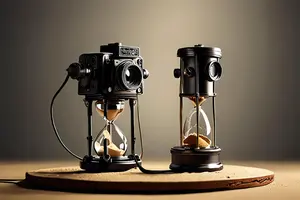
A hand lifts a product from a real table. The camera moves toward a metal edge, and a moment later it is traveling through a microscopic world of circuits, fibers, airflow, or material texture. This kind of scale transition is powerful because it can make invisible value visible and let live action and CGI do different jobs. Yet if direction, speed, light, or sound breaks, viewers immediately feel that they have left one product film and entered a separate animation.
A convincing transition does not depend on complexity. It depends on whether viewers can keep answering three questions: Am I still looking at the same product? Where did the camera enter, and where is it moving? What do I understand after entering the micro world? When those lines remain clear, the film can be visually bold. When they disappear, more particles, fly-throughs, and exploded views only make the product easier to lose.
The first job of a scale transition is to preserve product identity
Moving from a wide shot to a macro shot and then into CGI changes the visible proportions continuously. Viewers need at least one identity anchor that does not vanish at the same time: a distinctive bevel, a seam, a color, a button position, a reflection, or an action they can follow. The anchor need not stay in the center, but it must connect the macro and micro views to the same object.
If the film shows the full front of a device and then cuts to a directionless collection of parts, viewers have to use the voiceover to guess the relationship. A stronger transition moves toward a specific region, such as a vent, woven mesh, or transparent cover, and lets that shape or texture become the entrance to the CGI world.
Decide why the camera becomes small before designing the spectacle
A micro view works when it explains a relationship the eye cannot see directly: air passing through layers, liquid moving through a channel, light traveling through a structure, heat leaving a surface, or a material creating a particular appearance. It is less useful when it replaces a benefit that real action could already show clearly.
Before designing the shot, reduce its purpose to one sentence, such as “Why does the device continue to dissipate heat while held?” Avoid a vague instruction like “show advanced technology.” The first sentence determines an entrance, path, and result. The second usually produces generic blue particles and movement without meaning.
Establish real scale before leaving it
If viewers do not know how large the product is, a dramatic micro world has no reference. Our article on scale in product videos recommends one complete pickup that relates the product to a hand and its environment. A scale transition needs the same starting point: let the product become stable on a table, in a hand, or within its use space before moving toward a detail.
This does not require a long take in every film. A medium shot, a continuous pickup, or a familiar object in the same frame can establish the real baseline. The more extreme the micro world becomes, the cleaner that baseline should be.
Use a real surface as the entrance, not a cloud of effects
The easiest transition to break is one that covers the product with flares, smoke, or particles before the surface is readable. The effects hide the edit, but they also erase the point of entry. Viewers see a switch rather than an entrance.
A stronger doorway comes from a physical surface fact: the direction of brushed metal, the openings in a textile, refraction in a clear part, the edge of liquid, a lens coating, or the subtle curvature of molded plastic. Live action establishes that feature, and CGI continues to enlarge the same texture, direction, and color. The transition feels like a change in observation scale rather than a change in visual packaging.
Camera speed should change with scale
Moving ten centimeters across a real table should not feel the same as crossing an equal distance on screen inside a microscopic structure. The closer the camera gets to a surface, the more significant a small movement becomes. Once it enters a larger internal space, speed can expand again. If the camera accelerates continuously from macro to micro, the product feels thin and the internal world loses depth.
A useful rhythm is approach, slow, cross, and re-establish. The approach identifies the entrance. Slowing makes the surface readable. Crossing changes scale. One or two stable references after entry restore direction. The speed curve itself becomes evidence of scale.
Let focus change before the space changes
A macro lens creates shallow depth of field. As focus moves from the product edge to its texture, viewers are already prepared to look closer. The CGI shot can inherit that focus movement, allowing the sharp region to move from a macro detail into an internal structure. If live action remains completely sharp and the CGI world suddenly becomes extremely shallow, the two spaces use different rules of observation.
Focus should also do more than create attractive blur. It tells viewers which layer matters now and where the next layer begins. After entering the micro world, clarify the key structure before adding background complexity.
Carry one light direction across the scale boundary
A side light may shape the real product, while the CGI interior suddenly uses flat futuristic illumination. That change makes the two parts feel unrelated. Preserve one clear light direction before entry: a moving highlight, a sweep of light, or a controlled move from bright to dark. Inside, continue the same direction, color temperature, and contrast before developing any new internal source.
Materials should follow the same logic. The width of a highlight on real metal, the roughness of plastic, and the layers of reflection in glass should inform the CGI material. Both versions need not match pixel for pixel, but a restrained physical object should not turn into an over-glowing concept model.
Directional continuity matters more than elaborate matching
A product rotates from left to right in live action, while its internal mechanism unfolds in the opposite direction. The camera enters through the top connector, but CGI appears to look upward from the base. Viewers may not name these errors, yet they feel the discontinuity.
During preproduction, define three coordinates: the product's front, gravity, and the camera's entry direction. Use them in the 3D scene, animation path, and composite. The internal structure can still be simplified for clarity while remaining placeable inside the real product.
Live action carries weight; CGI carries invisible relationships
A scale transition should not uproot the object from the physical world. A hand supporting the product, a device meeting the table, or a mechanism closing gives it weight before entry. Our guide to physical weight in product ads explains how contact shadow, deceleration, surface response, and sound work together. These cues are often strongest when protected in live action.
CGI is better suited to paths a camera cannot reach, controlled reveals of structure, and compressed time. One medium is not inherently superior. Live action proves that a product exists and touches the world; CGI explains invisible cause and effect.
Sound is the cheapest connection and the easiest to neglect
As the picture enters the micro scale, sound can shrink the world first. Room tone narrows, friction, startup, or airflow moves closer, and the rhythm of internal motion grows from that same sound. The image may change radically while the ear stays on one causal line.
A common failure is to mute live action and start the CGI section with a huge science-fiction impact. The animation then feels like a packaged insert. Sound design does not need to claim that the real interior was recorded. It needs continuity among material, action, and rhythm, without using exaggerated effects to imply unverified performance.
Keep one readable scale reference inside the micro world
Once inside, every object can appear to float in limitless space. Preserve part of the casing, a fixed connector, one material layer, or an assembly axis as a reference. Viewers do not need precise measurements, but they need to know what is outside, what is inside, and what the motion is relative to.
A fully transparent product is not always the clearest answer. Too many layers overlap, especially on a phone screen. A controlled section cut with a fixed reference often communicates more than an entire transparent shell.
The film must find a way back
Many films place their most exciting CGI sequence in the middle and end directly on a logo. Viewers may understand the micro world without returning that understanding to the physical product. The return shot should confirm at least one thing: arrive at the same entrance, let the internal action trigger an external response, or allow the character to continue the action that began before entry.
For example, enter through a vent, show airflow, then return as the user feels the air and continues the task. Enter through textile openings, show the layers, then return to a hand touching the same region. The return is not another hero shot. It proves that the microscopic explanation and the real experience belong to one product.
AIGC can extend the space, but it cannot replace product coordinates
Generative imagery is useful for exploring textures, abstract flow, and impossible spaces. Product structure, connector positions, part counts, and real materials still need confirmed references. If the model changes openings, edges, or movement direction between frames, the transition loses its identity anchor.
A hybrid workflow can use AIGC for concept previs, environmental extension, and atmosphere, while live action, 3D, and compositing lock the product body and causal relationships. When a film explains a real internal principle, the evidence must return to the sample, engineering assets, and brand confirmation.
Review the transition three ways
- Watch without sound. Check whether the entrance, direction, speed, and return path remain readable.
- Watch only the two seconds before and after the cut. Check shape, light direction, focus, and motion continuity.
- Ignore voiceover and captions. Decide whether the micro sequence adds understanding or only visual stimulation.
If removing the micro sequence loses no product value, it may be decorative. If keeping it still leaves viewers unsure where they entered or returned, the visual system is incomplete. A strong scale transition adds knowledge without removing orientation.
The bolder the scale change, the clearer the physical anchor
Moving from a real table into a CGI micro world takes more than an effect layer joining two images. Product identity, purpose, camera speed, focus, light, direction, weight, and sound must continue through the change. The micro world reveals value the eye cannot see; the physical world makes that value believable.
If you are planning a product film that combines live action, CGI, or AIGC, explore ONCE hybrid production. We can begin with the real sample, the entrance shot, and the invisible information that needs explanation, then design a scale path that enters clearly, communicates, and returns to reality.