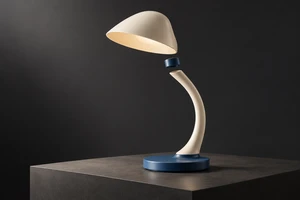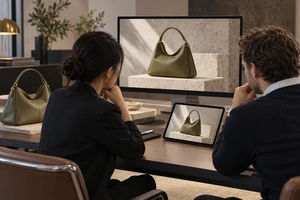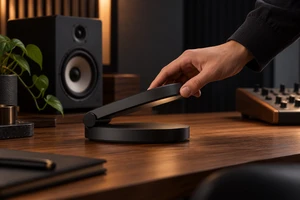
A product can look substantial in a close-up and compact in someone's hand. Both images may be attractive. But cutting quickly between them does not necessarily tell viewers how big the object is, or how much room it would take up in their lives.
A product video does not need to abandon close-ups to establish scale. What may deserve a place is a pickup whose origin and destination remain readable: where the object was, how the hand takes it and how it relates to another space afterward. That offers an intuitive reference, not a measurement in place of a dimension sheet.
Filling the frame does not establish physical size
Canon USA's What Lens Do I Need? explains object size, focal length, shooting distance and image size together, providing approximate calculation relationships. It is about imaging and framing, not a marketing standard for showing product dimensions. The relevant explanation was consulted on October 18, 2026.
One simple implication follows: with focal length and other conditions unchanged, moving the same object closer can make its image larger. Its physical dimensions have not changed. Occupying more of the frame is a framing outcome, not evidence of a large object.
A hand is not automatically an accurate ruler, either. If the product is held toward the camera while the person's body remains farther back, that difference in distance contributes to their apparent size relationship. Fingers may hide the product's edges, while a tight crop may remove most of the palm. A person appears in the image, but useful comparison cues may still be missing.
This does not call for a rigid side-by-side arrangement. Establish the relationship near a normal use position, then move closer to explore the material. Showing how large it is relative to a person, and showing which details deserve attention, can be separate tasks rather than competing demands on one extreme close-up.
Hands also differ. An object one person can comfortably grasp will not necessarily suit every intended user. A one-handed pickup alone does not establish low weight, comfort or suitability for prolonged carrying. Those judgments also involve actual weight, grip and the individual user.
Let the object move from its setting into a hand
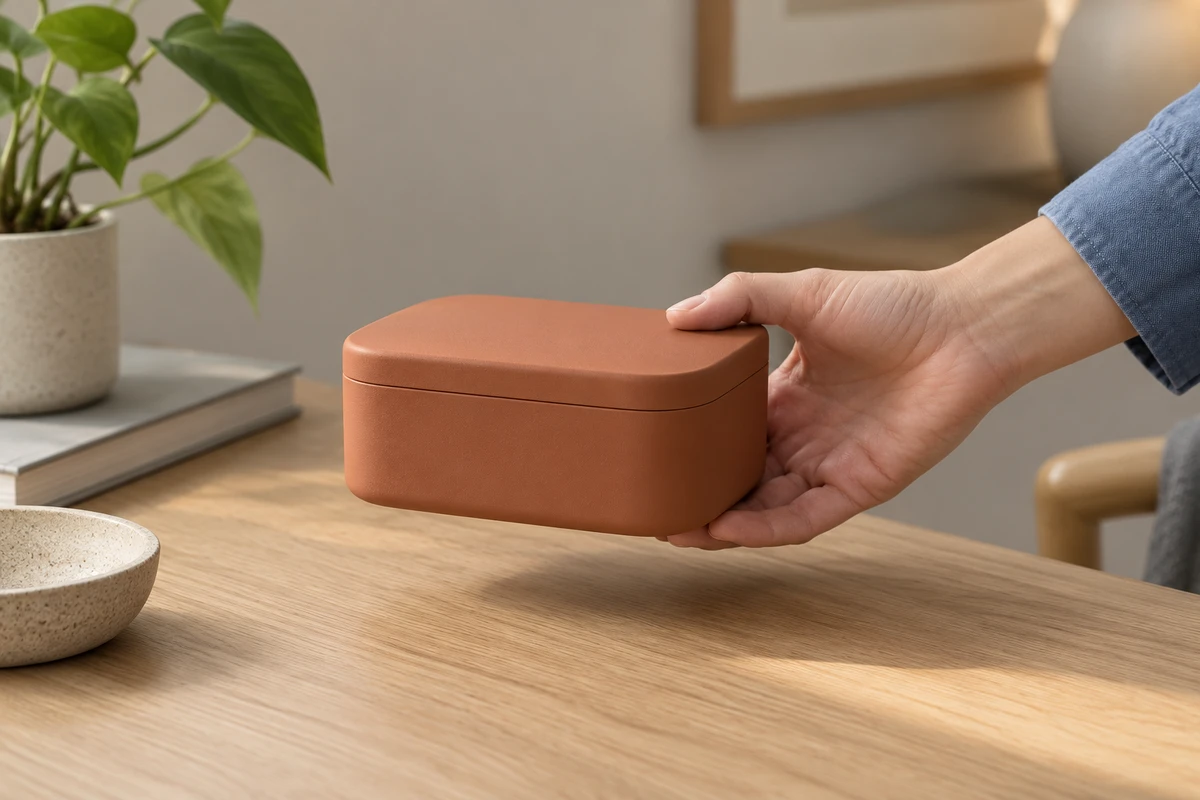
Imagine a fictional video for a small storage box. It sits on a desk; someone picks it up and places it in an open storage compartment nearby. There is no real model, specified dimension or fit test behind this example. It is a way to discuss staging. An actual shoot would need the sample and its real use conditions.
Suppose the first shot shows only the lid's texture, the next finds the box already in a hand, and the third shows it sitting in the compartment. Each may look good, yet the viewer has to reconstruct the comparisons. If the product is reframed to a different image size in every shot, it changes position while appearing to change scale too.
One pickup could instead remain visually connected. Begin far enough back to see the box's outline and its place on the desk. When the hand enters, do not immediately cut to the fingertips: allow the contact, grip and lift to be read together. Once the box is held steadily, the film can move into detail.
Keeping that movement continuous is not a claim about how many seconds an operation takes, nor a demand that every pickup become a long take. It answers a different question: how did the object in that setting become the one in this hand? Editing can omit an unimportant pause. But if the only useful scale reference disappears in the cut, it needs another clear place in the sequence.
The storage compartment should continue to contribute information, too. If it is cropped to a narrow edge, or a cut finds the box already inside, its spatial relationship may be hard to grasp. Conversely, showing that it fits this compartment does not establish that it fits every drawer or bag. An image can introduce a particular relationship without guaranteeing an unverified use elsewhere.
That is a worthwhile reason to design the pickup shot. The product need not remain central and largest throughout. It can briefly become part of a relationship between a person and a space, before the film returns to its defining details.
Close-ups and scale images answer different questions
Scale references are not a new marketing slogan. Baymard's Product Page UX: All Products Need at Least One ‘In Scale’ Image, published on May 30, 2017, describes participants using product images to judge size. It also cautions that video should supplement rather than replace static scale images. The historical research informs the question here; its percentages are not being presented as the current state of every category, or as a promise of improved conversion.
For a brand, that leaves room for dramatic, abstract and richly textured close-ups, provided the viewing journey also offers an understandable sense of proportion. A video can establish the reference itself, or a detail-led film and a clear real-product scale photograph can share the work. Every frame need not become an instruction sheet. Viewers should simply have an answer available when they need to judge size.
Actual dimensions still need to be provided separately, with the measured direction and product version made clear. External size and usable internal space are different information. A real pickup can help someone imagine an object, but it cannot supply an exact length or replace checking a particular storage location.
The same applies to AI concept imagery. A convincing relationship between hand, object and setting does not verify actual scale or fit. It can support a composition discussion. Product-size information still needs to come from the real sample and accurate records, not from whether an image looks plausible.
If you are planning new product content, explore ONCE's video production solutions. Bring the sample and the use location your audience most needs to assess, and discuss which shot should invite a closer look and which should make the product's size understandable.
The cover is an original AI-generated commercial concept, not a real-product photograph, calibrated scale reference or fit test.