Your China-based production partner has delivered the launch film. The overseas team now needs a six-second cut. A product action almost reaches its result, then the edit switches to the full branded audio sign-off. The ending sounds finished; the demonstration does not.
This is an illustrative editing problem, not a reported ONCE project. The decision is whether the short ad can accommodate its product task, clear brand attribution and the proposed sonic ending together. If it cannot, redesign the short execution. Do not silently truncate a protected sonic asset or remove the result the viewer needed to see.
A brand system can include a deliberate exception
The “Non-Linear” section of Toyota Brand Hub’s Sonic Signature Guidelines specifies the signature in the final three seconds of fifteen-second videos, but not in six-second videos. The page also contains broad language about always incorporating the signature. The format-specific exception matters; a producer should not lift a general sentence out of context and overlook it.
This is Toyota’s published guidance for that use, not a universal rule for automotive brands, all territories or every short ad. The page shows no publication date; it was checked on October 18, 2026. We have not treated its embedded media as an audio test conducted for this article.
The strategic lesson is our inference: an audio identity system becomes more usable when it defines exceptions as well as required placements. That is different from telling each local editor to improvise a shorter logo.
Google’s current Display & Video 360 format reference describes bumper ads as non-skippable in-stream ads of six seconds or less. This article addresses a six-second execution, not every short social video. Google Ads’ Trim video documentation describes AI-assisted extraction of important frames into shorter variants, with preview and light editing. Neither page displays an update date; both were checked on October 18.
Generating a short candidate does not establish that the action resolves, the brand is clearly identified or the audio treatment meets the client’s rules.
ONCE’s Two-Endpoint Cut
This is a proposed planning method, not a validated client experiment. Agree the one task the short ad needs to perform, then mark two positions on its timeline.
The action endpoint is the earliest place where the necessary action and result have been fully shown. For a fictional food-storage container, closing a lid may not be enough if the point is how the latches finish engaging. The brand and director first make an editorial judgment about the required result; they should not label that marker a measured moment of audience comprehension.
The attribution point is the earliest clear provision of the brand’s identity: readable product branding, an approved graphic identifier or intelligible speech, for example. It need not be the final frame. Providing the identity is not the same as proving that viewers noticed, recognised or remembered it.
Now insert the proposed complete sonic ending together with its associated speech and visual transition. Does it force the action to stop too soon? Mask something that must be heard? Leave the brand unidentified until the final instant? Review the actual cut, including pauses and transitions, rather than budgeting only the audio file’s nominal duration.
If the cut only fits after deleting the essential result, it has not fulfilled the original task. Making the sound louder does not restore the missing explanation. Speeding up a demonstration must not imply product performance that the real action does not support.
Compare permitted treatments, not an authorised cut with a rogue one
Where the brand rules allow it, prepare two candidates with the same product facts, claim and target duration. One keeps the approved full audio sign-off. The other uses an approved short-format identification treatment, such as earlier visual attribution without a separate sonic ending.
The alternative is not necessarily silent. Action and environmental sound can still serve the idea. Nor is it automatically a better ad: removing a sign-off may create room while weakening something else.
If no alternative has been approved, keep that candidate internal. If the client requires the full signature in every execution, Toyota’s exception does not authorise an exception for your client. Simplify the product action or develop a different six-second concept. Consider new footage only after identifying an actual source gap, rather than assuming the long film must supply every short version.
For an initial diagnostic comparison, use reasonably comparable playback loudness, equipment and viewing conditions. Ask people who have not read the brief what happened and whose ad it was. Record omissions, hesitation and wrong interpretations before explaining the intended answer. Naming the brand in the question undermines the attribution check.
These observations locate editing problems; they do not establish statistically validated recall gains, ad performance or sales. If brand memory is the research question, commission an appropriate study. Uncertain feedback should remain uncertain.
Make the exception transferable
Deliver the approved sound treatment with the ad’s task, action endpoint, attribution point, format, market, approval and recheck conditions. A local pronunciation, longer voiceover or different brand rule may invalidate a previously workable timing decision.
“No sonic logo in six-second ads” is too broad. A useful record names the execution and market, the governing guideline and the approved means of identification. Permission to omit one ending also does not mean deleting the brand’s longer sonic assets.
For recurring work between overseas marketing teams and Chinese production partners, our view is that these approved choices can become reusable creative knowledge. Whether they reduce revisions must be judged from real projects; no savings benchmark is claimed here.
ONCE’s wider brand and product production work provides the context for that conversation. Bring the long film, sonic guidelines, target market and indispensable product action. Start by comparing the two endpoints, then decide whether the job is a recut, a new concept or new photography. A consistent audio identity should guide the short ad—not force it to end before it has said anything.
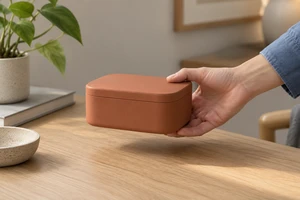
The cover is an original AI-generated concept scene, not client work, a product-performance test or a software demonstration.