A product slowly opens out. Its housing, connectors and internal modules hang in space, creating an immediate impression of precision. Yet if the viewer remembers only that there are many things inside, the exploded animation may have established a mood without explaining much.
The creative question is what happens after the parts leave their original positions. Can viewers still tell where each one belongs, what it connects to and why the film pauses there? Separation is not the subject. The relationships are.
A separated position is not an assembly procedure
An exploded product animation separates components visually; it does not depict an explosion. It can reveal hidden layers or isolate a connection. But a part moving that way on screen does not establish that it can be installed that way in reality.
The KeyShot 2026 manual's Part Animations explains that these animations change position, orientation and visibility while retaining the model hierarchy: animating a parent affects its children. Autodesk Inventor 2026's About Inventor Studio Environment for Render and Animation distinguishes constraint-driven mechanical movement from exploded views in presentation documents. Both were consulted on October 18, 2026.
The editorial implication is to treat spatial separation, actual assembly steps and working principles as different subjects. The first makes structure easier to inspect; the others need the relevant design information and verification. An elegant reassembly alone does not establish repairability, tight tolerances or better performance.
Make one connection the subject of the shot
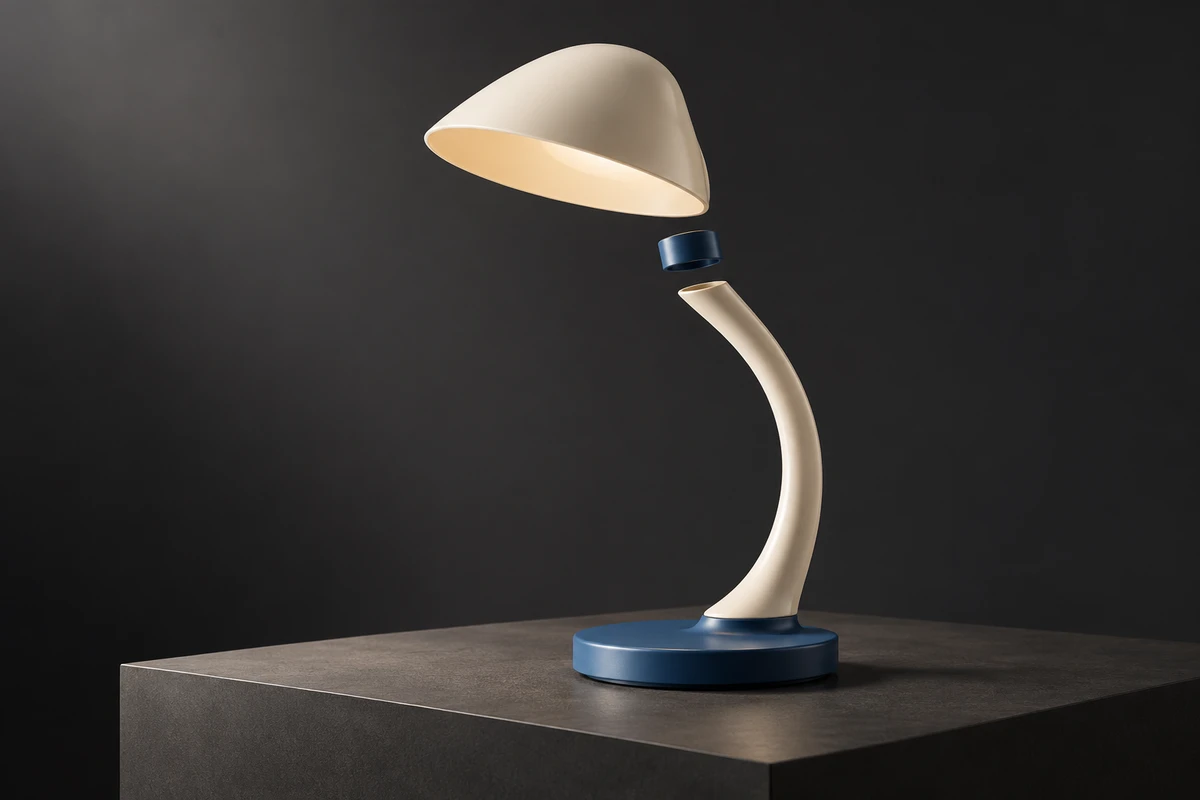
Imagine a fictional desk lamp whose shade joins the arm through a connecting ring, with a base below. This example is only a way to discuss animation staging. It represents no real brand, actual assembly design or ONCE project.
If the shade, ring, arm and base all fly in different directions, the viewer sees the shape of a product coming apart. If this passage is about the relationship between shade and arm, the base and arm can stay where they are. They are not uninteresting static objects. They give the viewer a reference for where the shade belongs.
The ring does not need to travel as far as every other component. It needs enough separation to reveal the corresponding location, without ending up so far away that it looks like an unrelated accessory. There is no universal distance. Judge it at the intended viewing size: can the interface still be distinguished on a small screen? Do the two parts still appear to belong to the same connection?
Grouping can preserve more than individual motion reveals
If the inside of a module is not this passage's subject, the module can move as a whole. The fact that every object in a model tree can be animated is not a reason to give every small part its own performance. Creatively, grouping protects attention for the relationship being explained. It does not assert that the same group can physically be removed as one unit.
Other layers can open out after this connection has been understood. A complex product does not require every shot to be complex.
Keep the observation point steady
When parts move, the camera orbits and focus changes at the same time, viewers must repeatedly locate the corresponding positions. In a passage primarily intended to explain structure, the camera can first find a clear view of the connection, then hold its viewing direction while the key components move.
A pause is not simply a slower animation. Movement removes an obstruction; the pause lets viewers inspect the relationship it reveals. If the ring has barely emerged before the film cuts to another angle, the newly revealed information has had no viewing time of its own.
This does not mean locking off the entire film. A flowing view can introduce the overall form, settle for the important connection and return to the complete product. Letting camera and components take turns creating change can produce clearer passages than adding movement to both simultaneously.
Materials and lighting belong in that decision too. If the interface disappears into a uniform dark area, moving the parts farther apart may not help. First make the corresponding shapes distinguishable, then consider more dramatic light. The aim is to reveal this relationship, not to give every internal surface a brilliant highlight.
Reassembly should answer the question separation raised
Reversing the whole animation is a convenient way to close an exploded sequence. There is also a creative question worth asking: does the return make that connection any clearer?
In the fictional lamp, the ring could first re-establish a visual relationship with its corresponding position before the shade returns to the whole. If a shot claims to demonstrate actual installation, its directions and sequence must follow the real design, not whatever looks smoothest. If it is a conceptual rearrangement in space, it should not be presented as an installation tutorial.
Some product qualities also deserve a different kind of shot. How it feels to pick up, how convenient it is to adjust and how its light actually falls across a desk call for appropriate real demonstrations and supporting information. Floating components cannot answer those questions on their own.
A useful structural shot may not show the most parts. It may simply let viewers understand, at last, that this is where these two pieces meet. Beginning with that specific question opens a more meaningful creative discussion than asking for something that merely looks more technological.
If you are planning how to reveal a new product's structure, explore ONCE's video production solutions. Bring the product information and the particular relationship you want viewers to understand, and discuss what animation and live action should each contribute.
The cover is an original AI-generated commercial concept, not a product photograph, engineering drawing or verified assembly illustration.