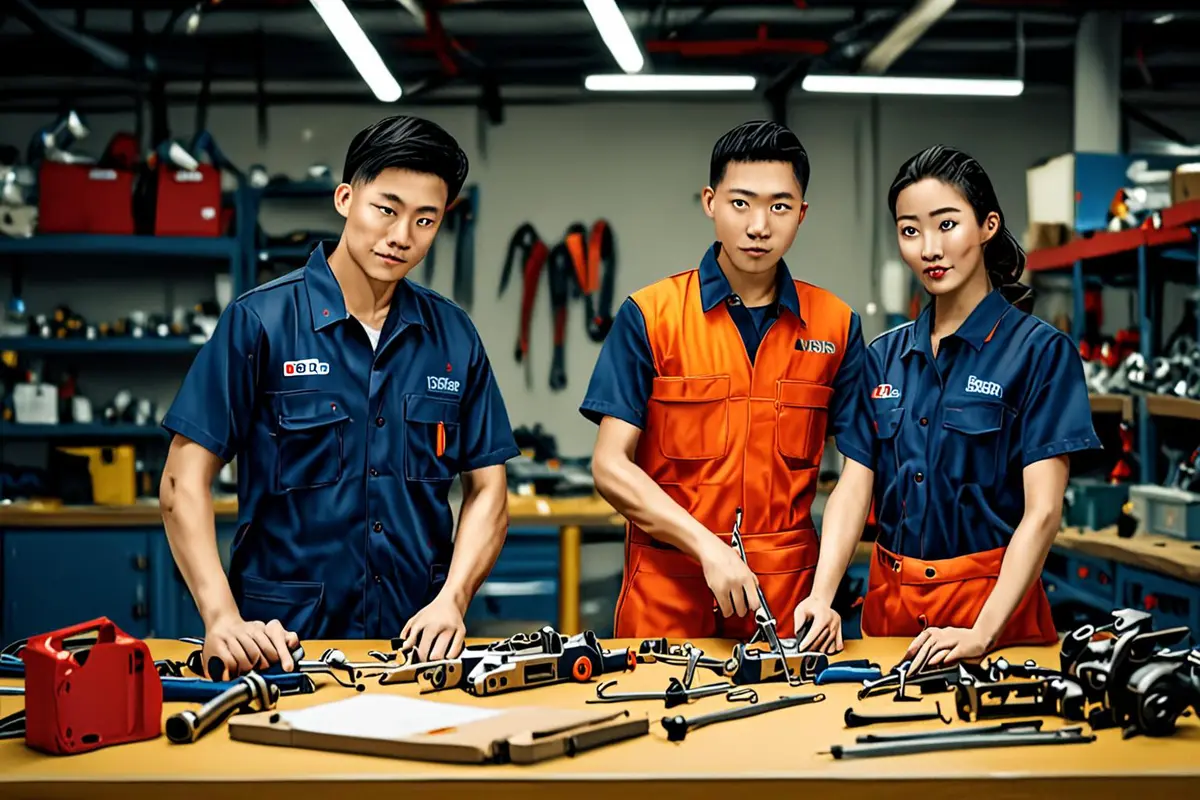
Workwear in corporate films often becomes a surface-level symbol of order. Everyone has just changed into the same jacket, every zipper sits at the same height, and no sleeve carries a crease. The group looks tidy beside the equipment, but rarely looks as if it has spent a full day working there.
Credible workwear does more than tell viewers which company a person belongs to. It reveals what that person is responsible for, how they use tools, where they are allowed to go, and why a colleague trusts them with the next step. Clothing that is separated from the task feels like a costume issued to talent. Clothing that participates in action and relationships becomes part of the organization.
Uniformity proves consistency, not that work is happening
A shared design can establish company identity, but identical wear, posture, and accessories erase differences between roles. Research, assembly, quality control, logistics, and client-facing staff may use the same basic garment without using pockets, cuffs, gloves, pens, tools, or badges in the same way.
The frame should preserve meaningful common elements while allowing real differences. The common elements show a system. The differences show that people inside the system perform distinct tasks.
Workwear first needs to answer three relationships
Its relationship to the task
Will the person bend, reach, carry, inspect a detail, or remain at a station for a long period? Fit, sleeve length, hem, and pocket position change those movements. Block the task before choosing how the clothing will be worn. Otherwise, the team may discover after fitting that a cuff blocks the operation or a jacket bunches up whenever the person sits.
Its relationship to permission
Some areas require a layer change, head covering, different identifier, or another real preparation step. The film does not need to become a policy demonstration. It can simply let the person complete the change before entering. Viewers then feel that the space has rules rather than assuming everyone can move anywhere.
Its relationship to the environment
The same garment behaves differently in an office, workshop, laboratory, and outdoor area. When people enter heat, dust, moisture, or strong reflections, their way of wearing the garment, its surface condition, and their movement should respond. The environment is not a backdrop, and workwear should not remain in fitting-room condition.
Perfectly new uniforms can look less credible than slightly used ones
New clothing is not a problem by itself. The problem appears when every garment is new in exactly the same way. Hard packaging folds, untouched pockets, and identical trouser lengths can make actual employees look like temporary extras.
Credibility does not require artificial dirt. Restore the condition that belongs to the role: a frequently used pocket has been opened, a cuff is rolled to a practical position, and a jacket settles naturally after sitting, crouching, and reaching. Wear, cleanliness, and creases all need a cause. A uniform ageing treatment cannot replace observation.
Fit changes professional performance
Oversized clothing obscures the relationship between hands and tools. Clothing that is too tight limits reaching, crouching, and turning. In closer shots, tension around the collar, shoulders, cuffs, and waist becomes obvious. If the person repeatedly adjusts the garment, they appear unfamiliar with the job.
Do not fit talent by asking them to stand straight for a front-facing photograph. Give them the real object or a correctly scaled prop and ask them to complete the hardest actions in the film. Our article on sitting in brand films explores how body state changes a relationship. Workwear also needs to be judged through movement rather than on a hanger.
Pockets, tools, and badges should move with the workflow
Occupational details easily become decoration. Tools are distributed evenly across every belt, pens extend from pockets at the same height, and all badges face camera. The image contains information but no use logic.
Ask when an object is removed, who returns it, whether it needs two hands, and where it goes after a handoff. An engineer returning a gauge to the same pocket, an inspector clipping a pen back after recording, or a project lead putting a badge away before a meeting turns a wardrobe label into continuous behavior.
The same uniform can still reveal different positions in a team
A manager, technician, and new employee do not need three color codes. Skill and responsibility can emerge through action paths, tool preparation, position, and the reactions of others: who checks first, who waits for confirmation, who completes a handoff, and who colleagues look toward when a problem appears.
Wardrobe only needs to support this with small differences in layering, cuffs, carried objects, or condition. Color helps control attention, but color should not replace the role that the person performs.
Protective equipment cannot appear only in the hero shot
If helmets, eye protection, gloves, or other equipment belong to the site's real rules, they should enter naturally when the person reaches the relevant area and be handled according to the actual process when they leave. Removing them merely to reveal a face, or adding unnecessary equipment to manufacture a professional image, weakens trust.
The company's on-site lead should confirm garments, equipment, zones, and actions before filming. Talent should not pretend to perform an operation they are not permitted to perform, and real employees should not change safe habits for the camera. Professionalism comes from alignment between rules and tasks, not from the number of accessories.
Lighting can rewrite the identity of a fabric
Reflective strips, nylon, coated fabric, and tight patterns may look normal on location but become bright lines, flickering texture, or featureless black under a strong edge light, camera movement, and mobile compression. A company mark may also disappear through folds, backlight, or shallow depth of field.
Test with the intended key light, camera position, and lens. Let the person walk, turn, and approach equipment. The logo does not need perfect visibility in every frame. Hands, face, tools, and product should remain more important than the fabric.
A clothing change can become part of a spatial transition
When a person moves from an office into a test area, or from the factory floor into a client meeting, the film does not always need narration to explain the change. Adding a real outer layer, putting on required equipment, adjusting a cuff, or returning a visitor badge can show the character entering a new working state.
This connects with our guide to corridors and doors in corporate films. Space changes permission; clothing lets that change land on the body. Together they keep the organization from becoming a collection of architectural cutaways.
Bring a real task to the fitting, not only reference images
An effective fitting can be brief, but clothing, character, and work object need to appear together. Prepare three types of action: the most common daily movement, the movement most likely to expose poor fit, and a handoff between departments. Record front, side, and back views, then inspect cuffs, hems, pockets, and identifiers in motion.
If real employees will appear, ask how they normally wear the garment, which objects always stay with them, and which actions they would never perform that way. Their answers reveal false blocking more effectively than a uniform reference sheet. The director then organizes those differences into a clear story.
Wide, medium, and close shots prove different things
A wide shot shows how a group relates to the space and whether the team occupies a believable working state. A medium shot shows how clothing supports the body and tools. A close-up uses cuffs, gloves, pockets, identifiers, and tool contact to prove detail.
Do not build professionalism from close-ups alone. Without wide and medium views explaining who owns the detail and which task is underway, badges and tools become stock-footage decoration. Camera height also changes perceived authority, as explored in our article on camera height in product advertising.
Continuity must record wearing state, not only the garment code
Across shooting days, wardrobe continuity is often reduced to “one blue shirt.” The edit is affected by zipper height, cuff fold, pocket contents, badge position, and when a stain or damp area appears in the task.
Continuity notes should follow story time rather than the production calendar. Clothing can reasonably change after the character completes work. When one action is split across two shooting days, the state cannot suddenly reset. Continuous wardrobe state helps preserve a continuous working process.
When workwear feels real, narration does not need to keep claiming expertise
A strong corporate film does not turn employees into background figures wearing matching clothes. It lets viewers see through clothing, movement, tools, and handoffs that a person knows the job, the role connects with other roles, and the company turns rules into everyday practice.
If you are planning a factory film, R&D story, or corporate brand video, contact ONCE. We can begin with real tasks, role relationships, and on-site wearing states, then make organizational capability visible through action.