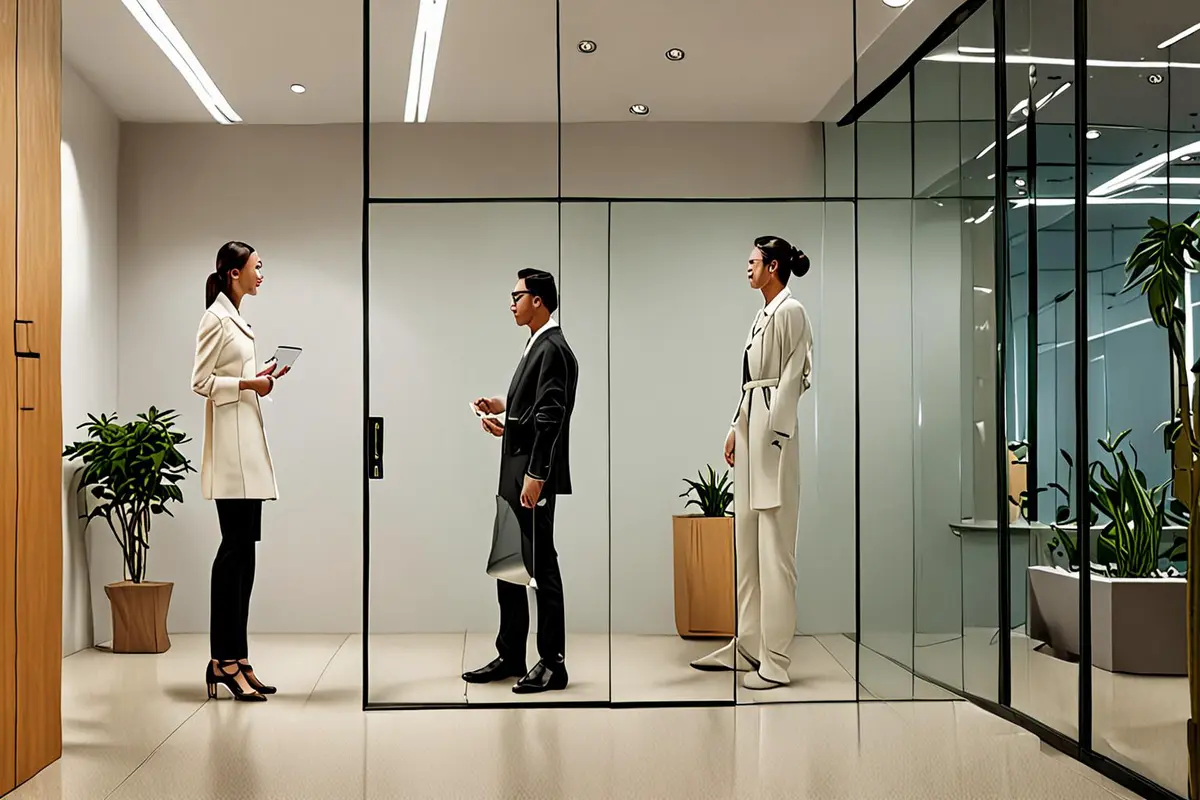
In corporate films, corridors are often treated as the safest transition. A person walks toward camera, the camera retreats, several doors pass in the background, and the next shot enters a meeting room. The sequence looks complete, yet it rarely explains how the company actually works. The corridor proves that a building exists without allowing an organizational relationship to occur.
A useful spatial transition helps viewers understand who can enter which area, how information moves between departments, and how a product advances from discussion to testing and then to delivery. Doors, corners, waiting areas, and passageways are not simply backgrounds. They are places where an organization rearranges people, access, and tasks.
A corridor connects working relationships, not just rooms
A researcher carries a prototype toward a test room and receives an update from a colleague on the way. A client representative crosses reception and is brought through a glass door by the project lead. A production supervisor passes through a buffer zone, changes clothing, and enters a controlled area. Each transition changes the person's role, behavior, and way of communicating.
If the corridor contains only continuous walking, viewers receive a vague impression of floor area. Give the route a task and the space gains meaning: why the person leaves, who they meet, what happens after the door, and how a product or document changes hands. Corporate scale can emerge through real handoffs rather than exaggerated wide-angle views.
Map the work route before planning the shooting route
Location scouts often tour a building in architectural order: lobby, showroom, meeting room, office, workshop. A film that copies this sequence becomes a property tour. The creative team should first map a task, such as “client raises a question, research confirms it, the lab validates it, and the team returns to explain the result,” then identify the real spaces that can carry those stages.
The production route can change for efficiency, but the finished route must serve understanding. Viewers do not need the exact position of every floor. They need to believe that the character has moved from one working state into another. When departments are far apart, an elevator cue, sound bridge, or handoff can compress travel. Unmotivated fast cuts should not pretend the rooms are adjacent.
A door matters because it changes behavior
People slow down, check, knock, use a badge, step aside, or wait for someone to receive them at a doorway. This brief adjustment makes the rules of a space tangible. If every character crosses every threshold at the same speed, all areas feel equally accessible and the company may look like an empty location hired for the day.
An open doorway emphasizes visibility and access
An open entrance can express everyday collaboration, but the film should show more than unrestricted movement. Let information cross the threshold: a colleague adds one detail, a prototype is carried inside, or a discussion begins because of a signal from outside. Openness comes from action, not from a voice-over claiming a flat organization.
A glass door creates transparency and a boundary at once
Glass lets viewers see the work before following a person inside. It can layer reflections, activity beyond the door, and someone waiting outside in one image. It can also reveal lamps, camera equipment, and irrelevant crew. The composition should decide who is visible and who remains outside before production controls reflection, flags, and camera position.
A controlled entrance needs a reason, not manufactured mystery
Badge access, clothing changes, or identity checks can communicate safety, confidentiality, or production discipline. Connect the restriction to the work: a person completes the necessary action at the threshold and then enters a specific task. Red lights, keypads, and closed doors without context can turn ordinary procedure into a cheap “secret high-tech zone.”
One handoff explains collaboration better than a beautiful walk
The most common corridor action is a single employee carrying a laptop. It is harmless but proves little about collaboration. A more informative action can be small: an industrial designer passes a prototype to a test engineer, a maintenance record is updated at the door, sales brings a client question to research, or a supervisor pauses to confirm a detail at a workstation.
The handoff should show that the task changes. Object, eyeline, and body direction transfer together, and the next shot follows the new holder. ONCE's article on screen direction in brand films covers axis and movement continuity. Corporate space asks one additional question: once direction is clear, is responsibility also being passed clearly?
Travel can show scale, but it should not be prolonged
Long corridors, several floors, and multiple access zones can suggest organizational complexity. Longer walking does not automatically make a company feel larger. A route without new information only consumes attention. Scale comes from successive working states: quiet discussion becomes a machine soundscape, open desks become a controlled laboratory, and an individual task becomes group coordination.
Keep one complete threshold action to establish the rule, then compress later travel into two or three clear nodes. Repeated following shots of the same back turn the film into a recruitment template. Every transition should add one new understanding rather than repeatedly prove that the building contains more rooms.
Camera position determines who the viewer is inside the company
When the camera retreats in front of a character, viewers feel guided through a visit. Following over the shoulder places them closer to a colleague or project participant. Waiting inside the room gives the space authority as the person enters. Remaining outside as someone leaves creates distance and restricted access.
Decide who the film is inviting before choosing the move. A client-facing corporate film can use a project lead as a guide and show how a problem is received. Employer-brand content can stay closer to an employee's point of view and preserve waiting, turning, and informal exchanges. Manufacturing content needs the product flow to remain clearer than the visitor's route. A consistent viewing role prevents the camera from switching between tour guide and surveillance footage.
Lens choice and speed must protect the change at the door
A close wide-angle follow increases depth, but stretches the corridor, reduces distant people, and exaggerates edge distortion. A fixed mid-length lens preserves the ratio between person and doorway but can reduce the feeling of travel. No lens is inherently more corporate. The useful question is whether viewers can read the behavioral difference before and after entry.
The camera does not have to cross every door. A character can pass through while sound connects to the next room, or the doorframe can create an occlusion cut that changes location while the action continues. Doorframes are natural edit boundaries. Used carefully, they compress travel; used repeatedly, they become a formula.
Sound tells viewers what is behind the door before the image does
Footsteps, ventilation, and distant conversation create a shared corridor. When a door opens, machinery, keyboards, fans, or a cleaner room tone can change the scale of the space. Sound may arrive before the door opens and prepare the next task. It can fall away after the door closes and confirm that the boundary is real.
Avoid covering every area with the same music bed. One or two real acoustic changes give the organization audible layers. When the location is noisy, record doors, footsteps, and room tone separately, then rebuild believable distance in post instead of replacing it with generic technology effects.
Offices, factories, and client areas need different movement logic
Office transitions are often driven by information and relationships: who joins a discussion, who leaves, and where a question is solved. Factory transitions depend more on product flow, personnel, and safety: where material arrives, when it is tested, and why people change clothing or wait. Client areas concern reception and trust: when visitors are guided, what they can see, and who explains the work.
Shooting all three with the same stabilized follow erases their difference. International versions must also consider how target viewers read entrances, social distance, and workplaces. ONCE's article on location localization for global brand films examines space and everyday behavior. Corporate localization should likewise appear in concrete movement rather than only in translated wall graphics.
Horizontal films and vertical cutdowns need different corridors
A horizontal frame can hold the door, starting point, and destination together. A vertical frame compresses lateral information, so a long walk may become only a person's back. Vertical versions can concentrate on the threshold: checking, handing off, turning, and entering, with foreground, background, and sound carrying the transition.
A short cutdown does not need to reproduce the whole tour. Keep one task-bearing entrance for each department and connect them with the same object or sound. Viewers then see an organization responding continuously rather than a building divided into isolated rooms.
AIGC and CG can turn a passable space into an impossible one
Generative extension can lengthen a corridor, add a view, or remove irrelevant signage, but errors often appear in door swing, handle height, glass reflection, human scale, and the connection between rooms. A still frame can look impressive while the character has no credible path through it.
A hybrid workflow should lock the live-action entrance, floor contact, doorframe size, main light direction, and walking speed before extending any area. Keep access, handoffs, and real production procedures in live action. Use CG or AIGC to extend distance, reduce visual noise, or preview an unbuilt space, while clearly distinguishing a proposal from a record of reality.
During the scout, carry one real task through the entire route
Before storyboarding, ask an employee who understands the work to carry a real sample, document, or question through the route. Observe where the task begins, which door causes a pause, who appears, when the object changes hands, and where the result becomes visible. Record the route, timing, light, noise, and restrictions, then choose which nodes deserve a shot.
The film will no longer use employees as measuring sticks for architecture or corridors as filler. Doors and passages become evidence of real operation: a task is received, access is respected, departments coordinate, and the product moves forward along an understandable path.
When transitions are clear, corporate capability becomes visible action
The most convincing corporate space is not necessarily the widest, newest, or most expensive. It lets viewers understand how work happens. A person enters with a purpose, changes behavior at a threshold, passes responsibility through a handoff, and gives the product or problem a next step. Organizational relationships become concrete actions.
If you are planning a corporate film for an office, research center, laboratory, or factory, send the floor plan, real workflow, accessible areas, and audience priorities to ONCE. We can begin with task routes, blocking, doorway tests, and horizontal and vertical camera plans so every transition explains how the organization works.