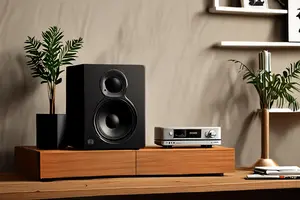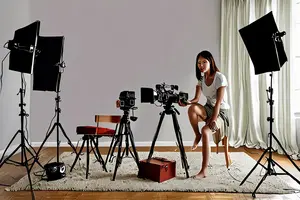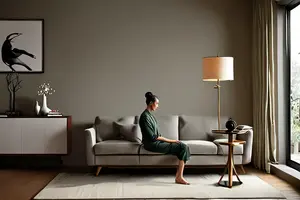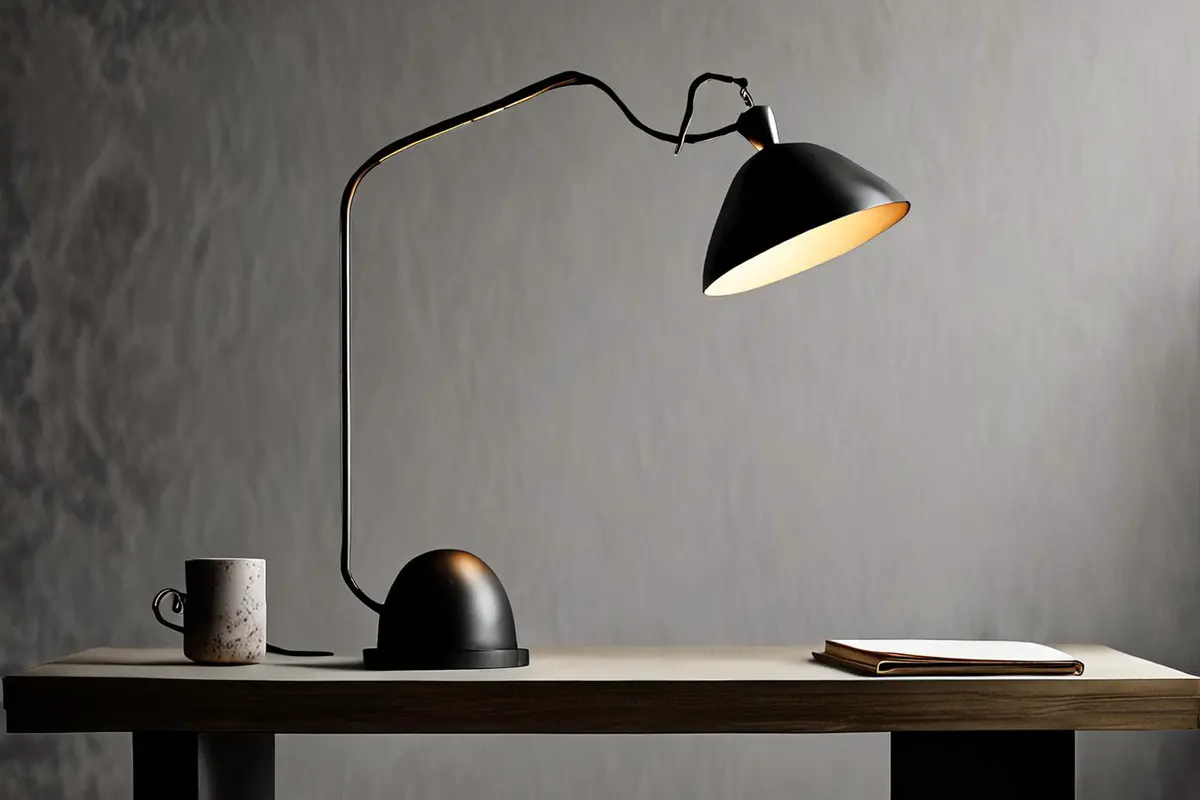
Move the camera twenty centimetres and the same product can acquire a different identity. At eye level, it feels approachable and usable. From above, it becomes a system to inspect, arrange or operate. From below, it gains mass, status and drama.
Product-ad shot lists often request one high angle, one eye-level view and one low angle as if camera height were simply coverage. The useful decision is deeper: who is the viewer in relation to the product, how does the object sit with a person, table and room, and can this viewpoint make the selling point understandable? Height is not decoration. It rewrites the product's role.
Separate camera height, tilt and focal length
A high camera does not always need to point steeply down. It can sit above the product while remaining almost level, allowing background lines and a little of the top surface into frame. A low camera does not require an exaggerated upward angle either. A longer lens can lower the viewpoint without creating severe distortion.
Height establishes the viewing position. Tilt determines which surfaces are visible. Focal length and distance shape perspective. When these variables are discussed as one, a request for more product authority can become a switch to a wide lens that enlarges the nearest feature and bends the edges without creating meaningful status.
Compare height before changing the lens
For a useful test, keep focal length, product position and image size fixed while changing only camera height. Then adjust tilt separately. This reveals whether the viewing position changed the product relationship or whether perspective and framing created the difference. Our earlier article on texture in product close-ups covers lighting, lenses and movement; this discussion isolates height and its narrative consequences.
Eye level makes the product available for use
When the camera sits near the main operating surface, viewers can more easily imagine their own position. A coffee machine outlet, speaker controls, suitcase handle or pet-device entrance can retain its real action direction. The product neither dominates the viewer nor lies open like a specimen.
Eye level does not have to feel neutral. A character's gaze, furniture lines and depth can make the product a companion, a work tool or an object waiting to be used. If everything occupies the same horizontal band, the frame may become flat. Distance, light and a slight lateral angle can restore depth without immediately raising or lowering the camera.
Overhead views explain systems, sequence and footprint
From above, the relationship between a product, its accessories and its operating path becomes easier to read. Ingredients moving through a kitchen appliance, the parts in a tool set, or a charging device connected to cables can become clear. This viewpoint presents the product as an understandable system rather than a heroic monument.
The trade-off is reduced volume and weaker frontal recognition. A clean, informative top surface can support an overhead view. If the top carries little information and the front contains the interface, ports or brand mark, a high angle can remove the evidence that matters. As the camera rises, the room also starts to resemble a diagram.
Preserve action direction from above
Decide where hands enter, where components open and how liquid or ingredients travel before the shoot. An arm can hide the key contact point even when the complete tabletop remains visible. Lowering the camera slightly and introducing a gentle tilt can preserve the layout while restoring side structure.
Low angles add weight and also increase distance
A low camera places the product above the viewer and can express strength, stability, speed or architectural scale. Portable power stations, vehicles, professional tools and large appliances often benefit. Yet authority is not the goal of every product. Personal-care, children's, pet and everyday companion products may feel oppressive from an unnecessarily low viewpoint.
A wide lens close to the floor enlarges the base while compressing the top and operating surface. When the main claim sits above, the heroic image can cost essential information. A low view can introduce the product, followed by an eye-level or slightly elevated shot that proves use. Every shot in one film does not need to maintain the same status.
Authority comes from relationships, not tilt alone
A stable supporting surface, restrained camera movement, a clear silhouette and a human scale reference all add weight. Placing the lens on the floor without controlling background clutter, converging verticals or an uninformative underside can make the camera look accidentally low.
Let camera height follow the body and the real action
A product's natural viewing level often comes from use. A seated device, standing tool, floor robot and wearable raised to the face each imply a different body position. Blocking the performance before choosing camera height prevents the product from looking polished while becoming disconnected from real use.
A point-of-view shot does not have to sit mechanically at eye height. The camera may move slightly lower or to one side when the viewer needs to see the hand-product contact. When the purpose is observation, it can approach the character's sightline. The important point is that the viewpoint describes a recognizable physical position.
Small products need scale references as well as height
Earbuds, chargers and handheld tools can lose their real size against a seamless background. An overhead view can use hands, a table and accessories as references. A low angle can turn a small object into an abstract monument. Both are valid, but the film should decide when viewers are feeling the design and when they must understand actual size.
The reference does not need to remain throughout. An opening low view can establish form, followed by a hand or familiar object that calibrates scale. If a foreground partly hides the product, camera height will also change the visible area; see our article on occlusion in product ads for that spatial relationship.
A character's gaze places the product inside a relationship
A character looking down at a tabletop product suggests inspection, selection or operation. A face and product at similar levels feel more conversational or companionable. Looking up at a large machine gives it scale and control. If camera height conflicts with the character's eye line, the performance and product shot can appear to occupy different rooms.
Before filming, draw the eye line, hand path and key product surface in one side view. The director, cinematographer and production designer can then see who becomes diminished when the camera moves, which background line crosses the product, and whether the character still appears to look at the same position.
A change in height should reveal new information
Rising from a low angle can turn a heroic object into a complete system. Dropping from overhead to eye level can move from arrangement into real use. If the beginning and end reveal the same information, the move mainly demonstrates equipment. Height changes should correspond to a new fact, a character action or a reveal of the environment.
Continuous vertical movement must also respect real time. When an action needs proof, the camera move cannot conceal the critical step. Our piece on long takes in product ads examines continuous action. Letting movement serve the action is more reliable than choosing a crane or robotic move and inventing a reason afterward.
The landing matters more than the range
Both the opening and closing heights should work as frames. Mark what the start establishes, what the end adds and when the product is most legible. A large move without a clear landing increases the risk of lighting equipment, changing reflections and difficult multi-format crops without increasing understanding.
Background lines expose the wrong height
As the camera rises, tables, cabinets and horizon lines move behind the product. A line crossing the brand mark, interface or a performer's face can destabilize an otherwise well-exposed and focused image. Low angles can bring ceilings, fixtures and studio infrastructure into view, increasing production-design and masking work.
Camera tests should inspect background lines, reflections and negative space as well as the silhouette. Mirrors, glass and polished metal record the camera's changing position. A vertical move may suddenly reveal a lamp, flag or crew member in the surface, so the whole path needs to be checked.
Live action, CG and AIGC need one camera logic
Generated backgrounds and CG products can produce attractive individual frames whose cameras do not belong to the same space. The visible top surface changes, the horizon remains fixed and the performer's gaze shifts. Before hybrid production, lock camera height, tilt, focal length, product dimensions and ground position, then assign live-action, CG and generated elements.
An atmospheric transition can use a more stylized height. A shot proving structure or use needs geometric continuity. Depth of field, smoke and fast cutting should not hide inconsistent viewpoints. Viewers may not name the error, but they will feel that the product floats or changes size.
Reconsider height for horizontal and vertical versions
A horizontal low angle may contain both product and environment, while a vertical crop keeps only an enlarged base. An overhead horizontal frame may show the full tabletop, while the vertical version removes hands and accessories at both sides. Camera height affects future versions as well as the beauty of one frame.
Storyboards can establish a primary height for the main aspect ratio and an acceptable range for the others. When necessary, cover the same action with two positions instead of asking post-production to create every format from one extreme viewpoint.
During review, ask where the viewer is standing
Mute the sound and remove the copy. Is the viewer using the product, inspecting it, looking up to it or looking down on a system? Does that position match the brand relationship? Then check whether the selling point sits on a surface this viewpoint can read, and whether the performance and scale remain consistent.
If three heights exist only to provide options, the storyboard has not assigned them a job. Eye level can carry companionship, overhead can explain relationships and a low view can provide weight. Remove any viewpoint the product does not need. The stronger the reason for the camera position, the less the film depends on technique for its own sake.
If you are planning a product commercial, launch film or multi-format content system, ONCE VISUAL can connect product claims, performance, production design, camera previsualization, live action and AIGC or CG. Contact us to decide where the viewer should stand before the shoot begins.