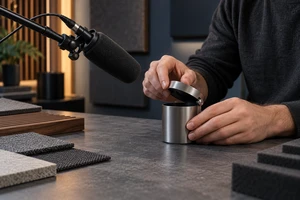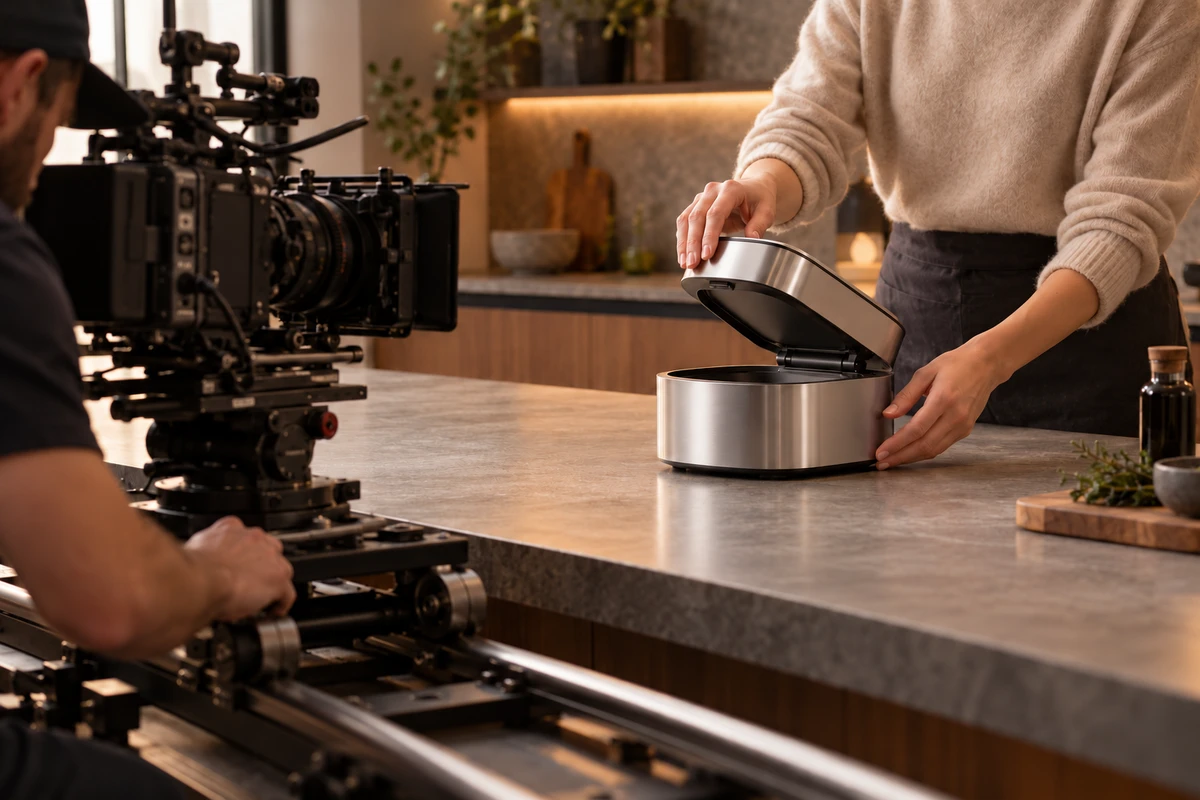
Product ads often divide one operation into polished close-ups: a hand approaches, a button activates, a mechanism turns, and the result appears. Every shot may be clear, yet the edit can remove a more persuasive fact. The audience cannot tell whether those events genuinely happened in one continuous operation.
The value of a long take is more than cinematic style. When a product promise depends on ease, speed, stability, spatial relationships, or human coordination, an unbroken shot can turn time into evidence. Viewers watch the action move from start to result without an edit replacing the difficult part. Continuity can also expose weakness. If the operation is slow, the path is confusing, or the product needs hidden adjustment, the long take makes the promise less convincing.
A long take proves continuity, not production difficulty
Single-shot sequences are often presented as demonstrations of filmmaking skill: complex camera movement, exact blocking, and lighting that changes across several areas. In a product ad, however, the audience does not primarily need to believe that the crew completed a difficult shot. They need to understand what the product accomplished during continuous time.
Long takes suit promises that contain a process: completing a task with one hand, moving a device from preparation into use, coordinating people across a workspace, or changing a room through one product interaction. When the camera does not interrupt that causality, the claim becomes observable action.
If the audience only needs a precise view of a tiny structure, a long take may be less useful than a close-up. The decision not to cut should improve understanding, rather than provide a striking production label for the treatment.
Identify the part the audience must witness
An entire commercial does not need to be one shot. A more practical approach finds the segment that should not be omitted: the moment a need emerges, the key operation begins, and the first visible result appears. That sequence may last only a few seconds or travel through a room.
The script should specify three things the audience must confirm during this time: who performs the action, what the product undergoes, and which action causes the result. Adding brand history, several functions, and character background to the same path turns continuity into a burden. A long take needs concentration, not every responsibility of the film.
Our guide to reaction shots and offscreen causality explored showing an effect before revealing its cause. A long take is better when cause and effect should remain in one temporal chain. The two methods can work together, but each needs a defined role.
Build the product action in three readable stages
Approach: let the hand meet the product
Give the viewer a spatial baseline before the operation. Where the person comes from, where the product rests, and how the hand approaches all reveal whether the interaction is natural. If the shot starts with a finger already pressing the control, the audience still cannot know whether a preparation step was removed.
Force: keep the meaningful change visible
Product value often appears while pressure is applied, a part turns, a catch closes, a surface unfolds, or a structure stabilizes. The camera must show the contact point, the body's effort, and the product's response together. Follow only the face and the function leaves frame; isolate the product and the ease of use becomes hard to judge.
Completion: allow the result to settle
Hold briefly after the action so the result can be read. An immediate whip toward the next area turns completion into a transition. The pause can be active: the person releases the product, walks away, or stops checking it while the product maintains its state.
Move the camera with information, not simply with the performer
A walking character does not require constant pursuit. Camera movement should answer where the most important information is now. As the hand reaches the product, the camera may reduce distance. When the result affects the whole room, the framing can open the relationship. Speed, direction, and focus changes should follow the transfer of information.
A common long-take failure is a camera that becomes the main attraction. Large circles, rapid passages, and complex wipes can make viewers admire the route while missing the product. A stable lateral move or modest push often preserves credibility better when it follows the action accurately.
This differs from the rhythm of repeated actions in brand advertising. Repetition establishes a rule across several appearances. A long take establishes trust through one complete occurrence. Both need a readable endpoint, but they use different editing logic.
Focus, occlusion, and light must hand information over in real time
Editing can optimize focus, lighting, and product angle separately. A long take cannot. A character crossing the foreground should not permanently hide the product. A focus shift from face to contact point needs a clear motivation. Lighting must keep both the person and product readable as the action moves between areas.
Plot the performer, product, camera, and light sources on a floor plan, then rehearse each handoff with a simple preview. Occlusion can guide attention: a body briefly covers the frame and then reveals a new product state. If the wipe exists only to conceal equipment or a transition, the choreography can feel imposed.
Reflective and transparent products need an additional check. As the camera moves, lights, crew, and tracks can enter their surfaces. An unbroken path cannot rely on beautifying every angle independently; art direction and lighting have to serve the whole route.
Performance should feel natural and remain repeatable
Long-take performance does not require mechanical precision. Characters need believable preparation, hesitation, confirmation, and release. This is especially important when the product promises ease of use. Excessive rehearsal can make convenience look like trained expertise.
The director can lock the contact point, screen direction, use of force, and final product state while allowing breath, gaze, and stride to vary. Across takes, the product and hands still need repeatable reset positions. When a hand double is involved, preserve the character's grip, speed, and physical effort; see our guide to hand models and character continuity.
If only a trained specialist can complete the action after many rehearsals, the film should not automatically present it as effortless for everyone. The shot can demonstrate craft, but the product capability and conditions of use must remain accurate.
Sound makes continuous time believable
An unbroken picture does not guarantee continuous sound. Camera movement changes the apparent distance of the person, product, and room. When a product is lifted, placed down, or carried into another area, its acoustic relationship should move too. If every sound remains pressed against the listener, the spatial journey loses weight.
Record the complete performance, room tone, and isolated versions of the key operation, then decide what needs support in post. Our article on ambient sound in product ads covers source distance, materials, and room tone. In a long take, these elements also carry temporal continuity. They cannot be reduced to a collection of attractive effects aligned to the image.
Know when to cut
A long take is not proof of honesty by itself. If the operation contains a small structure that must be understood, and the audience cannot watch both the person and the detail in one frame, cut to the necessary angle. Editing improves clarity when several functions need comparison, the time span is too large, or movement through space adds no meaning.
Do not use continuity to conceal a lack of information. A person can walk through several rooms without creating a new action, relationship, or result. If only one short segment needs continuous evidence, keep that part intact and edit the rest.
- Stay unbroken when viewers need to verify that action, time, and result genuinely connect.
- Cut deliberately when a new angle adds necessary information rather than visual noise.
- Hide a transition only when the version or production safety requires it, without inventing product capability.
AI and composite long takes magnify physical drift
Generated imagery can create flowing movement quickly, but extended continuity magnifies changes in product size, finger contact, material reflection, part placement, and inertia. The image appears uncut while the object quietly changes shape, removing the evidentiary value of continuity.
For hybrid production, lock the product model, key contact frames, motion path, and final state first. Keep physical product operation in live action where possible. Use AI or CG for environment extension, impossible spatial transitions, or clearly designed visual transformation. If physical relationships cannot remain stable, cut at a motivated point rather than confusing technical continuity with narrative continuity.
Adapt the continuous proof, not the entire camera move
A horizontal long take often uses lateral space. In a vertical crop, the person and product may no longer fit together. Identify the operation that must remain continuous, then redesign depth and camera distance for the vertical version. A direct crop can remove the contact point, result, or human response.
A 15-second edit does not need the full route from the master film. Preserve approach, key action, and settlement, then shorten the travel. Versions share the same continuous evidence, rather than identical duration, path, and framing.
Ask what the shot proves for the product
Turn off music and voiceover and watch the action. Can the viewer identify the moment the product changes state? Are cause and result visibly continuous? Pause at arbitrary points: do the product, person, and space still have a clear relationship? Finally, imagine adding a cut. Would it reveal necessary information, or merely make the pace seem faster?
A successful long take does not demand admiration for the absence of edits. It makes the operation feel real, the relationships complete, and the result credible. Technique recedes while product proof stays visible.
If your launch film, functional demonstration, or brand story needs continuous action to build trust, ONCE can design the segment through scripting, previsualization, blocking, cinematography, sound, and multi-format adaptation. Contact ONCE to make the long take serve the product instead of making the product serve the technique.