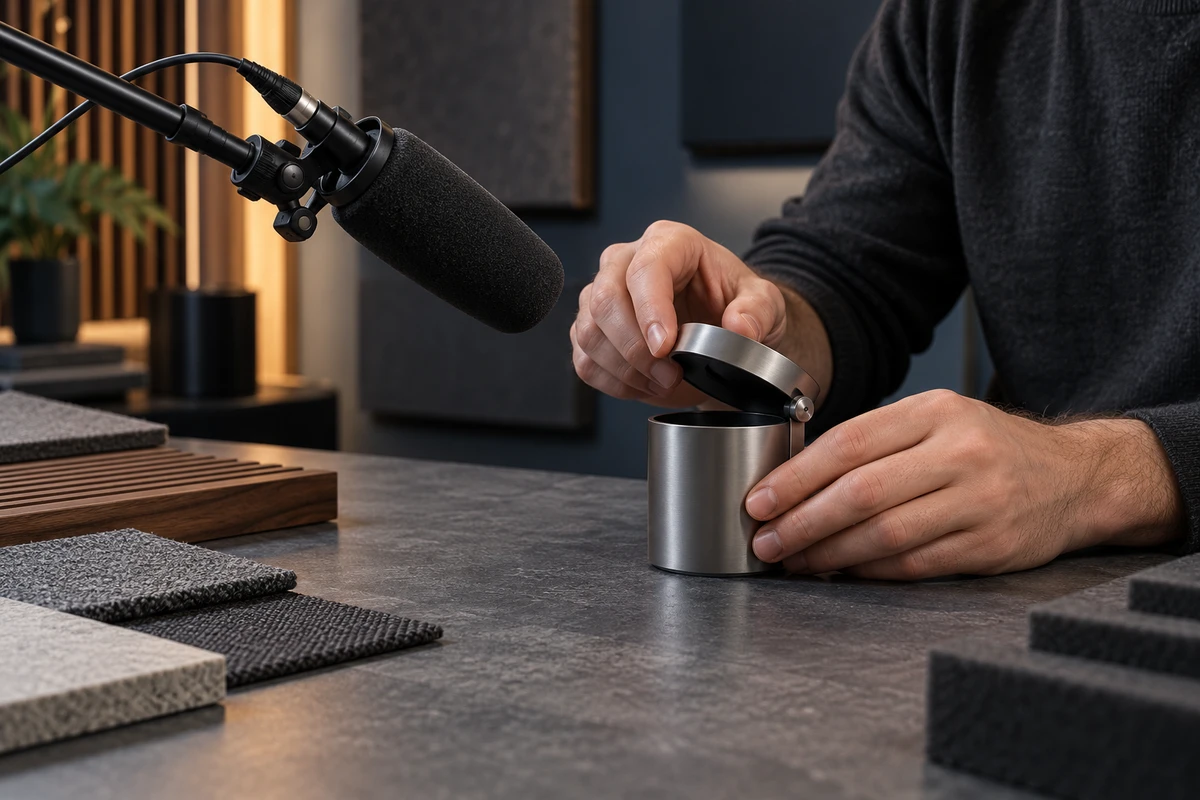
Remove the music from many product ads and the images suddenly feel weightless, empty, or unfinished. The missing element is often not an emotional track. It is the acoustic relationship between the product and the room: a lid closes without mass, a dial turns without resistance, or a character walks from a table to a window while the apparent distance never changes. Viewers may not name the problem, but the product feels pasted onto the picture.
Ambient sound does not mean recording everything that happened on set, nor does it mean covering the timeline with library effects. It answers a more precise question: what space contains this product, who touches it, how far away the action happens, and whether consecutive shots belong to the same world. These details become obvious without music, but they also determine credibility when music is present.
Ambient sound is evidence of space
An image can show the size of a room without making its distance perceptible. Cloth movement nearby, a door hinge farther away, and traffic softened by a wall tell the audience where the camera stands. Changes in direct sound, reverberation, and high-frequency detail turn a set into a place that can be felt.
The product gains a position through the same relationship. If an object on a table sounds as if it was recorded alone outside the scene, beautiful materials still float. If a small operating sound carries the right room reflection and meets the finger at the exact moment of contact, the product begins to occupy the air and the surface.
Our article on reaction shots and offscreen causality examined how sound can let a product have an effect before it appears. This article goes deeper into the sound itself: how it can describe space without making claims the product cannot support.
Map the sound sources before deciding what to record
Before the shoot, draw a simple source map for each scene. Divide the sound into three layers: close sounds directly tied to the product, mid-distance sounds that place the person in the room, and distant sounds that establish location and time. They do not need to play together, but the crew should know which layer carries the idea and which only provides scale.
Close sound gives an action texture
Buttons, catches, hinges, fabrics, liquids, and packaging can all create touch. The aim is not to enlarge every event. Preserve the beginning of contact, the resistance, and the point where the object settles. A clean result-only click can resemble a game notification. The sound of a finger arriving, a material flexing, or an object coming to rest gives the action mass.
Mid-distance sound keeps the person in the room
Clothing, breathing, chair movement, and footsteps should not automatically be removed as noise. They explain distance and bodily state. As a character approaches the product, the relevant details should become more specific. After the character walks away, the product should not remain equally close to the listener. This change feels more natural than simply increasing volume.
Distant sound establishes coordinates
Ventilation, traffic, corridor activity, or air moving through a window can establish a location quickly, but they can also become generic atmosphere. One or two continuous, unobtrusive sources are usually enough. Their job is to stabilize the coordinates, not to demonstrate how many effects the production collected.
Material realism comes from difference, not extra brightness
Commercial sound design often makes every product brighter, harder, and cleaner. Metal, plastic, glass, and coated surfaces then share the same premium click. Credible material sound comes from differences. A metal mechanism may have a short attack and slight resonance. A soft covering absorbs some high frequencies. Hollow and solid structures produce different tails from the same kind of tap.
Sound should follow the physical construction, while still improving readability. Production audio, close-up wild tracks, and controlled Foley can be combined to preserve the product's rhythm and gently emphasize the useful detail. If the picture shows a light touch but the sound suggests an impact, or a small object rings like an industrial door, the exaggeration arrives before the intended value.
This relates to our discussion of making product weight visible through motion and sound. That article focused on the perception of light, heavy, and stable. Here the central issue is how a source belongs to a room and remains consistent across materials, distances, and shots.
Silence also has to be designed
Quiet products invite a common mistake: remove the whole environment to prove performance. Real rooms are rarely absolutely silent, and an abrupt vacuum can sound like a broken track. A more credible method establishes an identifiable baseline and then changes one part of it.
A continuous low frequency might fall after a device starts while clothing, breath, and a distant room remain. The audience knows the space has not disappeared, so the change can be associated with the relevant source. For noise reduction, sealing, or stability, sound should not replace verified performance information. It can make a change perceptible; specifications and copy still carry factual claims.
Offscreen sound can connect shots and expose bad edits
When a sound begins before the cut, viewers naturally look for its source. When it continues after the cut, two images are understood as one action or one space. This sound bridge can smooth a product reveal, a location change, or a character's approach. It also reduces the feeling that every shot starts from zero.
A sound bridge is not universal glue. If the source sits to the right in one shot and the next image provides no directional response, if a character enters a larger room while the reflection stays identical, or if table contact continues after the product is lifted, continuity breaks. Sound must follow the source rather than simply extending the same clip.
Our guide to ensemble brand films described how sound connects different people and locations into one world. Product advertising compresses that principle into specific actions, preserving source, distance, and material through every cut.
What production sound, Foley, and libraries each solve
Production sound preserves spatial relationships and performance timing, but it can include lights, ventilation, roads, and equipment noise. Foley gives control over detail but can become too clean. Sound libraries quickly supply complex sources, but may not match the product's size, material, or room. A mature approach rarely chooses only one. It decides what information each layer must carry.
- Prioritize production sound for movement, authentic operating rhythm, room tone, and continuous actions that are difficult to recreate.
- Use Foley to strengthen contact, material deformation, packaging, and small mechanisms that must align closely with the edit.
- Use libraries to extend offscreen environments, sources that are unsafe to record, and atmospheric layers that can be reshaped.
Record a clean room tone and isolated versions of important operations on set. The purpose is not to replace every sound later. It gives post-production material for repairing cuts, controlling noise, and rebuilding distance.
Give sound room in the picture during production
Sound design is not decoration added after picture lock. If a shot cuts away as an action begins, the sound has no landing point. If a close-up shows only the result and never shows the hand approaching or the product taking force, post-production must invent the process. Storyboards should place important sounds in the action notes and state whether they are onscreen, offscreen, or carried across a cut.
For key operations, keep a little time before contact and after the object settles. When camera distance changes, capture a reference from the corresponding distance. AI-generated or CG shots need an agreed scale, material, and room even more urgently. Otherwise an image can be generated quickly while the sound team cannot tell whether the action belongs to a tabletop object, a home appliance, or an industrial structure.
A music-free version is more than a muted music track
The music and music-free versions of the same film usually need different sound priorities. With music, ambient sound can appear selectively and anchor important actions or places. Once the music is removed, room tone, breath, pauses around action, and sound bridges need to be reorganized. Muting one track often leaves long holes or exposes editing seams.
Music-free does not mean constant sound. Effective negative space comes after the audience understands the room and one source is deliberately withdrawn. An empty section without a baseline merely feels incomplete. Sound density should follow information rather than filling the timeline evenly.
Review distance, material, and causality one layer at a time
First, close your eyes and listen. Can you tell whether the product is near or far, whether a person moves, and whether the scene enters a new space? Then watch without sound and list the expected sources. Does every important event have a believable cause? Does any sound exaggerate a capability? Finally, play the full mix and decide whether voice, music, or environment carries the main information at each moment.
Loudness and channel specifications still need to be checked at delivery. See our guide to audio ad loudness and version approval. Technical compliance shows that a file can be delivered. Ambient sound design decides whether the audience believes that the product occupies this action, this room, and this story.
If your product film needs more credible texture, distance, and spatial continuity beyond the music, ONCE can design the acoustic relationships from storyboards and production recording through Foley and mixing. Contact ONCE to give the product a believable place in sound before asking the audience to judge it.