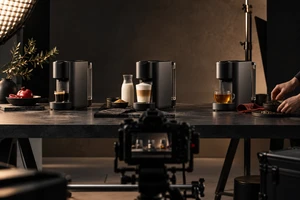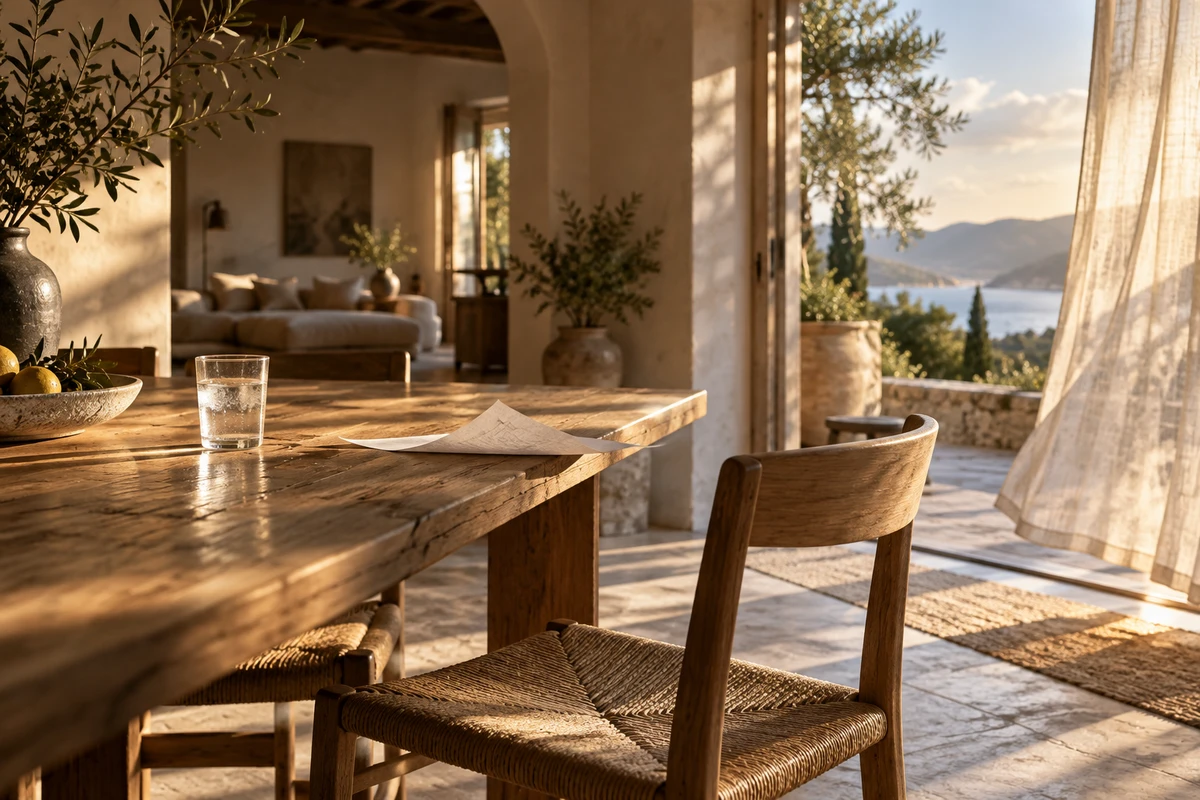
In a brand film, a person leaves the frame and the product is no longer at the center. The shot holds on a table, a window catching changing light, or a corridor that has just been used. These images are often treated as transition material. A useful empty frame, however, is not empty. It preserves the trace of someone who has left and continues to express how the brand understands space, time and everyday life.
Whether an empty frame belongs to the brand depends less on its beauty than on its continuity with the film around it: which materials remain visible, where the light moves, how long the camera waits and how sound extends the world beyond the frame. When those decisions stay consistent, the audience can remain inside the same brand world without seeing a logo, person or product.
An empty frame removes the subject, not the meaning
A performance shot directs attention through expression and action. A product shot organizes information around shape and function. Once those clear centers disappear, spatial relationships become easier to notice: the distance between a chair and a window, moisture left on a tabletop, light entering through a door, or machinery continuing somewhere out of sight.
The first question is therefore specific: what should the viewer continue to feel after the subject has left? It may be calm, anticipation, order, ease or a force approaching. Without an answer, the shot is only an attractive location photograph.
Brand character comes from repeated decisions
A single prop rarely creates brand identity. Timber, plants and morning light appear in countless campaigns. Recognition comes from how elements are combined. A technology brand built around precision may control spacing, reflections and shot duration very tightly. A home brand built around intimacy may keep looser arrangements, touch marks and light that changes naturally.
This is an easily missed layer of brand campaign and TVC production. Art direction, cinematography, sound and editing should not create separate versions of “premium.” They should repeat the same point of view through different crafts.
Design the evidence of someone being there
The most alive empty frames often contain the result of an action. A chair has not been pushed completely under the table. Condensation remains on a cup. A page lifts in the breeze. A door is still returning to its resting position. These details do not identify the person, but they give the room a recent past.
It helps to rehearse the full action before deciding when the performer exits. Prop positions and light changes then come from behavior instead of a set dressed simply to fill the frame. Viewers may not name each trace, but the space will feel less like a showroom and more like a place that has been used.
Camera position defines the viewer's relationship to space
The same empty room can feel like an invitation when observed from a doorway, like a pause beside a person when filmed close to the table, or like a large and intimidating structure when the camera moves low along a wall. With no performer to guide attention, the camera itself becomes the narrator.
Lens choice should do more than make the room look larger. A wide lens emphasizes depth and makes objects near the edge more active. A longer lens compresses layers and turns color and shape into a flatter order. These are different attitudes toward the space and should follow the brand character and surrounding shots.
Props should leave clues instead of forming a style inventory
If the film has already established a way of living through wardrobe, behavior and product use, the empty frame only needs to continue two or three of those signals. Repeating a material, a color accent or one recently handled object is often stronger than placing every symbol of an ideal life in the room.
Too many props turn the frame into a display. Too few objects without a relationship make it look like an unfinished set. The decision is not a fixed object count. Every object that remains should explain how the space is used.
Changing light can replace human action
An empty frame still needs an event. Cloud cover may slowly lower the brightness. An opening elevator may bring a strip of cool light. When a screen turns off, the wall may return to its original color. Each change gives the shot a beginning and an end.
Lighting design should consider how quickly the change becomes readable. A fast change can feel like an effect; a very slow one may disappear inside a short film. Capture a stable version and a version with a subtle shift so the edit has a real choice. A global grade should not be asked to imitate a source that never existed in the room.
Sound keeps people and time alive beyond the image
An unoccupied frame does not require silence. Footsteps at the end of a corridor, water stopping in a kitchen, or a vehicle moving away can show that life continues outside the image. Sound may enter before the next scene or remain for half a second after a person leaves, allowing the space to hold the action's aftereffect.
The goal is not to fill the environment. It is to choose one auditory focus that belongs to the brand world. Too many birds, wind layers and room tones can make the shot resemble generic stock footage. One accurately placed sound can make the space more specific.
In the edit, an empty frame changes breathing
Placed before an action, an empty frame creates expectation. Placed after it, the shot lets the result settle. Between two dense pieces of information, it gives the viewer a chance to locate themselves again. Its value comes from placement rather than duration alone.
Temporarily remove the shot and compare what the story loses. If the film is only one second shorter and its emotion, geography and point of view remain unchanged, the image may be filler. If the transition becomes abrupt, the exit loses its aftertaste or the next scene lacks direction, the empty frame is doing narrative work.
Horizontal and vertical versions need different spatial centers
A horizontal frame can use left-to-right distance and environmental relationships. A vertical frame depends more on foreground depth, architectural lines and localized movement. Cropping the center of a horizontal shot often removes the clues that originally lived near its edges and leaves only an unstructured wall.
When a campaign requires multiple aspect ratios, review the composition after the performer exits, not only while the person is present. A short reference take of the empty set can also help post-production understand how curtains, steam, screens and reflections should continue.
Test whether the frame still belongs to someone
During review, hide the logo and captions and look only at two or three unoccupied spaces. Ask the team to describe the time of day, what has just happened, the emotion of the room and why the image belongs to this brand. If the answers stop at “premium,” “cinematic” or “beautiful,” the frame still lacks a clear decision.
Empty frames do not need to carry every selling point. They preserve what performance and product shots cannot hold alone: the trace of use, the scale of a space, the patience of light and the continuation of sound. You can see how ONCE organizes environments, art direction and camera work in our commercial film portfolio.
If you are planning a brand film and want unoccupied shots to continue the brand's character, send ONCE your project brief to discuss the scene, art direction, cinematography and sound as one system.