When global brands shoot home-based advertising in a studio in China, the most common problem is not a lack of polish. It is the feeling that nobody in the target market could actually live in this home. The cast may be international, sunlight may appear outside the window and the packaging may be in English, yet the scene still feels wrong within seconds. The cause usually sits in spatial relationships: where someone enters, where a switch is placed, how breakfast moves from the refrigerator to the counter, where shoes and umbrellas are left, and why an appliance has no believable cable or trace of use.
Global brand video production does not require a perfect replica of a national show home. A more reliable method makes architectural conditions, replaceable art direction and human action point toward the same way of living. Local credibility does not come from one identifying prop. It comes from details that do not contradict one another.
Viewers believe the way of living before they believe the product belongs
A home scene has two jobs. It must present the product attractively and make viewers believe the product can enter their routine. A spotless counter can reduce the product to a display object. A room packed with local symbols can become a themed set. A convincing scene shows a relationship before, during and after use.
A kitchen appliance, for example, needs more than a counter that fits the brand palette. It should sit near a plausible power source, leave room for operation and allow the user to bring ingredients from storage, move the result to a table and reach the cleaning area. Even when the edit keeps only a few shots, this complete route determines whether the product feels at home in the space.
Define one household before deciding how the room looks
“A Western home,” “a Southeast Asian apartment” or “an upscale overseas residence” is not a usable art-direction brief. The team needs at least a market, a type of city, a household structure, a stage of occupancy and a time of day. A solo renter, a family with children and a couple who have just moved will leave different densities of objects and different paths through the same city.
Use an everyday route to define the space
Write one human route before making a prop list. Where are keys placed after arrival? Does the person switch on a light or open the curtain first? How many steps connect breakfast preparation to the table? What happens to the product after use? Once this route works, furniture direction, product position and camera access become easier to decide.
Separate fixed conditions from replaceable layers
Door and window proportions, wall corners, counter height and daylight direction are fixed conditions. Packaging, textiles, small appliances, tableware, lamps and wall dressing are easier to replace. First ask whether the fixed room can support the target way of living, then decide what should be changed. If the structure itself is implausible, adding more local props only makes the contradiction louder.
Architecture reveals location in the wide shot
The direction of a door, the thickness of a window frame, skirting, switches, outlets and the placement of heating or cooling may look like background details. Together, they define where a residence might be. They do not all need close-ups. Once a wide shot includes a person, product and room, viewers combine these clues automatically.
The answer is not to hide every fixed fitting. Excessive cover leaves walls without function and makes the room feel like a studio. Choose the camera direction so that the hardest structures to replace appear in plausible positions. When modification is necessary, prioritize the nodes that take part in action: the switch the actor actually touches, the power source the product approaches and the door that opens on camera.
Kitchens and bathrooms feel real through working relationships
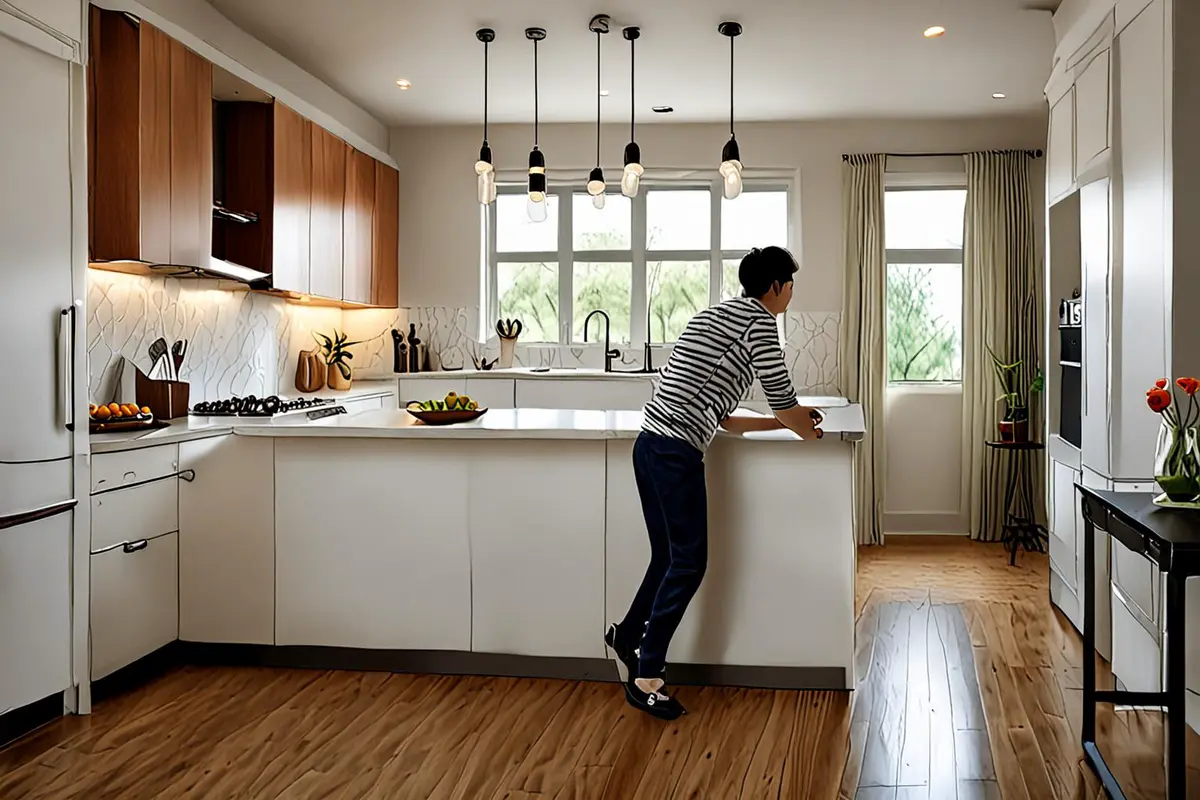
A kitchen easily becomes a beautiful counter with a row of props. A functioning kitchen, however, has preparation, operation, cleaning and storage areas. A cutting board too far from the sink, cups stored beyond easy reach or a product occupying the only useful work surface will force the performer into an awkward route. Viewers may not name the error, but they sense that the person is serving the camera rather than using the room.
The same applies to a bathroom. Towels, mirrors, the basin, power and personal-care items need to support one complete action. Arranging everything front-on for the composition often produces a retail display. Let the performer complete the routine once, then keep what the action needs and remove decoration that will never be touched.
Every trace of life needs a cause
A credible home does not have to be messy. It needs explainable traces. A blanket on the sofa connects to what the character has just done. Water in a glass has a believable level. Shoes at the entrance belong to an arrival or departure. Children's objects appear where a child would use them. Random books, cups and a jacket scattered across the set usually reveal that the art department is performing “lived-in.”
The product should share the same timeline. Is the package already open? Does the cable leave frame in the correct direction? Do steam, condensation, crumbs or folds continue into the next shot? These details decide whether the product has been used in this home or temporarily placed there for a photograph.
Daylight and weather determine which day the room belongs to
The same set can become a bright morning, an overcast afternoon or a warm night, but exterior brightness, practical lamps and human behavior must agree. A noon-bright window combined with every floor lamp switched on and a performer dressed for late evening removes the room's sense of time.
A target market should not be reduced to one color temperature. Start with weather, season and activity, then design window direction, practical-light states and exposure. Reverse angles must preserve the location of the window and the source of light. Local credibility is often broken in the edit rather than exposed in a single frame.
The wider the lens, the more accurate the spatial logic must be
A wide view explains the relationship among person, product and home. It also includes more structural contradictions at once. If a set only works from one direction, do not reveal every wall merely to make it feel larger. Medium shots can establish an action and close-ups can preserve texture and expression, but neither can repair a wide shot in which the character has nowhere to move.
A horizontal master usually needs a fuller spatial beginning. Vertical versions enlarge doorframes, counter edges and hands. Keep two compositions for the same action instead of cropping the center of the horizontal frame. ONCE's global launch content approach plans master films, short cuts and product assets together. Home art direction should begin with the areas those versions will actually show.
Performance must use the room, not simply stand inside it
When performers are told to “act naturally” without a task, they tend to carry a cup, look through a window or smile at the product. Natural behavior comes from choices provided by the room: taking something from a cabinet, moving around a table, shifting the product to a more convenient position and clearing another area after use. These actions explain why the character lives here and give the product a reason to enter the story.
Cross-cultural adjustment does not mean asking actors to imitate national stereotypes. Someone familiar with the target market can review the routine, language and object relationships, while the director turns them into playable tasks. When several market versions are required, replace actions and props that change meaning before simply replacing the cast and packaging.
Give live action, CG and AIGC different layers to solve
Live action is best at establishing the scale, material and physical contact between person and product. CG can replace exterior views, extend a room or modify a fixed structure that cannot be built. AIGC can explore different residential moods in preproduction and support transitions that do not alter product geometry or critical operation.
A generated background does not automatically correct a live-action foreground. If the window becomes another city, product highlights, light on skin and floor shadows still need one direction. A generated outlet, handle or counter cannot invite contact that the performer's hand cannot reproduce. ONCE's Pearl River Delta location and studio resources help identify which spatial relationships should be captured physically before deciding what to extend in post.
Run a no-product living test before filming
Before the product enters the scene, ask the performer to complete the story's arrival, preparation, use of the room and departure. If they must detour around implausible furniture, cannot find power, have nowhere to put down what they are holding, or need spoken direction for every step, the set does not yet contain a way of living.
After the route works, return the product and ask whether it makes the action easier, faster or emotionally different. The product's value then appears through a change in the space rather than a voiceover announcement. For a global brand, a credible home does not prove every performance claim. It makes viewers believe the product has earned a place in their lives.
Build the scene from the target household's real route
If your product needs a home-based campaign for overseas markets produced in China, ONCE can connect the target household, location conditions, human action, product states and horizontal and vertical coverage in one filmable scene plan. Contact ONCE to discuss global brand video production.