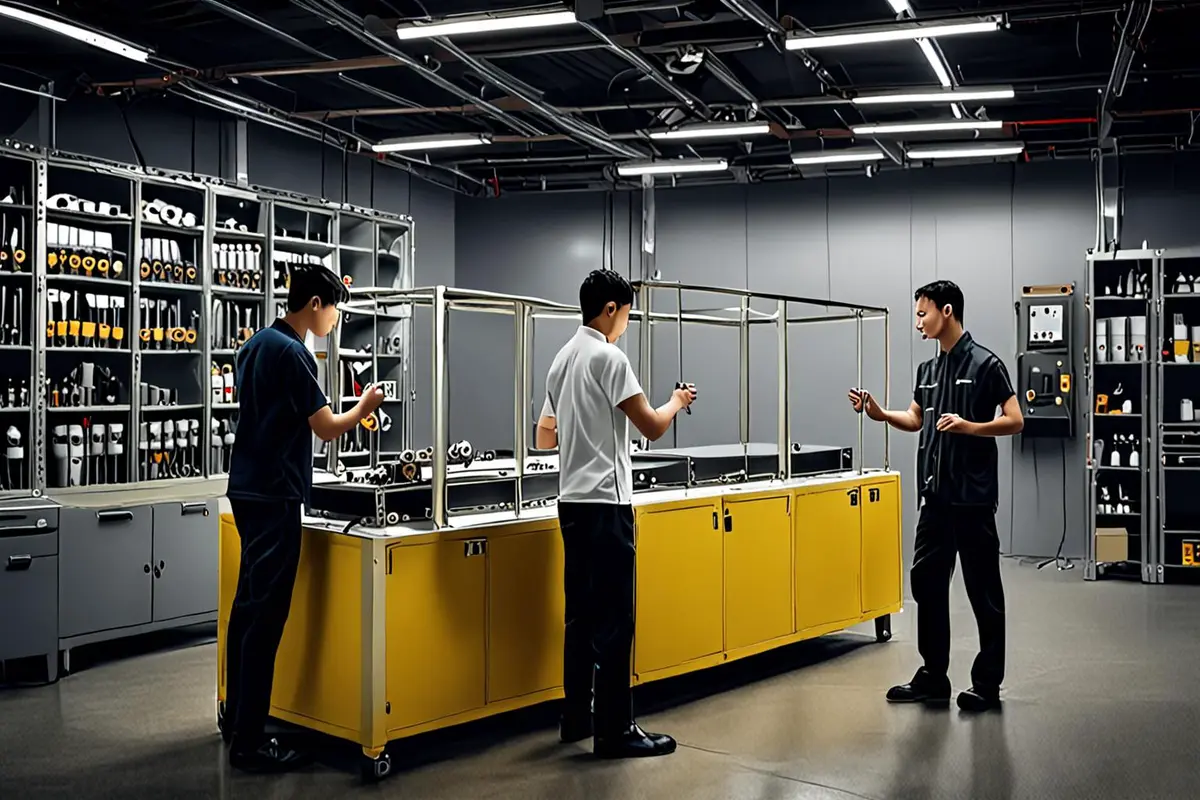
Your overseas service team wants existing equipment tutorials available through AR glasses. The production request says, “We already have the videos. Can you convert them?” That could mean playing a clip, connecting a technician with an expert in China, or placing guidance beside a particular physical component.
These are different purchases. A useful video can remain valuable without becoming an application, a support shift or a spatially aligned instruction. Define the required help before selecting the production scope.
A current signal from enterprise AR partnerships
On September 16, 2026, Snap announced enterprise SPECS partnerships involving Salesforce, AWS, NVIDIA, Trifork and Hololight. Its enterprise announcement describes Tandem by Trifork connecting onsite staff with remote experts who can see their view and add visual annotations. It also describes Hololight providing streamed access to tools, documents and 3D models.
We rechecked the announcements on October 30. They establish announced partnerships and directions, not a universal production deployment, support for a specific machine or guaranteed service-cost reductions. Snap's same-day investor release also describes management and security capabilities being built for enterprise deployment.
ONCE analysis: information is moving from a screen consulted before work toward access during the task. Procurement needs to identify the content, available expertise and operating environment separately. This article is not a SPECS deployment tutorial.
Ask three task questions
Is the answer stable and already approved? A short video, photograph or diagram may be enough when the user needs to recognize a component or review a fixed action. A new display device does not automatically justify rebuilding the whole experience.
Does this situation require judgment? When existing information cannot resolve a specific configuration or condition, the missing resource may be an available expert. That requires scheduling, communication and handover. Ten more clips cannot replace a conversation that needs judgment.
Must the information point to this physical location? Spatial guidance becomes worth evaluating when the actual difficulty is identifying which component, surface or obscured area a step refers to. The content and application teams must agree on positioning, viewpoints, occlusion and updates. An arrow added to a conventional video is not the whole job.
This is ONCE's proposed planning method, not a platform taxonomy. One workflow may use a clip and then escalate to an expert; a spatial application may call video assets. Combining them does not merge their responsibilities.
| Help purchased | What the scope needs to cover |
|---|---|
| Recorded instruction | Approved explanation, identifiable detail, language and callable files |
| Remote expertise | Expert and onsite availability, communication conditions, authorization and escalation |
| Spatial guidance | Application implementation, site adaptation, agreed display behavior and maintenance |
Review old footage by task and equipment version
Component views, complete actions, terminology and approved explanations may be reusable. Burned-in text, camera-dependent arrows and instructions for an older machine need separate review. A library count does not establish readiness.
Useful preparation can separate component identification views, detail shots, action start and end states, and editable text. Let the actual developer confirm whether transparent assets, 3D models or other formats are needed. Do not purchase a supposedly universal AR media pack before the runtime is defined.
If a hand or enclosure hides the relevant location, the original video may not contain an adequate explanatory view. Additional filming or a different explanation may be appropriate. A generated internal structure is not an approved source of equipment facts.
A hypothetical service problem
Imagine an overseas technician saying, “The tutorial is clear, but I cannot match it to this machine.” This is a fictional scoping example, not an ONCE project or a repair instruction.
Have the engineer check the version first. If the problem is simply a mismatch between visible labels and spoken names, identification footage and clearer terminology may solve it within an ordinary tutorial. If the configuration is outside the approved material, an expert must determine applicability.
If locating the guidance on the physical object remains the core problem, commission a controlled prototype for one approved identification task. Under agreed device and site conditions, examine whether the object remains identifiable from different viewpoints, whether occlusion creates ambiguity and how uncertainty returns the user to human support.
These are proposed evaluation questions, not claims that every platform supports the behavior. A composited first-person concept film can support discussion, but it cannot replace acceptance on the actual device. A prototype result also does not establish suitability for every machine, location or network condition.
Separate creation from continued operation
For comparison, use project input = content preparation and adaptation + application and site adaptation + deployment arrangements + continuing expert and maintenance support. List actual work over one evaluation period. Not every project needs every category, and shared tasks should not be counted twice. This is not a price benchmark or a savings forecast.
The content team delivers approved communication and files. Device and application partners own the agreed operating environment. The manufacturer's technical owner confirms equipment information, permitted actions and escalation. One supplier can cover several roles, provided each responsibility has an identifiable owner and endpoint.
Ongoing support should not disappear inside a film-delivery promise. Who is available during overseas working hours? Who reports a firmware or component change? Who withdraws obsolete instructions and verifies the replacement? These obligations determine continuing effort independently of video duration.
Start with one information gap
Choose a defined task with approved material and available reviewers. Compare adaptation of an existing tutorial, remote support and a spatial prototype. Record what each still needs. If conventional material resolves the problem, there is no need to migrate the entire library into a spatial application.
When discussing content preparation with ONCE, bring the approved manual, intended users, equipment version and one specific information gap. Decide what needs to be filmed from there.
The potential long-term asset is the relationship between footage, components, tasks and versions. That is a direction for productizing content services, not a claim that ONCE provides AR systems integration, remote repair or verified cost reductions.
Sources and limits
New Ways to Work with SPECS for Enterprise and Snap's SPECS announcement, September 16, 2026; checked October 30, 2026. The task questions, cost categories and fictional scenario are original ONCE analysis. This is not an equipment procedure, safety course or hardware recommendation. The original cover is conceptual, not a deployed system or platform result.