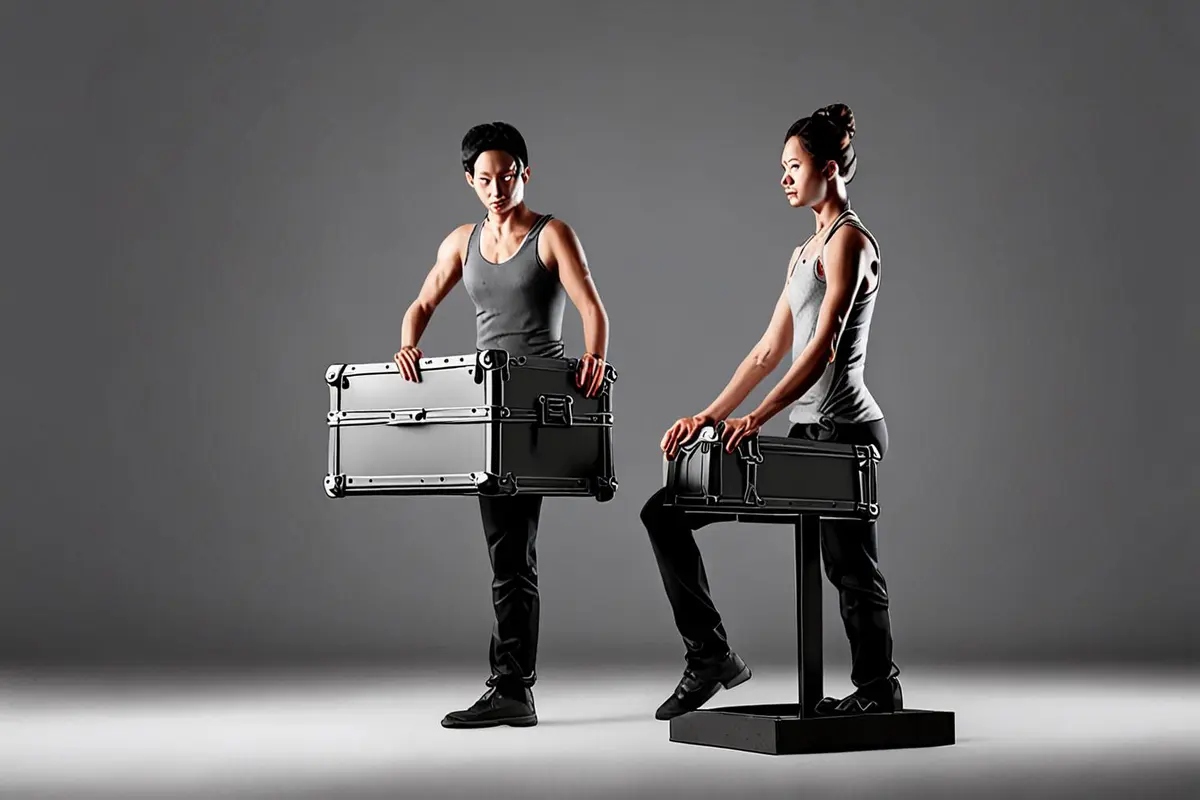
A specification sheet can state how much a product weighs. It cannot make a viewer feel whether that product is light, substantial, tiring to carry, or best moved by two people. Across a screen, weight becomes legible through preparation, lift-off, the response of a support surface, and the moment the object settles again.
Weight is not created by slowing the shot or adding a deep impact in post. It emerges from a complete physical relationship. A person anticipates the load before contact, distributes force through the body, deals with inertia as the product moves, and finally transfers that force back to a table, floor, or another hand. Preserve that relationship and the sense of mass becomes credible.
Weight begins before the product moves
A hand can approach a light earbud case directly. Moving a large speaker usually requires the feet, back, and both hands to prepare first. The clearest cues often appear before contact: finding a grip, moving closer to the center of mass, or clearing nearby space all tell the audience how much effort is coming.
If the performer is already holding a heavy object when the camera rolls, the shot records only the result. Begin from stillness and preserve the glance, the testing hand, and the small shift of the body toward the product. The performance does not need to be exaggerated. It only needs to match the real object.
The body, the support, and inertia provide different evidence
The body shows how much force a person uses. Finger joints, wrist angle, forearm tension, shoulder position, and a change in balance can all carry information. Small products may be explained by the fingers and wrist. Larger products need the arm, torso, or feet to remain in frame. An extreme hand close-up may reveal material while removing the scale of effort.
The support shows where the load goes. A cushion compresses, paper becomes pinned to a table, or a wheel changes speed on carpet. Inertia shows whether the product immediately follows the person. Light objects can change direction quickly. Heavy objects usually leave a longer visible path through starting, turning, and stopping. A shot does not need all three forms of evidence, but at least one must be clear.
Lifting, carrying, and setting down answer different questions
A lift is useful for showing starting force. The performer finds the grip, the product leaves the surface, and the body regains balance. Carrying shows sustained load: whether the object stays close to the body, whether the arms keep correcting, and whether walking rhythm changes. Setting down reveals how force ends, especially when the final few centimeters require control.
One generic lifting shot is rarely enough. A portable device may need to prove easy one-handed handling. Furniture, appliances, and outdoor equipment may need a complete move and placement. The action should serve real use rather than a vague idea of strength. Our article on damping feel in product videos focuses on resistance within knobs, hinges, and sliders. Perceived weight concerns the relationship between the whole product, the body, and the surrounding space.
Keep the center of gravity visible
A camera that follows the product too perfectly can turn it into a weightless graphic because the frame loses stable references. A slightly wider medium shot can retain the product, arms, and support surface. Close-ups can then explain grip, edge deformation, and contact. The complete action gives each detail something to describe.
Camera height also changes the reading. A low angle can emphasize volume but may exaggerate the product. An overhead view clearly shows placement and occupied space but can hide bodily effort. Begin near the real use perspective, then decide how far the creative treatment should depart from it. A gimbal or robot can repeat motion precisely, but perfect synchronization with the object can erase useful inertia and hesitation.
Light the contact and deformation
Weight depends on contact. Fingers compressing a soft handle, a package edge changing shape, or a cushion responding to a load needs side light or a readable contour. Flat frontal light may make a product clean while removing the very place where force becomes visible.
Contact shadows matter as well. As a product leaves a table, the changing distance between its base and shadow helps describe lift-off. When it returns, the shadow closes and the action finally ends. The goal is a reliable spatial relationship rather than dramatic darkness. Reflective products also need control so that the camera, fan, or crew does not become a false reference. Related techniques appear in our guide to reflections in product advertising.
Sound must follow material and contact
A heavy object does not always make a deep impact, and a light object is not automatically crisp. Wood, metal, upholstery, and carpet transform the same placement into different sounds. The product's cavity, shell, and internal construction also affect the length and frequency of contact. Sound design should first match material and action, then support emotion.
Production can record hand friction, product movement, the point of contact, and room decay separately. Post-production may clarify those layers. If a small plastic product is made to land like a safe simply to feel premium, viewers may not name the problem, but the physical relationship will feel wrong. Sound can strengthen visible weight; it cannot invent mass.
Editing must preserve the transfer of force
Weight is easily cut out. Jumping from first contact to an object already in the air leaves only two states. Cutting before the object has settled removes the end of the force. A complete action does not require every second in real time. It requires the decisive moments of applying force, leaving support, regaining balance, and placing the object to remain legible.
Slow motion can reveal muscle tension, material response, and inertia, but it changes our intuition for real speed. A stronger sequence often begins with one real-time action and uses a slower detail for a specific contact point. Acceleration can compress a long carry, but it should not cross the decisive load-bearing moment or a heavy product will appear magnetized into place.
Light does not mean cheap, and heavy does not mean premium
For travel gear, wearables, hand tools, and mobile work products, low weight may be the value. The right visual treatment shows how easy one-handed lifting, quick redirection, or sustained carrying reduces burden. Making such a product appear heavy would contradict the benefit.
Brands should not use acting and sound to disguise a product as heavier either. Weight figures, load capacity, and structural safety are verifiable performance claims that require real information and test conditions. Advertising imagery communicates experience. Quality comes from agreement among material, structure, movement, and sound rather than from adding mass to every cue.
Dividing the work among live action, CG, and AIGC
Live action is strongest at real contact: compressed skin, stretched fabric, a cushion sinking, or the tiny delay as an object starts to move. CG can explain an internal center of mass, a counterweight, or a sealed mechanism, but the external action still needs to match the real sample. AIGC can preview composition, blocking, and atmosphere, yet continuity may change product scale, grip, fingers, or deformation between shots.
In hybrid production, keep human contact, lift-off, and placement in live action while using post for internal structure or environmental extension. Generated imagery should not deepen compression, exaggerate muscle strain, or invent a shift in balance. The more a shot resembles physical evidence, the more carefully it must be checked against the real product.
Test the idea with one six-second action
A practical test can be simple. Ask the performer to approach, grip, lift, hold, and set down the product in roughly six seconds. Watch without sound and check whether body and object share the same physical logic. Listen without the picture and judge whether the contact matches the material. Then review the complete shot and see whether camera movement or editing hides the decisive force.
If the audience can infer whether the product suits one hand, two hands, or assisted movement, the sense of weight has started to work. If only slow motion, facial effort, and a heavy impact remain, redesign the grip, center of mass, and support.
If your product needs to communicate portability, substance, stability, or handling effort across a screen, bring a working sample, weight information, and real use actions to ONCE. We can test movement and camera choices, then extend the most credible cues into a hero film, product page, and social cutdowns.