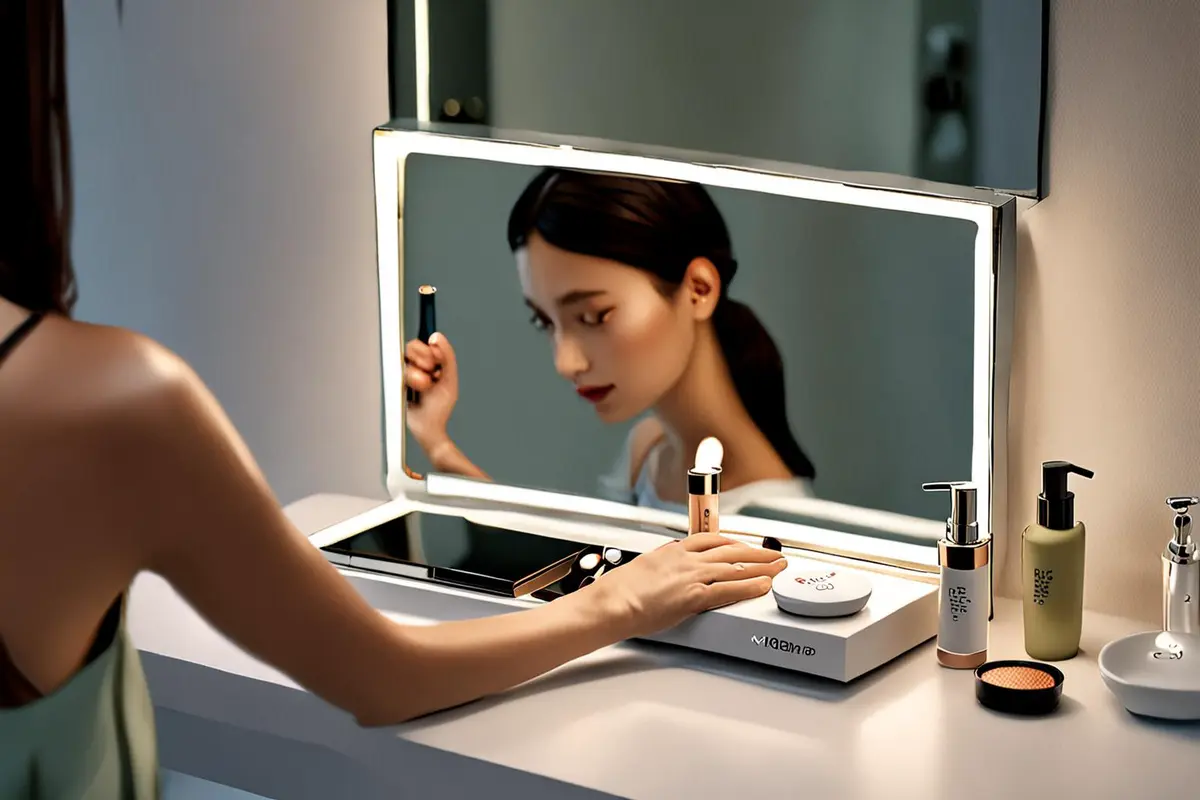
Imagine a simple test shot. A person stands at a bathroom counter holding a beauty device. Frame the face directly and the hand can hide the product. Cut to a close-up and the person’s reaction disappears. Once the mirror enters the composition, the same moment can hold two viewpoints: the hand and product remain clear in the foreground, while the reflection keeps the performer’s eyeline, shoulder movement and the space behind them. The mirror is no longer a decorative sign of “premium” styling. It becomes a second camera without a camera body.
The purpose is not to make the frame more complicated. It is to let information that would normally require two or three cuts remain inside one spatial relationship. This can be useful for beauty tools, appliances, wearables, vehicle interiors and packaging actions, whenever the product and the person using it must be understood together. The same mirror can also reveal the camera, lights, reversed text and incorrect movement. A reflection should therefore begin with a narrative task, not with a mood-board preference.
A reflection is a second viewpoint, not another packshot
The direct view can tell the audience where the product is. The reflection is often more valuable when it adds who is looking at it, what is happening outside the direct frame, or how an action changes the person. If both areas show the same product angle, the mirror merely repeats information. When the two viewpoints perform different jobs, the reflection genuinely extends offscreen space.
Cover the mirror area during a storyboard review and ask what necessary information disappears. If the answer is only “a bright surface,” the mirror has no narrative function. If the performer’s response, an arriving person, a rear product detail or the result of an action disappears, it is carrying the second viewpoint. This question touches reflective-surface production, but it is not the same topic. ONCE’s article on light shaping and product reflections explains how the environment enters a material; here the focus is how that reflected environment changes the story.
Three structures that open the space beyond the frame
Keep the product direct and the person reflected
This is the most reliable structure. The product stays clear in the foreground or hand-action area, while the mirror preserves the performer’s eyes and physical response. Viewers understand the action first, then read hesitation, recognition or satisfaction in the reflection. The performance does not need to grow larger simply because it appears in a smaller area. An exaggerated expression can pull attention away from the product.
Keep the person direct and reveal the product’s far side
A mirror can show a second angle when a product has front-and-back details, a hinge, a rear control or a fit that is difficult to see from one position. The direct view might show a person placing headphones over the ears while a side reflection reveals the ear-cup contact and button position. The two angles must still explain the same physical space. Moving a mirror to an impossible position merely to show more information makes the scene feel designed around the trick.
Let the reflection hold an offscreen action
A mirror can carry movement from a doorway, corridor, rear seat or the far end of a worktop. The direct frame can remain with the person and product. Viewers notice the change in the reflection, then wait for a response. Sound is a useful spatial anchor here. Footsteps, a latch, a button or packaging noise can locate the action before a small reflected movement becomes legible. Sound should connect the space, not invent product performance.
Map the reflection path before choosing lights
A storyboard rectangle labelled “mirror” is not enough. The set plan should place the camera, reflective surface, product, performer and major light sources, then show the fan of space visible from the camera position. Move the camera a few centimetres and the reflection may change from a shoulder to a lighting stand. Move the performer back one step and the product may overlap the face. A phone and temporary mirror can test the blocking before formal lighting begins. Mark the safe camera position, performer stops and product height on the floor.
Exposure and focus are not minor finishing issues. The reflected subject travels through a different visual route, and its background brightness and surface cleanliness affect legibility. If the direct view is bright while the reflected face falls into black, the mirror becomes a dull patch. If the reflection is too bright, it can overpower the product outline. The cinematographer has to choose which layer carries the primary message, then use lighting ratio, depth of field and occlusion to establish hierarchy.
Text, logos and interfaces create a harder constraint. A package front seen only in a mirror will read backwards. A screen interface may also reverse its directional logic. Keep readable identity in the direct view, or let the reflection carry silhouette and movement without carrying typography. Flipping the entire reflected area in post usually creates new mistakes: a raised left hand, an opening door and an eyeline all change direction with it.
Camera movement exposes a false mirror quickly
A locked shot can hold a stable relationship. Once the camera pushes, tracks or orbits, the reflected background, person and product must change according to the same geometry. If the direct view stops while the reflection continues drifting, or a person changes scale while crossing the mirror edge, the image begins to feel pasted together.
For live action, retain a complete mirror take, then capture the clean environment, clean product and necessary reflection references. When an environment is replaced or CGI is added, those plates help the compositor judge edges, occlusion and motion. ONCE’s guide to blending CGI with live action explains why reflection references, clean plates and camera data need to be captured together. Mirror shots make that record especially valuable.
If AIGC extends the set, it can change a view through a window, a distant background or the atmosphere. It should not casually rewrite product geometry, the contact between a person and the mirror plane, or reflected movement direction. A convincing single frame is insufficient. Review the entire action as the performer enters, crosses and leaves the reflection. An extra hand or a head movement delayed by half a beat will attract more attention than a minor background defect.
A horizontal composition may fail when cropped vertically
Reflection structures depend on two areas remaining visible together. A horizontal frame can place the performer, product and mirror in a triangle. A 9:16 crop may reduce the mirror to a narrow strip and remove the second viewpoint. Decide which relationship the vertical version must preserve: foreground product with reflected expression, or direct performer with reflected rear detail. If both cannot survive the narrow frame, change the product height, mirror angle or performer mark for the vertical take instead of relying on a sliding crop.
During review, play the shot three ways. First, watch only the direct view. Second, look only at the reflected area. Third, watch the complete composition with sound. Each area should explain its own action, and the combined frame should not create a fight for attention. That is the point at which the reflection carries information rather than adding reading effort.
Know when to remove the mirror
If viewers must judge exact colour, packaging text, connector direction or size, a direct view should normally take priority. A mirror with tint, distortion, dirt or a restricted angle can carry character and space, but it should not become the only product proof. On a small social feed, a reflected object may also shrink into unreadable movement.
The benefit of reflection is that one shot can contain two areas of space. The cost is more exact blocking, lighting control, cleaning, compositing and aspect-ratio adaptation. Return to one question: does the second viewpoint add information that the direct image cannot replace? If it does, build a test around that relationship. If it does not, remove the mirror and photograph the product and performer more clearly.
If you are designing a mirror shot for a launch commercial, product film or hybrid AIGC production, explore ONCE’s commercial and TVC production service, then send the product reference, target formats, mirror references and structures that must remain accurate through the project enquiry page. We can use one representative test shot to decide whether the second viewpoint truly serves the idea.