ONCE Advertising Cinematography Research · Advertising Cinematography Research 04/10
Research article / Work analysis · ONCE Editorial Team
A polished bottle can be bright on the monitor without looking more like metal. A uniform white patch covers its front, its edge disappears into a pale background, and nothing in the tonal transition explains the curve. Adding more light only pushes the patch toward clipping; reducing the level turns the product grey.
The problem may not be insufficient illumination. The team may be asking only where the lamp points, rather than what the surface can see. On polished metal, lacquer, glass and wet coatings, much of the recorded highlight is an image of the source, white cards, black flags, set and surrounding environment. Form is communicated by how those images stretch, break and grade across a curved surface.
Our central argument is that lighting does not paste value onto a product; the production designs the environment that the product can reflect, scatter or transmit. “Soft light,” “rim light” and “negative fill” are therefore not fixed aesthetic recipes. They become meaningful only within a specific relationship among material, viewpoint and background.
We propose a three-layer framework: material channel, visible environment and contour separation. It is not a universal lighting diagram. It is a way to test an advertising concept, a lighting test or a CGI match with three questions: by what route does light mainly reach the camera; what is the surface imaging; and where does the product end and the background begin?
Materials and method: no unique lighting diagram can be recovered from a finished frame
This article reads Framestore's production accounts for General Motors' The Calmest Man on the I-405, LEGO's Drive What You Love and Converse's Counter Climate, including the images described on those pages and the published credits. We also checked ARRI's Lighting Handbook, the microfacet-reflection chapter in the fourth edition of Physically Based Rendering, and the description of MERL's measured BRDF database.
These materials establish several production facts. The GM film was shot on an LED stage using high-resolution 360-degree road footage, producing interactive light and reflections. The LEGO project scanned and rebuilt a real home environment to add spatially consistent reflections to CG cars. The Converse project used neon, weather and environmental HDRI elements, backlighting and composited water beads to organize the shoe's material response. These disclosures let us study how “the environment enters the material.”
They do not allow us to claim that we inspected every frame or to supply undisclosed fixture counts, positions, focal lengths, exposures or card distances. A result may combine live action, CGI, compositing and grading; more than one physical setup can produce a similar visible effect. We therefore keep four statement types separate: documented production fact, limited content actually visible or readable on the project page, ONCE's interpretation, and an unperformed experimental proposal.
Layer one: identify the material channel before choosing a lighting recipe
Material is not merely a label such as metal, glass or plastic. It is a surface's directional and spectral response to incident light. For creative decisions, a complex response can first be reduced to three common channels:
- A diffuse component distributes incident light across a broad range of directions. Rough paper, unglazed clay and some fabrics often rely on it to make local color and broad form readable.
- A specular component is highly dependent on viewing angle. Polished metal, lacquer, wet coatings and glass surfaces bring the structure of the source and environment into the image.
- Transmission, refraction and volumetric scattering allow light to travel through a material, change direction inside it or spread beneath the surface. Clear glass, liquid, translucent plastic and skin require a different account of the light path.
Most products combine several channels. One piece of black plastic may contain a dark diffuse response and a narrow bright specular highlight. A bottle may require its glass edge, liquid volume and printed paper label to work simultaneously. Calling all of this “lighting the product” often forces incompatible tasks into one source.
The fourth edition of Physically Based Rendering, “Roughness Using Microfacet Theory” explains rough reflection through a distribution of microscopic facets: incident and viewing directions determine which facets can return light to the camera, while roughness, masking and shadowing shape the highlight and its falloff. This is not an on-set lighting chart. Its useful warning is that a highlight is not a sticker attached to a product. It arises from incident direction, viewing direction, surface-normal distribution and environmental radiance together.
The MERL BRDF database contains densely measured reflectance functions for 100 materials, associated with Matusik, Pfister, Brand and McMillan's 2003 paper A Data-Driven Reflectance Model. The lesson is not that selecting a material preset guarantees truth. It is that reflectance differs measurably: surfaces all described as black, silver or matte do not return light in the same way. Before production, the useful test is the final sample in the proposed viewpoint and light field.
Layer two: on a glossy product, the highlight is part of the environment
ARRI's Lighting Handbook relates hard and soft light to the physical size of the source relative to the subject: a larger diffused area generally produces a softer shadow edge. In product cinematography, shadow softness alone is incomplete. On a reflective curved surface, a larger source also becomes a larger bright shape. A strip diffusion frame becomes a band; a white card becomes a white region; a black flag becomes a dark band.
This is why negative fill is more than making a shadow darker. When black fabric or a flag occupies a direction visible to a glossy product, it enters the visible environment and supplies a controlled dark region beside a bright reflection. That region may separate shoulder from body on a bottle, reveal a chrome bevel against the background, or replace an unwanted ceiling and crew reflection. Moving the flag changes reflection geometry and contour, not just an exposure reading.
Gradients should be read in the same way. When a large bright area moves from light to dark across a curve, the transition can describe curvature. An abrupt break may indicate a genuine edge, or it may reveal a crease in the diffusion, an occluder or an environmental seam. A useful test watches whether the highlight travels continuously over the intended form rather than checking only average brightness.
GM on an LED stage: the road environment is both background and source
Framestore's account of #GMExhibitZero states that The Calmest Man on the I-405 was shot entirely on an LED stage. The team captured high-resolution 360-degree road footage for the volume. With one exception, the spot was achieved in camera without further VFX or post cleanup, and VFX supervisor Michael Ralla specifically described the interactive light and reflections produced by playback.
This case weakens the distinction between background and lamp. Interior trim, windows, metallic surfaces and the performers' eyes do not merely receive illumination from the LED image; they also receive directional changes from roads, sky, traffic and bright city regions. If playback supplies perspective outside the windows but does not make sense in glass and trim, two incompatible worlds emerge: the exterior moves while the material response remains still.
The documented facts are the 360-degree road material, LED stage, interactive light and reflections. Our interpretation is that the approach turns the environment into a large time-varying light field, making reflectance part of spatial credibility. It does not prove that an LED volume is inherently more truthful than a location or greenscreen, nor that every reflection required no intervention. Pixel structure, brightness range, color reproduction, shutter behavior and window polarization can create new constraints.
The transferable question is not simply whether to rent an LED stage. It is: what world must the product reflect? If one vehicle needs day, night and rain versions, has the team changed only the exterior plate, or has it redesigned what the glass, paint and interior surfaces can see?
LEGO: accurate reflections become evidence of continuous scale
Framestore's Drive What You Love account places a live-action house, CG environments, real cars, CG cars and LEGO cars in one production chain. The location was selected early, scanned and photographed for reconstruction at macro scale. The page explicitly states that these references were used to add accurate reflections to the CG cars and integrate them into the enlarged domestic world.
The problem is not merely that the cars need gloss. As they move through tables, bread bins and spaces beneath chairs, their reflections must keep explaining where they are. If the bodywork images only a generic studio source while the background is a kitchen, the car becomes a product model pasted into the scene. If every scale change simply enlarges the same highlight, the surface loses its relationship to domestic geometry.
The project page does not disclose how every bodywork reflection was generated. It does establish that location scanning, photogrammetry and environment reconstruction served reflection matching. Our interpretation is that reflectance here becomes evidence of continuous scale. Chair legs, counters, windows and bright room areas need not be individually legible, but their direction, density and motion should agree with the giant room around the car.
This also supplies a counterexample. If an idea deliberately seeks graphic flatness, a toy-package world or theatrical unreality, exact environmental replication may not be the goal. Material matching serves the rules of the world, not physical realism in every project. The team should be able to state which reflections establish space and which may be simplified into brand graphics.
Converse: backlight does not prove weather resistance; droplets need a visible condition
The Counter Climate project page explains that neon signage, weather and environmental HDRI elements were used with backlighting to create a strongly backlit city world. Water beads observed under different lighting conditions were tracked and composited over a CG shoe, while the work was measured against real material properties. The page images identify the sole, heel, eyelets, fabric details and droplets as subjects, but this article did not perform a complete frame-by-frame viewing of the film.
A wet surface introduces another specular layer. A droplet that has the same luminance as its background may remain invisible even when its geometry exists; backlight and environmental bright regions can give the edge and curve a directional highlight. The textile below cannot become only a beautiful rim. Fibres, seams, eyelets and construction must remain legible, or the wet world swallows the product.
The source documents the backlight, HDRI and weather elements, composited droplets and real material reference. Our interpretation is that lighting solves two distinct tasks: making the new wet layer visible and keeping the original shoe structure from being erased by it. Backlight is not a performance proof, and an image of beads cannot by itself establish long-term weather resistance. It turns a function-related material state into a visible event.
Layer three: contour separation is not a compulsory bright rim
Whether a contour survives depends on the difference across the edge. A black glossy product on black may separate through a white reflection, through a bright background region seen across a glass edge, or through a slightly brighter background behind a darker interior. Giving every product the same rim light turns different materials into one generic advertising texture.
Negative fill can be more precise than adding a lamp. On a white matte product, abundant frontal diffusion may flatten a change in plane; a black surface placed on the side away from the key can preserve a controlled falloff that describes thickness. On a transparent container, dark cards may create edges against a bright background. Against a dark background, the same cards may remove the contour entirely.
“Black flags make products premium,” “use a large softbox,” and “glass needs backlight” are therefore half-sentences. The other half must specify viewpoint, background luminance, product curvature, surface roughness, rotation range and delivery format. Without those conditions, a modifier name cannot replace judgment.
When the template fails: rough, transparent and moving products
Large soft sources can give polished curves continuous highlights while making rough fabric, embossed paper or brushed direction look too flat. If fine texture is the claim, a smaller source at a more oblique angle may produce micro-shadows that reveal it. The cost is a sharper highlight, more visible defects and less stable shimmer during rotation.
Transparent objects are not material-free. They become visible through edge refraction, surface reflection, internal absorption, bubbles and liquid interfaces. Bright frontal fill may produce only a milky rectangle; reorganizing bright and dark regions behind the object can reveal thickness. The production is controlling the background's path through the material, not painting the glass white.
Once a product rotates, a successful still setup can fail. A diffusion frame that gives a bottle a beautiful frontal gradient may cross a critical part of the curve and abruptly leave the surface. Camera motion changes reflection angles as well. A test should not select one attractive frame. It must inspect the continuity of the highlight path, label occlusion and contour survival across every required angle.
CGI and AIGC: a correct reflection is not the same as a correct material
CGI can expose environment maps, roughness, normals, refraction and geometry as parameters, but a complete parameter list does not guarantee a convincing image. If the environment lacks meaningful bright-dark structure, an accurate material model faithfully reflects an impoverished world. If camera, environment and product animation disagree, drifting reflections reveal the composite.
MERL's measurements and PBR's microfacet models establish computable material differences. They also remind us that real coatings, scratches, fingerprints, anisotropic direction and manufacturing tolerances do not appear automatically in a metallic slider. In generative video, a stable single frame is not evidence of stable material. Highlight direction, product marks, curvature and environmental change require shot-by-shot review across time.
This does not make live action inherently real or CGI inherently false. The LEGO case shows that a digital asset can belong to one world when it has measured environmental reference and consistent reflectance. A live-action body panel that images stands, crew and irrelevant white walls can equally damage the brand image.
An unperformed minimum test: let one product see four environments
The following is a proposed experiment. It has not been conducted for this article and has no results.
Choose a sample that combines polished, matte, transparent and printed-label areas. Lock camera, lens, composition, white balance, exposure reference, product angle and background. Change only the visible environment around the product and record four versions:
- One large white diffusion area;
- The same diffusion with a narrow black strip that creates a controlled negative reflection;
- A smaller, more oblique hard source while keeping the product's midtone exposure approximately matched;
- Alternating bright and dark background regions behind the product, with a transmission path preserved for the transparent section.
Rotate the product through the same angle in every version. Record five observations: highlight width and continuity; legibility of curvature changes; survival of fine texture and labels; time for which the contour remains distinct from the background; and jumps or unwanted studio reflections during rotation. For a CGI comparison, use the same camera and motion path and record environment reconstruction, material parameters and post adjustments. Do not compare only the prettiest final still.
The test can fail. Product displacement can be mistaken for a lighting effect. Unmatched midtones mix exposure with source geometry. Turntable-speed differences alter motion blur. Dust and fingerprints change local highlights. Conversely, if all versions receive only a holistic “premium” score and none of the visible measures above are recorded, the test cannot identify which relationship changed the material.
Write a lighting brief in terms of what the product must see
A plan that says “large soft key front-left, fill on the right, rim behind” is easy to copy and hard to justify. A more testable statement would be:
Across the hero view and a fifteen-degree rotation, retain one broad bright gradient from the bottle shoulder to its base on the left. Create a narrow dark band on the right with a black surface so the bottle separates from the light-grey background. Keep the label outside the principal highlight. Reveal the thickness of the transparent base with one bright region behind it. Recheck all four conditions after camera movement rather than forcing one lamp position to cover every view.
This does not lock the production to a branded fixture. It defines material, environment, angle and failure conditions. Cinematography, lighting, production design, product and post teams can decide whether the bright area comes from diffusion, an LED screen, a bounce or a CG environment; whether the dark band comes from a flag, a set surface or post; and where physical accuracy yields to a graphic brand decision.
The second study on lens and viewpoint separated spatial relationships. The third study on movement and blocking added time to space. This study adds material: as viewpoint or product moves, the environment visible to the surface changes. The three questions cannot be approved independently.
For production context, see ONCE's commercial production and collaboration scope. With the product sample, surface-finish notes, hero viewpoint, rotation range and delivery formats prepared, send ONCE a project brief and begin with a material-and-reflection test.
Sources and research note
Sources checked on 4 October 2026.
- Framestore, General Motors #GMExhibitZero. This article uses the disclosed LED-stage workflow, 360-degree road footage, interactive light and reflections, and project credits for The Calmest Man on the I-405. No publication date is displayed on the page.
- Framestore, Drive What You Love. This supports early location selection, previs, scanning, photogrammetry, CG environment reconstruction and reflection matching for cars. No publication date is displayed.
- Framestore, Counter Climate. This supports the use of neon, weather and environmental HDRI elements, backlighting, composited droplets and real material reference. No publication date is displayed.
- ARRI, Lighting Handbook, English edition dated 19 February 2020. We use only the foundational account of physical source size, diffusion and shadow quality; product promotion is not adopted as an aesthetic conclusion.
- Matt Pharr, Wenzel Jakob and Greg Humphreys, Physically Based Rendering: From Theory to Implementation, fourth edition, “Roughness Using Microfacet Theory”. This supports the stated technical scope of microfacets, masking and directional reflection.
- Wojciech Matusik, Hanspeter Pfister, Matthew Brand and Leonard McMillan, A Data-Driven Reflectance Model, ACM Transactions on Graphics, 2003; the MERL BRDF database states that it contains densely measured reflectance functions for 100 materials.
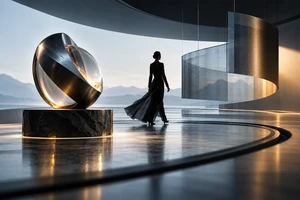
This is an original ONCE Editorial Team research article and work analysis, not a peer-reviewed academic paper. The cover is an original commercial concept image, not one of the cited advertisements, an ONCE client project, a real set or an experiment. No third-party campaign frames are republished here.