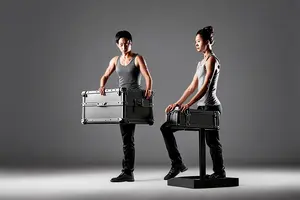
Your regional team has approved the pictures in an older product film. The factory can still supply the product, the demonstration remains relevant, and a new shoot seems unnecessary. But the only available audio is inside the finished English video. A proposal for AI dialogue removal looks like a shortcut to the next market.
Before commissioning several dubs, listen to what happens underneath the original speech. When the presenter closes a lid, does the contact sound survive? When a sentence ends, does the room suddenly return? The useful buying decision is whether the recovered sound bed can support localization at an acceptable repair cost.
A separation tool offers a rescue attempt, not a delivery certificate
Adobe announced new Premiere audio tools in public beta on September 8, 2026. Its Enhance Audio description includes separate control of dialogue, music, ambience and sound effects within a clip, including muting dialogue. This establishes an announced capability, not lossless recovery for every finished mix.
Amazon MGM Studios offers a useful delivery reference: its applicable M&E requirements call for effects under dialogue to be filled, with separate provisions for documentary and unscripted work. M&E means music and effects. Those studio requirements are not a universal specification for product advertising or Amazon listings.
ONCE analysis: separation makes a legacy film worth investigating. It does not establish that the resulting files are ready for a dubbing team. Buy an approved sound bed for a defined use, rather than treating the number of exported stems as the acceptance criterion.
Build an audio gap ledger around the hardest moments
Ask the supplier to test a section where speech overlaps a meaningful product action, including the speech entrance and exit. A clean instrumental passage tells you little about the difficult material. Choose the length around the complete action and its decay, rather than an arbitrary sample duration.
The ONCE audio gap ledger has four fields: picture timecode, required audible event, what survives separation, and the proposed repair. The following is an illustrative scenario, not a client result or a measurement of a particular tool.
- A case latch disappears. Count this as an individual event. Look first for an existing clean recording or record the actual sample held by the China production team. If Foley is needed, check material, force and timing against the picture.
- The room drops away during speech. Measure this as a continuous gap. Restore an appropriate environment rather than scattering extra effects through every pause.
- A recognizable English syllable remains. Log language residue separately. Audition the point during a pause in the new dub; a louder voice is not a reliable repair.
Also listen for music level changes inherited from the old narration. They may be intentional. Do not flatten them automatically, but check whether they still support the new performance when its pauses move. The target is a coherent new mix, not the maximum removal setting.
Use two listening passes before approving the rescue
Pass one: the proposed localization bed without a new voice
Compare the bed with the picture and reference mix. Check old-language residue, product contacts, environmental continuity, musical tails and audible holes. The reference explains the original action and atmosphere; it does not require every rebuilt effect to sound identical. Any recovered original recordings must also be checked against the final picture timing.
Pass two: a representative target-language performance
Add an approved sample of the new voice. Listen for crowded moments, exposed gaps and inherited music dips that now land in the wrong place. A target-language reviewer still needs to approve the words and pronunciation. Passing one language does not approve all the others: the repaired bed may be shared, while each performance, mix and export needs its own review.
A full mix alone can hide damage behind the new voice. An isolated bed alone cannot show how the new performance sits. Once both passes work, review the finished version on the agreed channel and playback devices.
Separate shared repair from the cost of each language
Use this scope model: rescue cost = source review and separation sample + shared sound-bed repair + translation, voice and mixing for each language + finished-version checks.
Describe shared repair through discrete events, continuous gap duration, usable replacement recordings and manual difficulty. Do not multiply the same common repair by the language count. A different picture edit or a market-specific sound design is additional work and should be identified separately.
This is a purchasing model, not an ONCE rate card or a claimed industry saving. Compare three outcomes before approving the full language order:
- Separate and patch: the picture remains suitable, damage is concentrated, and important sounds have credible replacement sources.
- Rebuild music and effects: repairs cover much of the film, the old music no longer suits the brief, or patching approaches the work of a fresh design. Confirm the basis for using replacement music.
- Retire this version: an audible performance claim cannot be reliably reconstructed, or picture, lip movement and embedded text already require substantial new production.
For a brand working with a Chinese supplier, a small clean-sound recording session using the available physical sample may be a useful alternative to repeated processing. It still needs a defined brief and approval. Foley can support the feel of an action; it cannot become evidence of measured motor noise, noise cancellation or another acoustic performance claim.
Write the sample request around unresolved gaps
A practical request is: “Return a candidate bed without recognizable original dialogue, one target-language trial mix, and a timecoded list of unresolved gaps. Quote common repairs separately from language work. Identify original recordings, new recordings and reconstructed effects.” A filename containing M&E should not stand in for that explanation.
After sample approval, agree the picture version, duration, channels, file specifications, intended use and receiving team's requirements. A short social ad does not automatically need a studio distribution package; it does need a clear acceptance standard.
For an existing film, send ONCE the approved picture, every available audio source and the product actions that must remain audible. The next useful output is a repair decision before a large dubbing order. Our ONCE production solutions can use that scope to coordinate the product sample and sound work with your China-based production resources.
Sources and limits
Adobe: Generate and create directly in your timeline with new AI-powered innovations in Premiere and After Effects, September 8, 2026, supports the public-beta capability description. Amazon MGM Studios: Delivery & QC, accessed October 29, 2026, provides the M&E reference and its content-specific exceptions.
The gap ledger, two listening passes and purchasing model are ONCE recommendations. They are not a certification process from either source, a test of the announced software, or a forecast of savings. The source material, required delivery and approved sample determine whether rescue is worthwhile.