Research and development scenes often collapse into a familiar fiction. The whiteboard looks untouched, the drawing has already reached its final version, and three people point at the same circle as soon as the camera rolls. The frame contains engineers, formulas and a prototype, yet no thinking is taking place. Viewers see a meeting arranged for a corporate film rather than a product moving from a problem toward a decision.
A credible R and D scene does not need to reveal every technical detail. It needs to make something more useful visible: what the team is observing, where interpretations diverge, and which clue changes the next action. Drawings, whiteboards and screens should carry a problem between people instead of acting as generic signs of innovation.
Film the Problem Appearing, Not Only the Answer on Display
A highly finished drawing can explain a result, but it rarely communicates development. Thought usually begins with an incomplete situation: a dimension does not match the prototype, an airflow path must be redrawn, a test user hesitates at one interface step, or two parts interfere with each other during assembly. When the audience first sees that specific resistance, the measuring, marking and discussion that follow have a reason to exist.
This also changes how engineers speak. They do not have to face the camera and recite a claim about constant innovation. They can explain what is known, what remains uncertain, and what the next action will test. The article on technical experts expressing uncertainty on camera focuses on language and credibility. This article asks how those decisions become visible through marks on paper, spatial relationships and continuous action.
One Drawing Can Play Three Different Roles
The same sheet of paper can be evidence, a relationship map, or a decision. The scene should choose one primary role before shooting. Otherwise, performers take turns pointing while the edit has no cause to follow.
Evidence Gives the Problem a Visible Landing Point
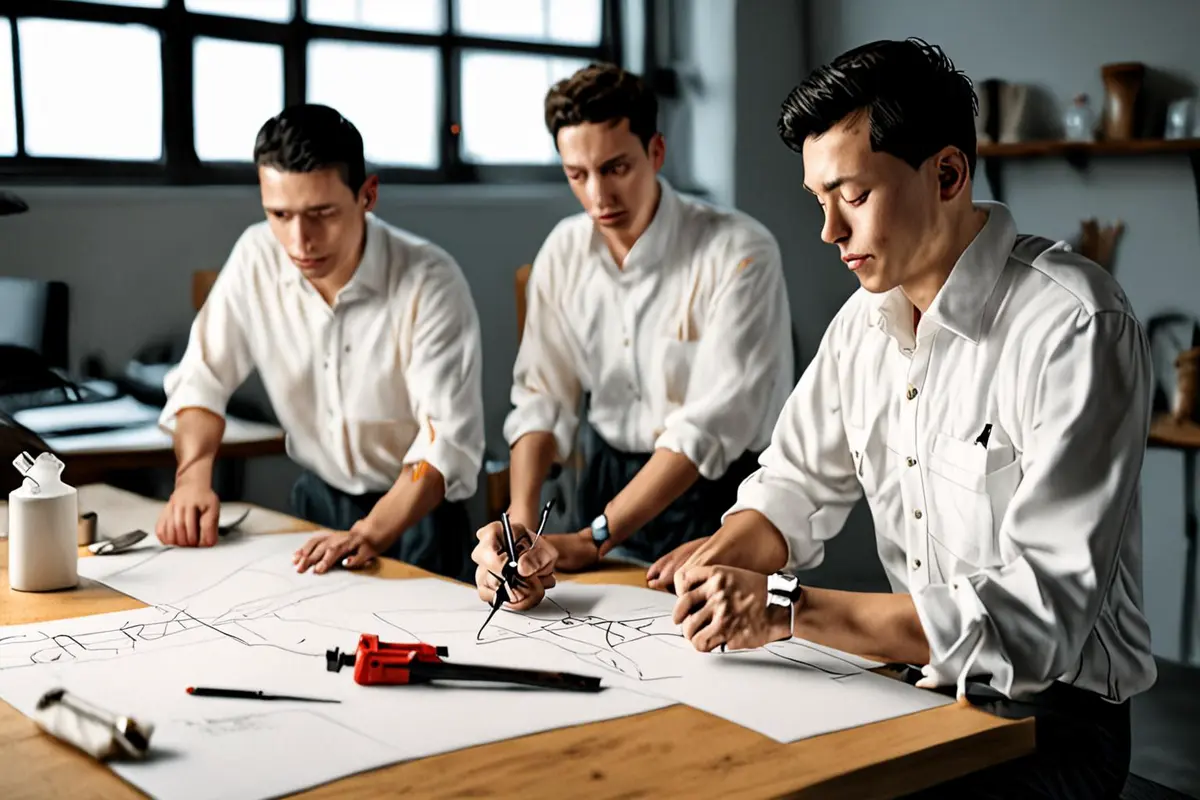
An evidence drawing does not need to be complete, but it must connect with a physical observation. A caliper meets the edge of a prototype, a pencil returns to the corresponding dimension, or a test image sits beside the actual structure. The audience understands that the discussion grows from observation rather than a prepared line. The shot must hold the hand, paper and object together; an unreadable overhead insert is not enough.
A Relationship Map Lets Different Disciplines See the Same Thing
A relationship drawing brings engineering, design, manufacturing or marketing concerns onto one surface. An engineer sketches a structure, a colleague adds the user path, and a product lead marks the moment that matters to the audience. The value is not the number of job titles in frame. It is whether each person changes the information on the page.
A Decision Moves the Scene from Paper Back to the Object
A decision drawing needs a consequence. The circled area is opened in the following shot. The rejected path disappears from the test. A new arrow becomes the direction of another trial. Once the page changes what people do, it stops being a prop and becomes part of the story.
The Order of Changes Matters More Than a Full Whiteboard
Many development scenes begin with a completely filled whiteboard, leaving the cast to pretend that one final mark completes the work. A more natural scene designs a repeatable progression: establish the problem, add two possible explanations, erase one, and connect the remaining path to the prototype. Viewers do not need to read every word. They can understand movement through addition, hesitation and deletion.
Continuity records should track line color, arrow direction, erased areas and the state of the board after each take. If a reverse angle belongs to an earlier version, a line that was removed suddenly returns and turns an authentic discussion into visible performance. A master board and transparent overlay sheets can make the evolution repeatable while preserving the irregular quality of handwriting.
Blocking Determines Whether This Is a Discussion or a Lecture
When one person faces everyone and the rest stand in a line, the image describes instruction. Discussion needs different directions of attention. One person studies the drawing, another checks the prototype, a third reads a reaction, and someone may briefly leave the board to verify a detail. The camera does not need to show everyone with equal clarity. It should follow the problem as it moves through the space.
People density also changes the meaning of a development environment. A single engineer in an open lab suggests concentration. Several people around a small table suggest collaboration and may also create visual pressure. The article on space density in corporate films explains how the number of people changes a factory image. In an R and D scene, each person still needs a visible task; extra lab coats do not create expertise.
Sensitive Information Should Be Replaced Before the Shoot
A large blur added in post-production steals attention and advertises that something is being hidden. The better solution happens before the camera arrives. The development team prepares a filming version of its materials. It keeps the real hierarchy, proportion, line density and work logic while replacing project codes, supplier names, unreleased parameters and critical dimensions.
A filming document cannot be a few arbitrary lines. If it is too vague, engineers have nothing meaningful to handle. If it is too precise, it can expose information. The team can preserve the shape of the real problem, such as insufficient space between two parts or one unnecessary step in a user path, while replacing exact values and structures with approved equivalents. Depth of field can limit what viewers read, but soft focus should never be the only protection for information that should not have entered the frame.
Paper, Screen and Prototype Must Describe the Same Problem
R and D sequences often look busy: a line on paper, a rotating model on a screen, an indicator on a prototype, and a hand swiping through an interface. If the four images come from unrelated problems, they form only a montage of activity. A credible chain begins with one area marked on paper, enlarges that area on screen, performs the corresponding action on the prototype, and returns to the drawing to record the result.
An internal structure does not require a full CAD assembly on screen. A confirmed local section, simplified movement or state comparison may explain the relationship more clearly. Physical accuracy still matters, but the corporate film must also connect the graphic with human judgment, touch and the next test. Foreground objects can create an observational point of view, as described in this piece on foreground occlusion in product films, but they should organize attention instead of hiding an unresolved action.
AI Can Extend the Environment but Cannot Invent Engineering Facts
Generative tools can help compare laboratory backgrounds, reflections in glass, screen brightness and the separation between people before a shoot. They can also extend distant areas that do not affect product truth. They should not generate electrical connections, dimensions, test results or interfaces that the brand has not confirmed. The more a generated image resembles professional documentation, the easier it is for an incorrect detail to be mistaken for a real capability.
Live action should preserve people, changing handwriting, contact with the prototype and continuity around critical structures. A motion team can redesign screen content from approved material. Generative imagery is better reserved for environmental extension and noncritical information. This division keeps the scene flexible without asking a visual model to perform engineering judgment.
Camera and Sound Should Preserve the Rhythm of Thought
Development is not always fast. A pause before drawing, a second look at the prototype, or two people not agreeing immediately can give a decision weight. Editing does not need to remove every hesitation, and every line on a whiteboard does not need a futuristic sound effect. Pencil friction, turning paper, a caliper returning to zero, and a component placed back on a table already establish a working environment.
The camera can begin at a medium distance so viewers understand who is responding to whom. It moves closer when the problem reaches the object, then returns to a wider scale when the decision redistributes the work. These changes in distance follow the thinking process instead of merely adding shot variety.
During Review, Ask Whether the Drawing Changed the Next Action
Mute the voice-over and remove the captions for one pass. Can the viewer identify the initial problem, see which clue changes the judgment, and watch the drawing lead to measuring, opening, testing or rebuilding? If so, the scene works. If everyone only points at a completed diagram from beginning to end, even a full whiteboard remains a technology-themed backdrop.
A credible development scene does not prove professionalism by exposing confidential material or making actors speak technical language quickly. It leaves visible consequences: one line is erased, one component changes direction, and one test begins again. If you are preparing an industrial corporate film, a technical-team interview or a product-development story, ONCE can develop the public materials, human tasks, spatial blocking and screen graphics together through its brand and corporate film production service.